Will AI replace translators? Here's what the data actually shows
Will AI replace translators? We look at CSA Research data, real translator workflows, and industry trends to show what's actually happening to the profession.
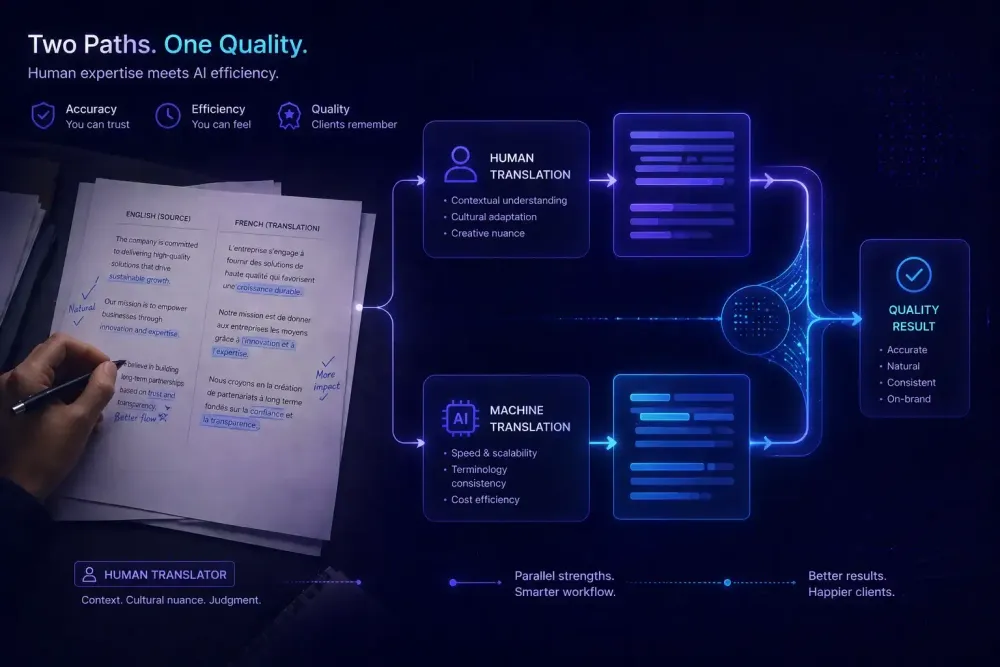
"Will AI replace translators?" is the question we hear from almost every freelance translator and agency contact we talk to these days. The honest answer: partially, in some content categories and language pairs, and the pace varies significantly by market. Easy reassurances don't help anyone plan a career or a pricing model. So we looked at what CSA Research, Slator, and other industry analysts have actually published, combined with what we observe from translators and agencies working with AI translation tools day to day.
The way this question usually gets framed
The debate tends to run on absolutes. One side predicts AI will wipe out translation jobs within a decade. The other insists human nuance is irreplaceable and the question is naive. Neither helps a translator decide how to price their services next month.
What the data shows is more specific: AI is already handling a growing share of translation volume, particularly in the commodity tier, while the profession shifts toward work that machines do poorly. Specialist review, quality judgment, cultural adaptation, domain-specific accuracy. That's not comfortable reassurance. It has real consequences for translators who work in high-volume, general-purpose content at standard rates.
CSA Research, which tracks the global language services market annually, has documented consistent market growth even as AI adoption accelerates. The industry has grown past $60 billion in recent years, driven largely by an explosion of digital content that needs localization. More content volume doesn't automatically mean more human translation jobs, but it does mean the market is expanding even as AI processes more of the volume.
What we see is not replacement but restructuring: a redistribution of work across different skill levels and content categories, happening at different speeds depending on language pair and market.
Where AI is genuinely displacing translation work
Let's be specific about where the displacement is real, because it's not evenly distributed.
AI translation has become reliable enough for high-volume, repetitive content where consistency and speed matter more than voice or cultural nuance. Product descriptions, technical specifications, internal communications, FAQ content: these are categories where large translation buyers are already cutting their human-translated word counts. Software localization was one of the first areas to shift toward AI plus post-editing rather than full human translation. The language is constrained, the acceptable variation is narrow. A UI string that says "Your file has been saved" needs to be accurate and consistent. It doesn't need to be inspired.
The rate compression is documented. Slator has reported that MTPE rates (machine translation post-editing) per word are significantly lower than full human translation rates, often 30 to 50 percent lower depending on content type and language pair. For translators who relied on high-volume, repetitive content, this is already showing up in agency bid sheets.
Language pairs matter too. For high-resource pairs like English-Spanish or English-German, AI quality has improved to the point where experienced post-editors can work through output considerably faster than translating from scratch. For lower-resource pairs, Kazakh-English, Swahili-French, Mongolian-Chinese, the AI output is substantially weaker and requires heavier human correction. The competitive pressure is lower there, for now.
Medical device documentation, legal contracts with jurisdiction-specific implications, literary work, certified translation for official purposes: these sit in a different category. But for translators doing general-purpose work in widely-supported language pairs, the pressure is real.
Where human translators are holding their ground
The content categories where human translators aren't being displaced share a few recognizable traits: high stakes, cultural complexity, or concrete consequences when something goes wrong.
Legal translation is the clearest example. A clause that's semantically equivalent in two languages may have entirely different legal effects in different jurisdictions. Professional legal translators understand that nuance, know when a term has a jurisdictional dependency, and carry professional accountability for their output. AI produces fluent text. It doesn't flag that an apparent equivalent lacks the same legal standing in the target jurisdiction.
Marketing adaptation, genuine transcreation rather than translation, is another area where human judgment holds up. A tagline built around an English idiom may fall flat in another language not because the translation is technically wrong, but because the cultural register doesn't transfer. Agencies that have run marketing copy through AI and light post-editing report inconsistent results, particularly for humor and brand voice in unfamiliar markets.
Patent translation, pharmaceutical regulatory submissions, financial disclosures: these require documented human review processes that AI pipelines alone don't satisfy. The stakes are too high for buyers to accept AI output without qualified human sign-off.
The honest caveat: holding ground doesn't mean immune. Categories that feel protected today may look different in three years as models improve and training data grows. Counting on a permanent AI blind spot isn't a durable plan. Investing in skills that make human judgment genuinely irreplaceable in a specific domain is.
The post-editing role: real skill, complicated economics
The translation industry's main response to AI has been to formalize MTPE as a recognized professional role, where translators review and correct AI output rather than translate from scratch. This can look like a reasonable adaptation. The economics are trickier than they appear.
Good post-editing isn't just fixing grammar. A competent post-editor checks for accuracy against the source, verifies terminology consistency against the project glossary, catches hallucinations and omissions, and maintains consistency across a document. Full post-editing on dense technical content takes longer than the per-word rate often implies, especially with lower-quality AI output.
The economic problem: post-editing rates are usually set as if the work is simpler than source-to-target translation. Because the target text already exists, buyers price it as a "checking" task rather than a linguistic judgment task. Translators who shift to MTPE work often find their effective hourly earnings decline — not because the cognitive work is easier, but because the per-word rate doesn't account for the actual time required.
Post-editing works well economically when the AI output quality is consistently high, when the project has a well-maintained glossary and style guide, and when the translator has negotiated a rate based on actual time-per-word rather than accepting a generic MTPE rate. It breaks down when it's positioned as a blanket substitute for full translation at a discount, regardless of AI output quality.
The volume paradox: more content, roughly the same translator demand
One of the stronger arguments against replacement is the content volume paradox: as AI makes translation cheaper, organizations translate more content than before, work that previously sat untranslated because it was too expensive. This expanded demand partially absorbs the displacement happening elsewhere.
CSA Research has documented this among translation buyers who adopt AI tools. The same total translation budget often now covers significantly more languages and more content than before. A company that previously translated ten markets at full human rates might now cover 30 markets with AI-assisted workflows at a similar overall cost.
The catch: this volume expansion creates work, but not necessarily the same kind as before. New AI-handled volume tends to flow through automated pipelines with minimal human review. The human work it generates is concentrated at the specialist, QA, and project management layers. A junior translator who depended on high-volume general content is competing directly with AI output. A senior specialist reviewing AI-translated pharmaceutical documents is in a different position entirely.
For agencies, the volume dynamic is actually a growth mechanism. More languages, faster turnaround, and lower per-word prices can generate more total revenue. The question of whether AI replaces translators looks very different from an agency's perspective than from an individual translator's, and that distinction matters more than it usually gets acknowledged.
What this shift looks like in actual workflows
A German-English technical translator in automotive documentation described a two-year period of reorientation: fewer requests for translations from scratch, but growing demand for glossary curation, AI output review, and client communication around quality decisions. Her per-hour earnings are higher than three years ago. The work looks different, and so does her client roster.
An agency handling Kazakhstani government and legal documents found that AI tools accelerated their lower-stakes work, business correspondence, internal reports, general website content, while their legal and regulatory practice stayed fully human-reviewed by qualified legal translators. The productivity gains in the general pipeline freed senior translator time for work that actually required domain expertise. That's role differentiation, not displacement.
This works when there's a clear internal sense of which content categories warrant full human translation, which work well with MTPE, and which can take raw AI output with a final read. It falls apart when agencies apply the same approach across everything, treating an internal newsletter and a regulatory filing as if they require the same level of scrutiny.
For more on the structural forces driving these shifts, our piece on what's really changing in AI and the translation industry goes deeper. For the workflow-level view, how AI translation tools are changing the way translators work is a practical starting point.
If you translate for a living, here's where to focus
The practical question isn't whether AI will replace translators in the abstract. It's whether your specific combination of language pairs, domain, and content types is in the category being compressed or in the one holding up.
Look honestly at your workload. What proportion is high-resource language pair, general content, high volume? That's the segment under the most pressure right now. What proportion is specialist, high-stakes, requires cultural judgment, or sits in language pairs where AI output is still poor? That's more protected, at least in the medium term.
The translators navigating this well are investing in domain depth. A translator who knows pharmaceutical regulatory submissions is not interchangeable with a generalist, and buyers who need that expertise know it. They're also learning how AI tools fail in their domain — because understanding AI output quality is increasingly part of what professional translators bring to a project.
Staying outside AI-assisted workflows entirely and waiting for clients to return to full human translation on commodity content isn't going to work. That market is contracting.
The harder truth is that the answer to "will AI replace translators?" depends entirely on which translator, which language pair, which content. For some, the displacement is real and already measurable. For others, it's still largely theoretical. Figuring out which category your work falls into, and acting on that, is more useful than debating the abstract question.