How AI translation tools are changing the way translators work in 2026
How AI translation tools actually work in professional workflows in 2026 — TM leverage, post-editing, what changes for agencies and freelancers, and which tools matter.
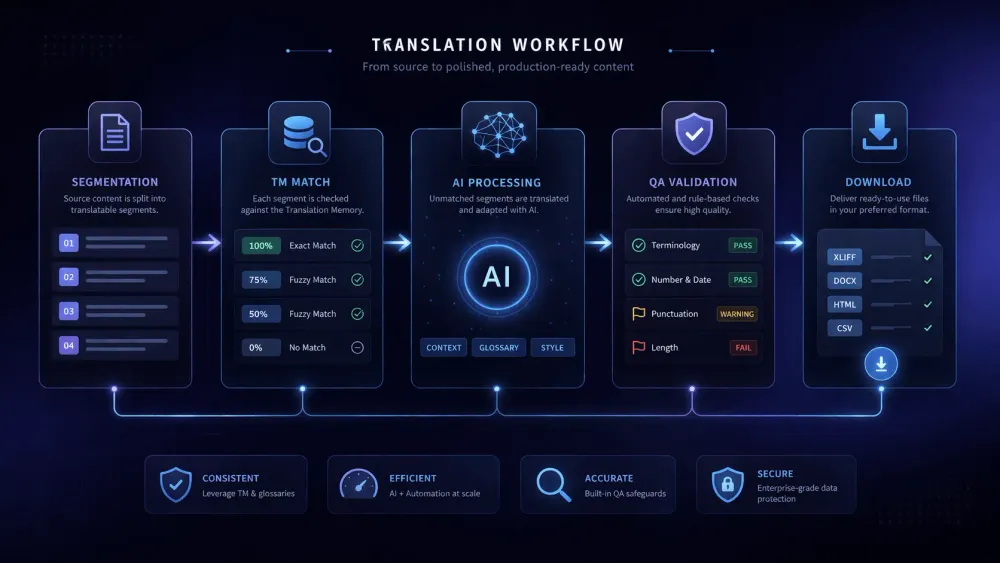
AI translation tools have changed how translation work gets done — but not in the way most people expected. The conversation in 2024 was about replacement. The reality in 2026 is more mundane and more interesting: translators who understand how these tools work are producing more output with better consistency, while those who treat AI as either a magic solution or an existential threat are struggling with both.
What AI translation tools actually do in a professional workflow
The term "AI translation tool" covers a wide range of products that work differently. Standalone machine translation engines — DeepL, Google Translate, and similar services — take text in and return translated text out, with no further context. Integrated AI translation workflows sit inside a CAT tool environment, draw on translation memory and glossary context, and return structured outputs with quality scoring.
Most professional translators and agencies aren't using standalone MT engines for client work anymore. They're using AI translation as a layer inside a larger workflow — one that starts with CAT tool preparation (TM leverage, glossary loading, file segmentation) and ends with human post-editing of the AI output, tracked against the source.
The distinction matters because the quality and consistency of AI translation varies significantly depending on what context the AI receives. A translation engine that gets a raw source text with no domain context produces a different result than one that gets the same text plus a domain-specific glossary and a prompt describing the audience and register. This is why terminology preparation has become central to AI-assisted translation workflows, not an afterthought.
Smartcat's AI translation pipeline illustrates the principle. According to Smartcat's documentation, their pipeline runs in sequence: segmentation, TM lookup (with exact matches auto-confirmed), AI translation using the best engine for the language pair, automated QA checks for missing tags and glossary violations, a glossary-term correction step, and a fallback translation if the primary engine fails. Each step adds context or catches errors the previous step might miss. That layered approach is what separates a professional AI translation workflow from pasting text into a free MT engine.
How translation memory interacts with AI
Translation memory and AI translation are sometimes treated as competing approaches. In practice they complement each other. TM handles segments where an exact or near-exact match exists from previous projects — confirmed, human-reviewed translations already approved for that client. AI handles everything else.
The Smartcat knowledge base defines a TM as "a database of previously translated and approved segments, reused in future projects for consistency and cost reduction." Exact matches are applied automatically. Fuzzy matches (similar but not identical source segments) are suggested rather than auto-confirmed, and typically cost less than full translation.
In a project with significant repetition — technical documentation, legal templates, software UI strings — a mature TM can handle a large percentage of segments before AI translation even starts. AI then handles the remaining segments, ideally with glossary context that keeps its output consistent with the TM-confirmed segments.
The failure mode is when TM and glossary are out of date. The AI produces terminology that conflicts with confirmed TM segments, and revision takes longer than it would have without AI at all. This is the most common operational problem we see with AI translation workflows: the tooling is in place, but the reference data feeding it hasn't been maintained.
The post-editing workflow: what it actually looks like
Post-editing (MTPE — machine translation post-editing) is the professional practice of reviewing and correcting AI-translated output against the source. It's a distinct skill, and it's different from full translation.
In full translation, the translator starts with a blank target segment and produces a translation from scratch. In MTPE, the translator starts with an AI draft and decides: accept as-is, edit lightly, or reject and translate from scratch.
Light post-editing targets fluency and obvious errors. Full post-editing targets both fluency and accuracy, bringing output to publication quality. The scope should be defined before the project starts, not left to translator discretion. When "post-editing" is undefined, some translators do light edits and miss accuracy errors; others do full translation-quality review and aren't compensated for it.
The QA report generated at the end of an AI translation job is the post-editor's starting point. It flags segments where the AI likely struggled — low quality scores, glossary term mismatches, unusual segment length differences between source and target. A systematic post-editor works through flagged segments first, then spot-checks a sample of the rest. That triage approach is faster than reading every segment sequentially and catches more of the high-risk content.
What changes for translation agencies
For agencies, the shift to AI-assisted translation changes project economics more than workflow fundamentals. The translation step is faster. The preparation and review steps are the same or more involved.
Preparation has always mattered, but it matters more now. If a translator working without AI support uses a wrong term, a revisor catches it in one place. If an AI translation job runs with a wrong term in the glossary, that error appears in every segment containing that concept — potentially hundreds of instances that all need correction.
This is why agencies that have made AI translation work well tend to have invested in their terminology infrastructure before their AI tooling. A well-maintained client glossary loaded into the translation prompt produces consistent output that needs light post-editing. A project that runs without a glossary produces output that reads fluently but uses inconsistent terminology — and inconsistency is exactly the kind of error that's hard to catch in a post-editing pass, because each individual segment looks acceptable in isolation.
For project managers, AI translation also changes how you allocate time. Less time on the translation step itself. More time on preparation (glossary review, prompt approval, file validation) and more time on structured post-editing triage (reviewing QA reports, prioritizing revision effort where it's actually needed).
What changes for freelance translators
The impact on freelancers is mixed, and it's worth being direct about that.
For translators working in high-repetition, lower-specialization domains — generic business content, form letters, product descriptions — AI pre-translation reduces the amount of active translation per word and puts pressure on per-word rates. The market rate for MTPE work is lower than for full translation, and that shift is real.
For translators with genuine domain specialization — legal, medical, technical, financial — the situation is different. AI translation in specialized domains makes more errors that require domain knowledge to catch. A post-editor who understands the regulatory context of a medical device manual, or the legal force of specific contract language, adds value that AI cannot replicate.
The practical question for any freelancer: what percentage of your work falls in domains where catching AI errors requires domain knowledge? That answer tells you more about your exposure to rate pressure than any general statement about AI's industry impact.
Tools that matter in 2026
The AI translation tool space has matured into a few clear categories.
CAT tools with integrated AI translation — Smartcat, Trados, memoQ — include AI pre-translation as a built-in step that integrates with the TM and glossary infrastructure already in the tool. This is the workflow most agencies and professional freelancers use.
Standalone AI translation services — DeepL, Google Cloud Translation, and similar APIs — are useful for high-volume, lower-complexity content where a full CAT tool setup isn't needed.
AI translation workflow products built around specific input formats are a growing category. SnapIntel is built around the Smartcat bilingual DOCX export: users import that file, prepare domain analysis, glossary, and prompt context, approve everything before the job runs, then download translated output with a QA report. The approval gate before translation means the context is in place before any segments are processed — not added after the fact.
Free MT engines are still useful for personal use or quick source-content review. Not appropriate for client-facing professional work without post-editing and QA.
The right tool depends on what you're already using. If you're in Smartcat, building your AI translation workflow around tools that connect to Smartcat's exports reduces friction significantly. If you're evaluating from scratch, the CAT-integrated AI translation in your main tool is the right starting point before looking at purpose-built AI translation products.