AI and the translation industry: what's really changing and what isn't
An honest look at ai translation industry trends: where AI has changed real workflows, where it hasn't, and what it means for agencies and freelancers in 2026.
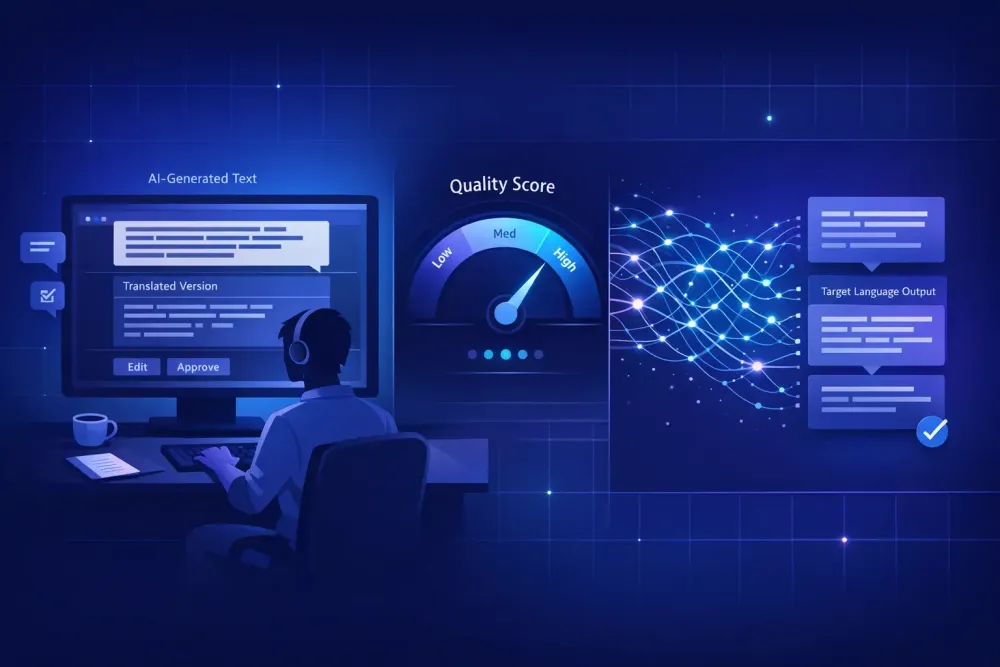
The most common version of this conversation goes like this: someone asks whether AI is going to replace translators, someone else says it already has, a third person explains why both are wrong, and everyone leaves more confused than when they started. We find the question genuinely harder than either side admits. AI has changed translation work in ways that are real and measurable. It has also failed to change it in ways that were confidently predicted three or four years ago. Getting this right matters, because agencies and freelancers making decisions about tools, training, and positioning right now are betting on how it plays out.
What has actually changed
The thing AI translation got right — faster than most people expected — is volume. Running a first draft through a modern neural machine translation engine, or a large language model prompted for translation, produces output that is often post-editable in roughly the same time it would have taken a translator to produce a first draft manually. For content that is formulaic and repetitive, this is a genuine shift.
Technical documentation, product descriptions, legal boilerplate, and software UI strings all benefit from this. Their quality requirements are specific but not creative: accurate terminology, consistent phrasing, correct structure. When AI output works in these contexts, it gives the human translator a usable starting point instead of a blank page. Machine translation post-editing — MTPE — has grown significantly as a workflow model as a result.
Where the productivity gains don't apply as cleanly: marketing, literary, and culturally adaptive content. These require choices that depend on understanding what the reader will feel and how they'll interpret the text in their cultural context. Machine output in these areas is often plausible but flat. The editorial work required to make it actually good can be more time-consuming than translating from scratch, which is an outcome that surprises people who haven't tried it.
What hasn't changed as predicted
Three to four years ago, there were confident claims that AI translation quality was approaching human parity for most language pairs in most domains. That was wrong, or at least it was measuring the wrong things. Automated quality metrics like BLEU scores don't capture what professional translators, editors, and clients actually complain about when MT goes wrong — register mismatch, tonal inconsistency, mistranslated idiom, and domain-specific terminology errors that a system trained on general web text handles poorly.
CSA Research has consistently found that while translation buyers are adopting MT at increasing rates, the proportion who report it "fully replacing human translation" in their workflows remains small. The more common pattern is MT as an acceleration layer for human translators. The translator's job changes — more time on review and editing, less time on initial drafting — but the translator doesn't disappear from the process.
The other prediction that hasn't materialized is that AI would quickly commoditize niche domains like legal, medical, and financial translation. Domain-specific accuracy is hard to achieve without domain-specific training data and careful post-editing by specialists. Agencies that specialize in regulated industries have, so far, held more pricing power than those doing general content translation. The quality bar in those domains is set by compliance requirements that generic AI output doesn't reliably meet.
How agencies are actually adapting
The agencies navigating this well share a few characteristics. They've stopped treating AI as a yes-or-no question and started thinking about where in their workflow it adds value and where it doesn't. For high-volume technical content, they've built AI-assisted workflows with MTPE as the standard. For high-stakes regulated content, they maintain human-first processes with AI used only for terminology consistency checking and QA flagging.
They're also being honest with clients about what AI does and doesn't change. Agencies that have presented AI-assisted translation as fully equivalent to human translation without disclosure — and priced accordingly — have run into problems when quality doesn't meet client expectations. The more sustainable approach: transparent service tiers where the AI-assisted option is priced lower and scoped appropriately, while the human-first option maintains its value for content where quality genuinely matters.
One structural change that's happened at multiple agencies: project management burden has increased even as translation production has gotten faster. AI-assisted workflows require more upfront setup — glossary preparation, prompt development, post-editing quality calibration — and more QA work on the output than traditional human translation did. The headcount savings in production sometimes get partially absorbed by the resources needed to manage AI workflows properly. This is worth factoring into any cost model.
What this means for individual translators
The freelance translator situation is more complicated. MTPE as a service category has grown, but post-editing rates are generally lower than rates for human translation — sometimes significantly lower. Translators who have positioned themselves primarily as production workers generating target text face the most pressure. Translators who have positioned themselves as subject-matter specialists, reviewers, or terminologists face less.
The skill set that seems most durable: deep domain expertise in a specific field, the ability to recognize and correct the specific failure modes of AI output in that domain, and terminology management skills that help build glossaries and translation memories that make AI outputs more reliable in the first place. These are things that generalist AI systems aren't good at replacing, and clients in specialized domains are willing to pay for them.
For translators thinking about this practically, our earlier piece on how AI translation tools are changing the way translators work covers the workflow-level shifts in more detail.
The rate question
Translation rates have not collapsed the way the most pessimistic predictions suggested they would. CSA Research's market data shows the overall translation market continuing to grow in value even as per-word rates for some content types face downward pressure. The growth is driven by volume: more content exists that needs translating than ever before, AI or no AI, and not all of it can be handled by fully automated pipelines without human involvement.
What has changed is the distribution within the market. High-volume, low-complexity content — the kind where MT works best — is getting cheaper. Specialized, high-stakes content — where human expertise is genuinely load-bearing — has held its pricing better. This bifurcation is probably not reversing. Agencies and translators positioned in the lower-complexity segment face more structural pressure than those who have moved toward specialization and quality assurance work.
A reasonable view of what comes next
The honest answer is that no one knows how fast AI capabilities will improve or what the next step-change in model quality will look like. What we can say with more confidence is that the agencies and translators who have treated AI as a workflow tool to be integrated thoughtfully — rather than either a threat to ignore or a silver bullet to deploy everywhere — are in a better position than those at either extreme.
If you work with Smartcat bilingual DOCX files and want a more structured approach to AI-assisted translation with preparation controls and QA visibility built in, SnapIntel is designed for exactly that workflow — handling domain analysis, glossary preparation, translation execution, and output review as a connected sequence rather than a single unmanaged step.
The industry is not going back to what it was five years ago. But the translators and agencies still doing serious work are not the ones who were supposed to have been automated out of existence either.