Why enterprises now prioritize translation platforms over AI models in 2026
Why enterprises now choose translation platforms over raw AI models in 2026: terminology governance, QA artifacts, and audit trails explained.
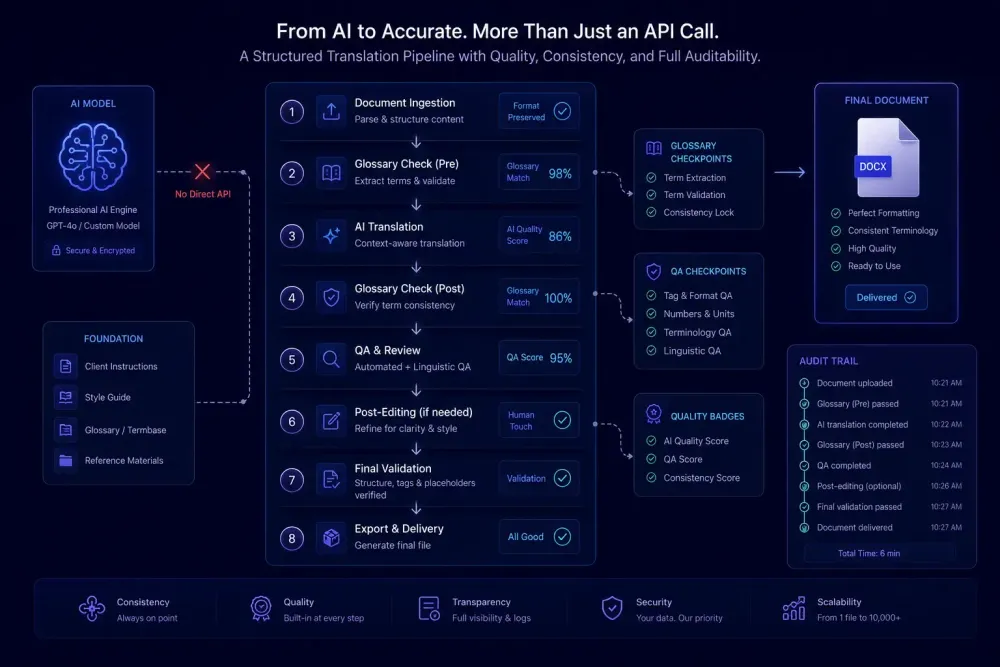
The question of translation platforms vs AI models ran hot in corporate localization circles throughout 2024 and 2025. By 2026, a fairly clear answer has emerged from enterprise procurement behavior: structured platforms are winning the mandate, even when the underlying model quality is the same. That outcome is worth examining closely because it has nothing to do with AI translation getting worse. If anything, output quality from current-generation models is better than it was two years ago. What changed is how enterprise buyers evaluate a translation vendor and what they now ask to see before a contract gets signed.
What "just using the API" looks like in practice
Direct model integration for translation sounds practical until you work through what "practical" means across several thousand documents.
A logistics company we learned about from a localization consultant built an internal translation tool in early 2025 that called the OpenAI API directly, applied a system prompt with some terminology guidance, and returned translated text. For the first six months, the team was satisfied. Translations came back quickly, the output was fluent, and maintaining the integration required little engineering effort.
The problem surfaced during a quarterly review of customs documentation. The same legal concept ("carrier liability") was appearing as two different phrases in target-language documents, depending on which version of the system prompt had been in use when each file was translated. Both translations were defensible in isolation. Side by side in a document package reviewed by an importing country's customs office, they created ambiguity in a legally significant context.
Tracing the inconsistency required pulling every document from the preceding three months and reviewing the relevant segments by hand. Two translators spent four days on the exercise. The company's response was to migrate to a translation platform with a glossary gate — the exact feature they had decided was unnecessary when output quality seemed fine.
This pattern repeats across teams that have tried direct API approaches at scale. The raw API model provides a capable translation engine and nothing else. Terminology enforcement, translation memory reuse, QA artifact generation, and project-level audit logging are all absent unless someone builds them from scratch. Most teams underestimate how much engineering that work requires, and how much maintenance it demands as model versions change and client requirements grow more specific.
Translation platforms vs AI models: what the workflow layer actually does
A platform is not simply a prettier interface over an API call. The workflow layer between the user and the underlying model does several specific, meaningful things.
Glossary management is the clearest example. A platform stores approved term pairs for each client or domain, passes them into the translation context during each job, checks the output for correct term application, and flags or corrects mismatches before the file reaches a human reviewer. Term detection in source segments, consistent injection into the model context, and output validation are each nontrivial to build and maintain as models change. A platform treats this as a standard feature rather than a custom engineering project per client.
Translation memory reuse works at the segment level. Before any source segment goes to the model, the platform checks whether it was previously translated and confirmed in an earlier project. An exact match — a source segment that is 100% identical to a previously confirmed segment — can be reused without a new model call at all. Fuzzy matches, where the source is 75–99% similar to a prior segment, surface as reviewer suggestions. Over a long client relationship with stable source content, this reuse meaningfully reduces the volume of new translation work per project.
Progress tracking becomes important once file batches reach any real size. A platform surfaces queued, running, completed, and failed states per file during a batch job. When a 150-file job fails partway through, the project manager knows exactly where it stopped and can restart from that point. A direct API integration that fires all requests and waits for responses has no intermediate state to report.
Output artifacts complete the picture: a translated document with the original formatting preserved, a neutral source/target spreadsheet for bilingual review, and a QA report that categorizes observed errors. Generating these artifacts consistently across DOCX, XLSX, and PPTX requires engineering work that a platform has already done and that a custom integration would need to replicate independently, and maintain through every format change.
The terminology problem at enterprise document scale
Concrete numbers make the scope of this problem easier to see.
A pharmaceutical company preparing a regulatory submission faced a document package of 340 pages across 12 files, with a domain glossary of 180 approved term pairs for that submission alone. They attempted AI pre-translation using a direct API integration. Their team injected all 180 terms into the system prompt. For most segments, the model applied them correctly.
For a document of that length, "most segments" still leaves room for dozens of term misses or inconsistencies. A regulatory submission is not a context where some sections can use one translation and other sections a different one. The review pass required to catch and correct those misses added more time than the team had budgeted.
The platform they adopted next ran term detection at the segment level. When a domain-specific term appeared in a source segment, the system verified the target segment contained the approved translation. When it didn't, the segment was flagged before reaching a human reviewer. The review process shifted from hunting for term violations to examining genuinely ambiguous content — a much smaller set of segments that actually needed human judgment.
This approach works best when the glossary is well-maintained and the domain is consistent across the document set. It doesn't help much if the source content is heavily idiomatic or the term set is poorly defined. But for technical, legal, and regulatory content where precise terminology matters, segment-level glossary enforcement is the difference between a manageable review pass and a days-long reconciliation exercise.
Post-editing is often proposed as the fallback for term inconsistencies, but post-editing a fluent translation for terminology is unusually difficult — fluent output makes glossary violations easier to miss on a first pass. The reviewer sees grammatically correct sentences and has to slow down specifically to check each candidate term. That is a different skill and a different cognitive load than reviewing for fluency errors.
What enterprise procurement now requires from translation vendors
The shift in enterprise procurement requirements between 2023 and 2026 shows up in the specifics of RFP documents.
Earlier procurement cycles for translation services asked about translator credentials, language pair coverage, and turnaround times. The current generation of RFPs from regulated industries asks for terminology governance documentation (what glossary was applied, per project), machine-readable QA reports (error type and count per file), data processing agreements specifying where source text goes and for how long, and — with growing frequency — BYOK configurations where the buyer's own AI API key is used rather than a shared vendor subscription.
A direct API integration can satisfy few of these requirements without custom development. It produces translations but usually not the documentation or the contractual data handling framework. A platform built for professional translation workflows addresses most of these requirements as standard: the QA report is generated per job, the DPA is part of the vendor relationship, and BYOK is increasingly a supported configuration option.
The BYOK question matters particularly in regulated industries. When an enterprise routes translation through its own API key, the data handling is governed by their direct agreement with the model provider rather than by an intermediate vendor's subscription terms. We've written in detail about what BYOK actually means for AI translation. The practical upshot is that enterprise security teams are asking about it routinely, and vendors who cannot offer it are losing procurement conversations to those who can.
Language service providers who built their AI translation capability on a custom API wrapper often discover this gap late — at the RFP stage rather than during the build phase. At that point, retrofitting the documentation and data handling framework is more work than adopting a platform would have been.
Governance, auditability, and the compliance shift in 2025 and 2026
The broader change behind the platform preference is that enterprise buyers began applying to translation the same governance expectations they now apply to other AI-assisted business processes.
Two years ago, the question procurement teams asked was primarily about output quality: is this translation accurate? By 2026, regulated industries have added a second question: can you demonstrate how it was produced? That means documenting the model version, the glossary version, the QA method applied, and the timestamps — not as optional paperwork but as a baseline vendor requirement.
A platform generates this audit trail as a side effect of running each job. The project record captures the glossary ID and version in use, the QA report data, and the file processing timestamps. This information is available months after the project closes, which matters when a compliance question arrives retrospectively.
An internally built API wrapper may or may not capture this information, depending on whether the engineering team thought to include it. In most cases we've encountered, audit logging was added after the first compliance question, not before. Reconstructing a project record from partial logs is slow and often incomplete.
Data handling sits alongside this as a second governance dimension. Enterprises in financial services, healthcare, and pharmaceuticals are now asking, specifically, whether the translation vendor retains source text, for how long, and under which contractual terms. A platform vendor operating under a signed DPA can answer this precisely. A team running content through a shared API subscription often cannot, because the model provider's terms apply to the subscription holder, not to each end client whose documents pass through.
There is a detailed analysis of this dynamic in data privacy in AI translation. The regulatory pressure behind enterprise procurement's data questions has grown considerably since 2024, and it is now affecting vendor selection decisions in ways that were not visible two years ago.
Compliance teams at enterprise buyers are also starting to ask about version consistency: if the AI model was updated between two batches of the same document type, can the vendor demonstrate that term application and output quality remained stable? A platform with versioned glossaries and per-job model configuration records can answer this. A custom integration without structured logging cannot.
The model-agnostic platform: why the two aren't in opposition
The most productive framing of translation platforms vs AI models is not a binary choice. The platforms gaining the most traction with enterprise buyers in 2026 are those that separate the workflow layer from the model layer, letting buyers control which AI engine runs underneath.
That means a platform that enforces glossary gates, generates QA artifacts per job, operates under a DPA, and allows the buyer to supply their own API key and route translation calls to whichever model they've selected. The buyer gets workflow structure and documentation without ceding control over the model provider relationship or the data handling terms.
This architecture answers the question that enterprise procurement teams actually care about: not "which model are you using?" but "can you prove the process was controlled and documented?" The model is a component. The platform is what makes that component auditable.
For agencies competing for enterprise accounts, the implication is direct. The ability to say "we use a high-quality AI model" is no longer a differentiator; current models are close enough in output quality that buyers largely treat them as interchangeable. The ability to say "we produce a QA report per file, we enforce your approved glossary at the segment level, and we operate under a DPA your legal team can review" is the differentiator.
Teams that built their AI translation capability on a direct API approach will need to build the workflow layer eventually, either as internal engineering work or by adopting a platform. The sooner that happens, the less likely the gap is to surface at a contract negotiation rather than before it.
A practical check for your current setup
Before concluding that your translation operation doesn't need a platform, it is worth running through a short diagnostic. For any recent AI translation project, can you produce: the specific glossary that was applied (with the version in use at the time), a QA report that records error types and counts, and a signed data processing agreement covering how source text was handled?
If any of those three are missing, that is the gap enterprise procurement will find. Building all three on top of a direct API integration is possible but requires sustained engineering investment that most teams underestimate. Adopting a platform shifts that cost to a subscription and provides the documentation framework from day one.
This doesn't mean every translation operation needs a full enterprise platform immediately. For low-volume, informal content with no sensitive data and no external compliance requirements, a direct API approach works and the overhead of a platform isn't justified. But the moment a client asks for a QA report, a DPA, or a glossary application record, the platform layer stops being optional. Building it after the fact, under deadline pressure, is considerably harder than having it in place before the question comes up.
The translation quality from today's AI models is good enough that the gap between a raw API call and a platform-mediated call is usually small for most content types and language pairs. The workflow and governance gap between the two is much larger — and for enterprise accounts in 2026, it is the gap that determines whether you win or lose the contract.