Phrase vs memoQ vs Trados: 2026 CAT tool comparison for agencies
Compare Phrase TMS, memoQ, and Trados in this cat tool comparison 2026 — pricing, TM leverage, automation, and which fits your agency workflow.
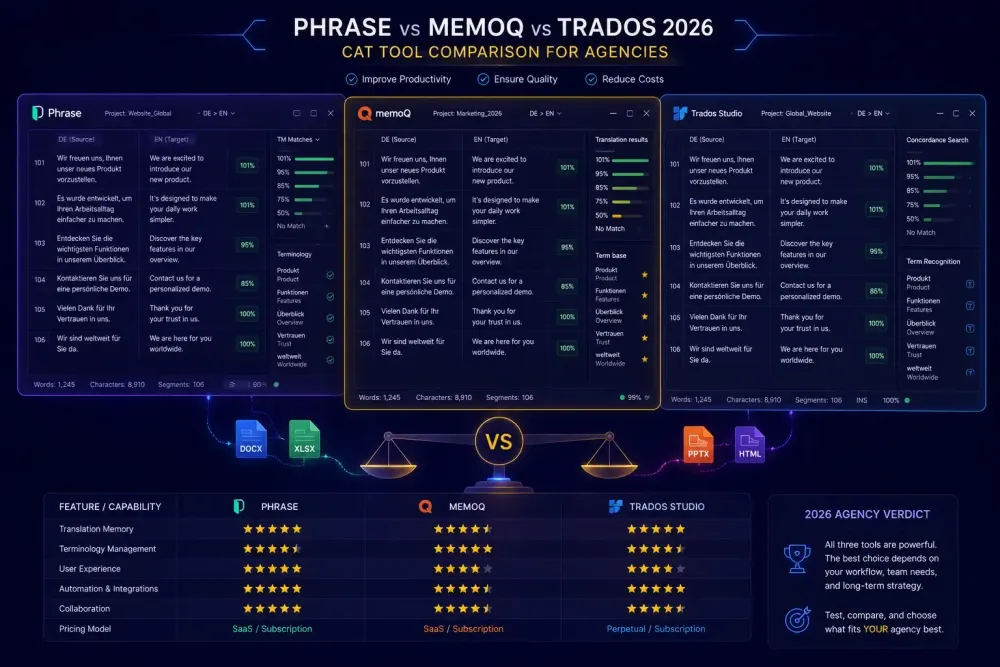
Choosing a CAT tool for an agency is one of those decisions that doesn't age well. What made sense three years ago may now carry a subscription price that's doubled, a feature you depended on moved behind an enterprise paywall, or a cloud product that still feels half-baked next to the desktop version your team actually trained on. We've worked with agencies running all three tools in this comparison — Phrase TMS, memoQ, and Trados — and the honest answer is that the right choice depends far more on how your team operates than on which product has the longest feature list.
This cat tool comparison 2026 won't cover every option. There are twenty-odd CAT tools and a dozen translation management systems that agencies use. But Phrase, memoQ, and Trados account for the majority of installs among mid-size to large LSPs, and they represent genuinely different bets on what an agency needs.
What's actually shifted in the cat tool comparison 2026
The short version: AI pre-translation has changed what agencies need from a CAT tool, cloud offerings have matured to where the desktop-versus-web debate is largely over for new adopters, and licensing costs have gone up across the board.
A few years ago, the main ROI argument for any CAT tool was TM savings. If your agency translated recurring content — product manuals, regulatory documents, ongoing maintenance work — a populated translation memory paid for the tool. The math was simple: 30% savings on a million-word annual volume justified even a steep license fee.
That math still works, but AI pre-translation has moved the comparison point. Agencies that run GPT-4 or similar LLMs as a pre-translation step are now measuring fuzzy match savings against near-zero-marginal-cost AI output, not against full human rates. The result is that TM leverage has become one factor among several rather than the defining ROI argument. The tools winning agency evaluations in 2026 tend to be the ones with strong workflow automation, clean API access, and architectures that accommodate an AI pre-translation step — not necessarily those with the most refined TM algorithms.
There's also a market consolidation factor. CSA Research has documented the ongoing shift toward fewer, larger LSPs, which pushes CAT tool vendors to offer serious project management and team features alongside the editor itself. A two-person agency can run on a desktop CAT tool with minimal overhead. An agency with twenty project managers and sixty distributed freelancers cannot.
Phrase TMS: built for agencies managing high volumes
Phrase TMS (formerly Memsource, rebranded in 2022) is the most cloud-native of the three tools in this comparison. It was built as a web application from the start — no desktop client to install, no on-premise server to maintain. For agencies with remote project managers or translators spread across multiple countries, that architecture matters in practice.
The project management layer in Phrase is the strongest of the three. You can configure automated workflows where jobs advance through stages without a project manager manually pushing them: translation completes and triggers editing, editing triggers a QA check, QA sign-off triggers the file-out notification to the client. For agencies handling recurring, predictable content types like software strings, marketing copy, or CMS content, this automation removes a real coordination overhead that compounds across dozens of concurrent projects.
Phrase's API is well-documented and widely used. Agencies connecting their TMS to content management systems, order management platforms, or custom client portals consistently find Phrase's integration story cleaner than the alternatives. The connector marketplace covers common CMS integrations, and the REST API handles edge cases that don't fit a pre-built connector.
The trade-off is the translation editor. Translators who have spent years in Trados Studio or memoQ's desktop client report that Phrase's browser-based editor is less comfortable for sustained work. TM and glossary integration functions properly, but the keyboard shortcut coverage and segment navigation don't match what a power user gets from a native desktop application. For agencies where project managers use Phrase daily but translators are external freelancers working in their own tools, this barely registers. For agencies where in-house translators are in the editor for full working days, it's a friction point that shows up in productivity.
Phrase pricing is subscription-only, tiered by project manager seats and translation volume depending on the plan. Entry tiers are accessible for smaller agencies, but costs scale directly with headcount. Agencies extending access to large freelancer rosters should verify how contractor access is priced before signing. We've seen agencies surprised by the cost increase when moving from a small team to a mid-size one — it's the kind of pricing cliff that only becomes obvious after you're already committed.
For more on how Phrase compares against another cloud TMS, our Smartcat vs Phrase comparison covers that head-to-head in detail.
memoQ: the CAT tool that translators actually prefer
memoQ holds an unusual position in the market: a loyal following among professional translators, strong word-of-mouth in the freelance community, and an editor feature set that rewards users who put real time into learning it. We've worked with agencies that chose memoQ largely because their best freelancers already knew it and worked faster in it. That's not a technical argument — but in practice, it's often the most consequential one.
The desktop client is the core of the memoQ experience. The editor is fast, the keyboard shortcut system is well-designed, and TM suggestions and glossary matches flow into the translation window in ways that feel tighter than what Phrase's web editor delivers. Translators who work with memoQ regularly are faster in it. That speed affects either cost or throughput in measurable ways.
For agencies, the choice between memoQ cloud and a self-hosted memoQ server is worth thinking through. memoQ cloud has improved considerably and handles standard agency workflows without any IT infrastructure. Self-hosted provides more control over data residency and allows deeper customization — which matters for agencies working in regulated industries like pharmaceutical or financial translation. Self-hosted makes sense when you have IT staff to manage server maintenance; it's not the right fit for a team that wants zero infrastructure overhead.
memoQ's QA framework is the most thorough of the three tools. It covers number and date consistency, terminology adherence, repeated segment handling, tag verification, and language-pair-specific checks. One agency we worked with used memoQ's QA reports as the primary feedback mechanism for their freelancers — flagging errors automatically and sending reports directly to translators for correction before delivery. Over six months, that loop reduced client revision requests by roughly a third. This is where memoQ earns its reputation.
memoQ also offers a translator-specific license tier priced below the full agency edition, which gives agencies the option to put both in-house and freelance translators on the same tool without paying agency-level rates for everyone. Worth factoring in when comparing against Phrase's per-seat structure.
The friction for larger agencies is project management at scale. Workflow automation requires more manual configuration than Phrase. Managing fifty concurrent projects across fifteen language pairs is possible, but the project management interface is slower to administer. Project managers who have used both tend to find Phrase faster for day-to-day project work.
Trados Studio and Trados Enterprise: legacy tool, real pricing pressure
Trados has been the industry standard for long enough that a large share of working professional translators have used it at some point in their career. SDL Trados Studio — now under RWS following the 2021 acquisition — carries an installed base and an ecosystem that neither Phrase nor memoQ can match purely by virtue of how long it has existed.
The ecosystem depth is genuine. The Trados AppStore offers hundreds of plugins: specialized QA extensions, OCR integrations, invoice management tools, domain-specific automations. MultiTerm, the terminology management component, remains one of the most complete termbase solutions available, supporting hierarchical term structures, multiple definitions, usage notes, and crosslinks between related terms. For agencies in pharmaceutical, legal, or financial translation where terminology governance matters seriously, MultiTerm's depth is useful in ways the other tools aren't. For agencies with straightforward glossary requirements, that complexity is overhead.
The complication for agencies evaluating Trados in 2026 is pricing. Since the RWS acquisition, Trados Studio has moved toward subscription licensing and introduced Trados Enterprise for larger teams. The transition has frustrated long-standing users who preferred perpetual licenses. Across comparable team configurations, Trados carries higher costs than both memoQ and Phrase. The counterargument — that ecosystem depth and translator community familiarity justify the premium — is defensible for large agencies where those factors genuinely matter. For agencies starting fresh without legacy constraints, the case is harder to make, and most formal evaluations we've seen recently conclude the same way.
Trados Enterprise (the cloud version for larger teams) is a more modern product than Studio and handles multi-user workflows better. Getting it configured correctly at scale is substantial work, though. We've seen agencies move to memoQ specifically because the Trados Enterprise onboarding required more consulting time and cost than the sales process suggested. The gap between the demo experience and the actual implementation effort can be significant.
The switching cost argument deserves honest attention. If your agency has years of TM assets in SDLXLIFF format, a team trained on Trados workflows, and clients who supply Trados packages, the cost of moving is real. Productivity dips during tool transitions are measurable, and TM migration takes time. That's a legitimate reason to stay. Our Trados vs memoQ breakdown goes deeper on that specific decision if you're weighing those two.
How TM and glossary handling compares
All three tools support standard TMX import and export, so TM assets are portable between them. The differences show up in how TM is applied during translation and how each tool handles edge cases — segments with slight formatting differences, minor source text variations, segments with embedded tags.
memoQ's TM engine draws consistently higher marks from translators for the usability of fuzzy match suggestions at the 70–85% range. Suggestions at those match levels tend to need less editing than what Phrase or Trados returns at comparable scores. This varies by language pair and content type and is hard to quantify in general terms, but it's consistent feedback from translators who work regularly across all three tools.
Phrase handles TM with clean segment-level fuzzy matching. It doesn't have the TM management depth of memoQ's x-translate or Trados's leverage analysis tooling, but for standard workflows it functions reliably. The web-based TM management interface is accessible to project managers who aren't technical users.
For terminology management, Trados with MultiTerm is the strongest option for agencies with complex, multi-domain glossary requirements. memoQ's termbase handling is solid and integrates cleanly into the editor. Phrase's glossary functionality is adequate for most workflows but less configurable. If you manage terminology across five or more distinct client domains with overlapping terms, these differences will surface in real work.
Pricing and total cost of ownership
List price comparisons miss part of the picture. Total cost includes training time, IT infrastructure for self-hosted configurations, integration development, and the productivity cost when translators move to a new environment.
Phrase's subscription model is predictable but scales with headcount. An agency moving from ten to thirty project managers sees costs grow proportionally. The absence of server infrastructure is a real offset for teams without dedicated IT staff.
memoQ's cloud pricing is competitive with Phrase at comparable team sizes. The self-hosted option has higher setup cost but can be more economical at scale with the right infrastructure. The translator-specific license tier matters here too — it gives agencies more flexibility in how they extend access to their freelancer roster compared to Phrase's per-seat structure.
Trados carries the highest licensing costs of the three across most agency configurations in 2026. This is consistent feedback from agencies that have run formal evaluations recently. The premium makes the most sense for agencies with significant Trados investment already — in those cases, switching costs can exceed the pricing gap in year one. For agencies starting fresh, the cost difference needs a clear justification that goes beyond ecosystem depth.
Which CAT tool fits which agency in 2026
No tool wins across all situations. The right choice is determined by team structure, technical resources, and how your translators actually work.
Phrase is the strongest option for agencies that prioritize project management automation, API integrations, and cloud-native operations. It works well for agencies with recurring, high-volume clients on structured content types. If your translators are mainly external freelancers using their own preferred tools, the Phrase editor experience matters less than it would otherwise.
memoQ is the right choice when translator experience is a first-order concern. If your in-house translators or core freelancers will be in the tool for sustained periods daily, memoQ's desktop experience and QA capabilities create real productivity gains over time. It also fits agencies with detailed terminology management requirements or complex quality workflows. This doesn't apply if your team has no prior memoQ experience and the agency isn't prepared for the learning investment.
Trados makes sense when your agency has established Trados workflows, significant TM assets in SDLXLIFF format, or clients that deliver Trados packages. The switching cost argument is real and in many cases decisive. For agencies without those constraints, the pricing premium is harder to justify compared to a few years ago.
Before committing to any of the three, run a genuine two-week pilot with your actual project types, your actual translators, and your actual volumes. The tool that looks best in a feature comparison sometimes loses to the tool that creates less friction in practice. That gap only becomes visible when you're actually working inside it.
If you're adding an AI translation step to your existing workflow — whether you end up on Phrase, memoQ, or Trados — SnapIntel accepts DOCX and XLSX files and returns a neutral XLSX with source and target columns that imports directly into any of these tools as a TM source.