Smartcat vs Phrase: Which CAT Tool Is Right for Your Agency in 2026?
Compare Smartcat vs Phrase for translation agencies in 2026. Translation memory, pricing, AI, integrations, and honest guidance for picking the right CAT tool.
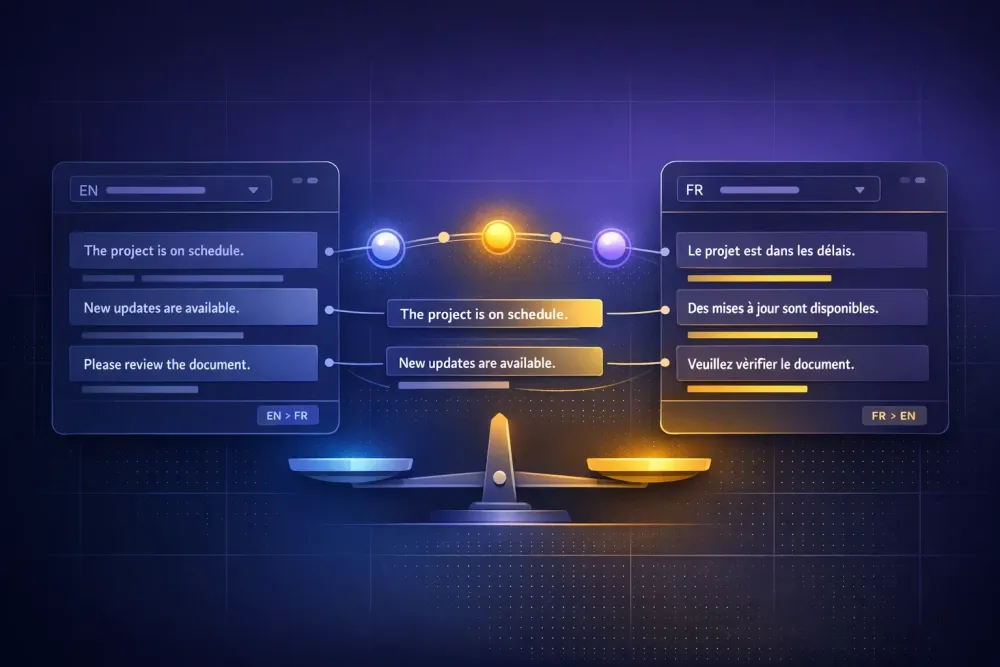
Agencies comparing Smartcat vs Phrase usually start with the wrong question. They ask which tool is better, when the real question is which one fits the way their team already works. We have watched agencies pick the wrong platform and spend six months rebuilding workflows around it. We have also watched agencies pick the right one and forget they switched within a quarter.
Both tools cover similar territory on paper. Both are cloud-based CAT platforms with translation memory, glossary support, QA checks, AI translation, and agency-level project management. The differences sit underneath those feature lists, in how each tool expects you to run projects, pay for work, and connect to the rest of your stack.
This post is our attempt at an honest comparison, written for agency owners and project managers who are stuck between the two. If you want a short version: Smartcat tends to fit agencies that want an all-in-one platform including freelancer sourcing, while Phrase fits teams with existing rosters who need a polished TMS on top of that. The longer version is below, with the caveats that matter.
What each platform actually does in 2026
Smartcat is positioned as an AI-driven translation and localization platform. The company describes it as a multi-agent AI system where specialized agents handle file preparation, translation, formatting, and project coordination, with a browser-based CAT editor, translation memory, glossary, and a marketplace of 500,000-plus vetted freelancers in the same workspace. You can upload a file, have it translated with layout intact, optionally route it to a human reviewer from the marketplace, and pay everyone through one invoice.
Phrase positions itself differently. It is primarily a translation management system (TMS) with a CAT editor and AI capabilities layered on top. Phrase is typically bought by companies that already have their own translator network or agency relationships and need a system for managing jobs, files, quality, and integrations at scale.
In practice that difference shapes everything. Smartcat pulls agencies toward doing more inside one platform. Phrase assumes you will bring your own people and your own process, and gives you a control layer. Neither approach is correct in the abstract. It depends on how much of your agency's identity is tied to a specific roster of translators versus a specific tech stack.
If you run a boutique agency with a handful of long-term freelance specialists, Phrase's "you already have translators, we manage them" model matches your reality more closely. If you are a growing agency that keeps hitting capacity walls because you cannot find translators fast enough in a new language pair, Smartcat's built-in marketplace solves a real problem you probably already have.
Translation memory: how each tool treats your biggest asset
Translation memory is often the single most important asset an agency owns, so how each tool handles TM matters more than almost any feature on the comparison page.
Smartcat's translation memory works the way most agency people expect. Segments are stored as source-target pairs, exact matches are applied automatically, and fuzzy matches are suggested to the translator. Smartcat states that exact matches cost zero Smartwords, its internal credit unit, and fuzzy matches cost roughly 40 percent of a full segment. For agencies with high-repetition work, that pricing structure shows up as real savings. A report full of repeated segments that would cost $1,000 at full rates might come in closer to $600 once TM reuse kicks in.
Phrase has translation memory too, with fuzzy matching, concordance search, and the ability to maintain separate TMs per client. Phrase TMs are well-regarded in the industry for their control features around metadata, penalties, and context fields. Agencies moving from Trados or memoQ tend to find Phrase TMs familiar, in part because the TMS model there evolved from that lineage.
We see two practical divergences. First, Smartcat bundles TM into its AI translation pipeline: segmentation, TM lookup, AI translation, QA, and glossary-based correction happen in one pass, driven by its multi-agent system. Phrase tends to separate these stages, which some agencies prefer because it gives clearer control over what happened at each step.
Second, migration matters. If your agency already has a mature Trados or memoQ TM and you are picking between Smartcat and Phrase as a new home for it, Phrase is usually the smoother migration. If you are starting relatively fresh, or your old TMs are a tangled mess you planned to rebuild anyway, Smartcat's starting-from-scratch experience is less painful. Our complete guide to CAT tools in 2026 goes deeper on migration trade-offs if you need them.
Pricing models: Smartwords versus seats
Pricing is where most agencies make the real decision, even when they pretend otherwise.
Smartcat's pricing revolves around Smartwords, where one Smartword equals one word of AI translation. Other AI actions cost more: AI voiceover is 10 Smartwords per word, image text re-embedding is 1,000 Smartwords flat, and AI image generation is 20 Smartwords per image. You can buy Smartwords through subscription or pay-as-you-go, keep them in a shared workspace balance or a personal balance, and unused ones expire at the end of the subscription term. Exact plan pricing changes more often than we can track reliably, so we defer to Smartcat's own pricing page for current numbers.
Phrase pricing is traditionally quoted on a per-seat and per-volume basis, with enterprise tiers negotiated individually. Exact numbers move around too often for us to quote them usefully here.
The practical difference is this. Smartcat's model makes AI translation variable and human review optional, while Phrase's model makes platform access fixed and translation volume elastic. A five-person agency with sporadic large projects often finds Smartwords cheaper because they only pay when they translate. A fifteen-person agency with steady volume often finds seat-based pricing more predictable because their cost does not spike when a big contract lands.
A common mistake we see is agencies comparing only the sticker price. Both platforms have real cost baked into onboarding, training, and the time it takes to rebuild workflows. Whichever you pick, budget at least a full month of partial productivity while the team adjusts. If you have two project managers, that lost time is a meaningful number to put on the page.
AI translation: two different approaches
Both tools offer AI translation, but the architecture differs in ways that affect how you use them day to day.
Smartcat's AI translation pipeline is described publicly as a six-step sequence: segmentation, TM lookup, AI translation with the engine chosen per language pair, QA checks for tags and numbers and glossary violations, OpenAI-based correction for flagged terms, and a fallback to Google NMT if the primary engine fails. A user-facing layer sits on top in the form of Smartcat AI, a conversational chat interface where prebuilt agents such as the Document Translator, PDF Translator, Website Translation Agent, Media Translator, and Software Localizer handle specific content types end-to-end.
Phrase's AI capabilities are built around its own portal that routes content to different engines, with customizable rules for engine selection and scoring. Phrase typically appeals to enterprise buyers who want fine-grained control over which engine handles which content type, and who also care about redaction and anonymization before AI processing. If your agency has clients in regulated industries and you need to show an audit trail of how text was handled, Phrase's controls in this area tend to be more mature.
For a small or mid-sized agency without that regulatory overhead, Smartcat's default pipeline does most of the work you would otherwise configure manually. For an enterprise buyer, or an agency serving enterprise buyers, Phrase's controls are often part of the sale.
A limitation worth naming. Neither platform lets you see under the hood of every AI decision. Both platforms will rephrase source content in ways that look fluent but are wrong, and both will pass QA checks that only verify structural things like tags, numbers, and glossary terms. Post-editing is still a human job regardless of which tool you pick, and MTPE time should still be budgeted into every project.
Integrations and ecosystem
Integrations reveal who each tool's intended buyer really is.
Smartcat has native integrations with CMS platforms like WordPress, Contentful, Drupal, Webflow, Squarespace, and Ghost, plus design tools like Figma, project management like Jira, e-commerce like WooCommerce and BigCommerce, and enterprise systems like AEM, Sitecore, Salesforce, and Zendesk. It groups them into three categories: full automation where content is pushed and pulled without human involvement, real-time API access, and manual sync.
Phrase covers a similar list and has historically been strong in enterprise connectors and developer-oriented workflows. Phrase's Figma plugin, GitHub integration, and CLI tools are well-liked by engineering teams who treat strings as code.
The difference is directional. Smartcat's integrations read as "we want to connect your marketing stack and ship multilingual content faster." Phrase's integrations read as "we want to slot into your software development lifecycle and manage strings across versions." If your agency's client mix is mostly marketing, e-commerce, and content, Smartcat's ecosystem maps closer to the work. If your clients are software companies shipping products in many locales, Phrase tends to win.
This shows up in file format coverage too. Smartcat states support for DOCX, PDF, PPTX, HTML, XLSX, video, images, and SCORM. Phrase's format coverage is strong especially around developer formats like JSON, YAML, XLIFF, and PO. Both cover the essentials. The depth at the edges tells you who they were built for.
Smartcat vs Phrase: which agency profile fits which tool
Picking between these two tools is less about features and more about fit. We use a rough heuristic when agencies ask us.
Smartcat tends to fit best when your work mix is heavy on marketing, content, or e-commerce localization; you frequently need translators in new or rare language pairs and do not have an existing roster; your project managers want to reduce time spent on file prep and freelancer coordination; your agency is growing and wants to scale without proportionally hiring more PMs; and you want AI translation, human review, and payment in one invoice.
Phrase tends to fit best when your clients are software, SaaS, or product companies localizing at scale; you already have a mature translator roster you want to keep; your workflows are deeply integrated with developer tooling like GitHub, CI, or repo-based string files; you need enterprise-level controls on engine selection, data handling, and reporting; and you are willing to invest in configuration to get a highly tailored setup.
Neither answer is forever. Agencies do move between platforms. We have seen agencies grow out of Smartcat into Phrase as their clients shifted toward enterprise software. We have also seen agencies move from Phrase to Smartcat after realizing their PM cost was growing faster than their revenue and they needed the marketplace to source translators on demand.
The thing to avoid is picking based on a demo. Demos are built to make the tool look inevitable. Run a two-week real-project pilot in each tool with the same content, the same translators if possible, and the same QA checks. What you learn from a pilot is more useful than any feature comparison.
A practical way to decide this week
If you want a concrete takeaway rather than a summary, here is one. Pick one live project of roughly average size for your agency. Run it end to end in Smartcat and Phrase as parallel pilots, using the same source files, language pair, deadline, and reviewer. Track four numbers during the pilot: total time spent by your PM, total cost including platform fees and translator pay, final QA report issues, and how much manual file handling each workflow required.
If you do this with one real project, you will have a defensible answer within two weeks. The wrong approach is to pick based on pricing pages, marketing sites, or analyst reports. The right approach is your own pilot data with your own content and your own people.
One note for agencies that already work in Smartcat and primarily deal with Smartcat bilingual DOCX exports. If that is your daily reality, tooling around that export format can save time alongside the broader CAT tool decision. SnapIntel is a workflow product we build that takes Smartcat bilingual DOCX files, helps prepare domain analysis, glossary, and prompt content, runs AI translation behind an explicit approval gate, and returns translated DOCX, spreadsheet exports, and a QA report. It does not replace Smartcat or Phrase. It fits after the Smartcat export and before final review. More at snapintel.io if that matches your workflow.