CAT tools in 2026: a complete comparison for agencies and freelancers
A practical cat tools comparison 2026: how Smartcat, memoQ, Phrase, and Trados actually differ — and which one fits your workflow.
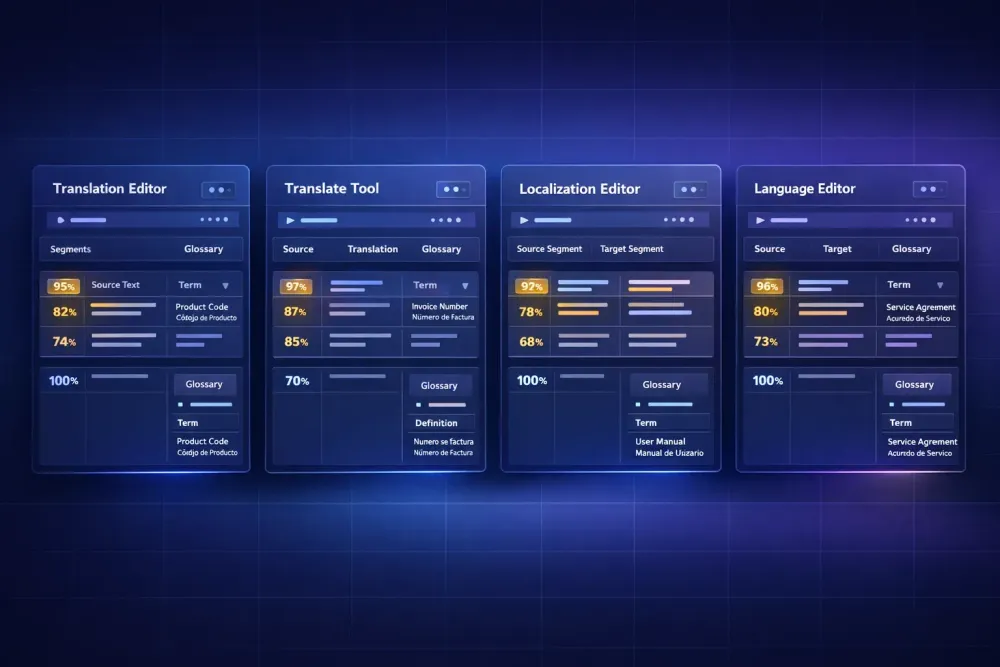
If you've tried to pick a CAT tool in the last year, you already know the problem: the market looks roughly the same on paper and wildly different in practice. Every tool claims translation memory, glossary support, and some version of AI translation. The real differences show up when you're three months into a project and realize the tool you chose doesn't handle your file formats, doesn't play well with your clients' preferred export formats, or costs twice what you budgeted once you factor in per-user licensing. We've watched a lot of agencies and freelancers make this decision, and the mistakes follow recognizable patterns. This is our honest attempt to map the cat tools comparison 2026 as it actually exists — not as vendors describe it.
What "CAT tool" actually means in 2026
The term Computer-Assisted Translation tool used to describe a narrow category: software that showed source and target text side by side, pulled suggestions from a translation memory, and helped translators work through a document segment by segment. That's still the core of what a CAT tool does. The segment-by-segment workflow remains the dominant model for human translation.
What's changed is what gets wrapped around that core. Most platforms have now layered AI pre-translation, automated QA checks, and project management on top of the traditional CAT editor. Some have added freelancer marketplaces. Some have built API integrations with CMS platforms so content flows in and out without manual file handling. Others have kept the product lean and focused entirely on the translation editor itself.
This shapes how you should evaluate tools. A small agency where a project manager handles workflow manually and the translator works in the editor needs different things than an enterprise localization team connecting their CMS, automating QA, and routing segments by domain. The "best CAT tool" question has no universal answer — it only makes sense once you know which of those you are.
Smartcat: strong for agencies that want everything in one place
Smartcat is built around a combination of CAT editor, AI translation, project management, and a marketplace of over 500,000 vetted linguists. The translation pipeline runs through segmentation, translation memory lookup, AI translation, QA checks, and glossary-term correction in sequence, handled by a multi-agent AI system where specialized agents manage different parts of the workflow.
For agencies, the most practical advantage is that TM savings are priced into the system. Segments with exact translation memory matches cost zero Smartwords — Smartcat's internal credit unit for AI actions. Fuzzy matches cost roughly 40% of full price. On projects with heavy repetition — technical documentation, legal contracts, software localization where boilerplate recurs across versions — this can reduce costs meaningfully.
The marketplace integration is useful when you need specialized translators for niche domains. The matching algorithm weighs language pair, subject expertise, rates, availability, and reviews. You assign freelancers directly from the platform and pay them through a single invoice rather than managing multiple payment relationships.
Where Smartcat is weaker: deep offline functionality isn't there, and if clients require specific proprietary export formats that aren't natively supported, you'll feel the edges. It's also a platform where value compounds when you commit to the ecosystem. The more of your workflow runs through it, the more it pays off — and the more friction there is in leaving.
memoQ: the workhorse for complex projects and regulated domains
memoQ has a reputation as the tool professional translators in regulated industries — legal, medical, pharma — trust most for complex work. It has one of the deepest translation memory implementations on the market: detailed fuzzy-match analysis, TM penalties for older matches, and granular control over how TM gets applied.
The desktop client gives you offline capability, which matters when sensitive documents can't leave a local network. memoQ's term extraction and termbase management are thorough enough for clients in regulated domains where terminology consistency isn't a preference — it's a compliance requirement.
The honest tradeoff: memoQ has a steeper learning curve than most competitors. New translators and project managers take longer to become productive, and if you're onboarding a lot of freelancers, you'll spend real time on training. The pricing model has also shifted over the years. Per-seat licensing adds up faster than you expect across a large translator pool — worth doing a full cost calculation before committing.
Phrase (formerly Memsource): built for enterprises managing high content volumes
Phrase is the platform you'll encounter most often in enterprise localization programs that need translation workflows connected to product development pipelines. Its connector ecosystem covers CMS platforms, GitHub, Figma, and a range of e-commerce systems. For organizations publishing content across multiple channels without manual file exports and imports, Phrase's integration model is genuinely well-designed.
Translation memory and glossary management are solid. QA automation is configurable for teams that need to enforce terminology or flag structural issues before delivery. The automatic flagging of low-quality segments for human review — rather than having reviewers check everything — reduces wasted review time on segments that are already fine.
The tradeoff is cost. Phrase is enterprise-priced, and the jump between tiers is steep. Smaller agencies often find themselves paying for infrastructure they don't use. If your workflow doesn't involve CMS integrations or high-volume automated pipelines, more cost-effective tools cover the core CAT functionality just as well.
Trados Studio: the legacy player that's still relevant
Trados Studio is the most widely recognized name in professional translation software, particularly in Europe. It has the largest installed base of any CAT tool, which means when a client sends you a Trados package file, you can work with it natively without conversion. Translation memory portability in the TMX format also works most cleanly between tools that have been around long enough to implement it properly.
The desktop application is powerful and deeply configurable. Translators who spend years building up their workflows get a lot out of that depth — custom filters, complex TM settings, specialized QA rules. The flip side is the same as memoQ: the learning curve is real, and the full studio license carries one of the higher upfront costs in the market.
Trados has pushed its cloud-based TeamWorks product for collaborative workflows, and the integration between the desktop client and cloud project management has improved. If you're starting fresh in 2026 without an existing Trados ecosystem, though, the reasons to choose it over newer platforms are mostly about compatibility with specific client package formats or particular feature requirements that other tools don't cover.
Three questions that cut through the feature comparison noise
When agencies and freelancers come to us trying to make this decision, the conversation eventually gets to three questions that feature matrices don't answer.
First: what file formats does your client base actually send you? If 80% of your work is DOCX, XLSX, and PDF, most tools serve you equally well. If a significant chunk is SCORM, InDesign, or proprietary CMS exports, you need to test format handling specifically before committing.
Second: how do you need to handle TM ownership across clients? Some tools make it easy to maintain separate TMs per client and merge or share selectively. Others treat TM more as a shared pool. If client confidentiality matters — and in legal or financial translation, it always does — the way a tool handles TM segmentation matters more than most comparisons cover.
Third: what does the real per-word cost look like at your actual project volume? Subscription costs, per-user licensing, AI translation credits, and marketplace fees interact in ways that make headline prices misleading. Run the math for a typical month of your real workload, not an idealized average.
Our guide to Smartcat for translation agencies covers one of the major platforms in more practical depth if Smartcat is on your shortlist.
What actually drives the choice
No single CAT tool wins across every situation. Smartcat has the most integrated offering for agencies that want AI translation, project management, and freelancer sourcing without stitching together separate tools. memoQ is the call when translation memory depth and offline capability matter most. Phrase is for enterprises with high-content-volume, multi-channel workflows who need reliable CMS connectivity. Trados holds its ground through ecosystem compatibility and desktop configurability.
Across all of them, translation memory and glossary management — the fundamentals that have defined CAT tools since the 1990s — still drive the most measurable productivity gains. AI translation has changed how fast a first draft appears. But the human review and TM-building work that follows is where quality and consistency actually get established. Whatever tool you pick, investing in those fundamentals pays off longer than any individual feature does.