Trados vs memoQ: which CAT tool is worth the price in 2026?
Trados vs memoQ compared on pricing, features, TM quality, and workflow fit in 2026. Find out which CAT tool makes more sense for your work.
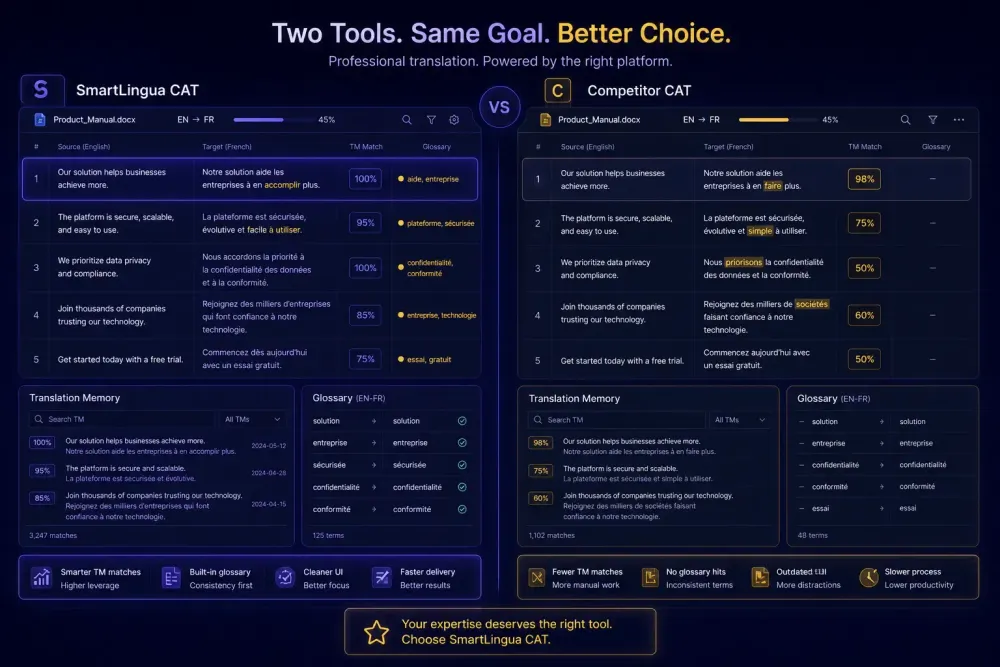
The debate over trados vs memoq has been running for as long as professional translators have had opinions about their tools, which is to say a long time. Both dominate the professional translation space, and both have shifted to subscription pricing that has made more than a few freelancers quietly furious. Each has a loyal community willing to argue the case. What actually matters when choosing between them isn't which tool wins some abstract feature comparison. It's whether the tool's strengths match the specific work you do every day: your language pairs, your domains, your clients, and how your team is structured.
We've had enough conversations with translators and agency managers using both platforms to see clear patterns in who thrives on each. This comparison tries to be honest about those patterns rather than just list features. The feature lists are long enough on each vendor's website already.
What Trados and memoQ actually are in 2026
Trados (now officially RWS Trados Studio) started as the industry-standard desktop CAT tool and has grown into a broader platform: desktop editor, cloud-based project management via Trados Team and Trados Enterprise, TM server infrastructure, and a growing set of AI translation features. It carries decades of market history, which produces both deep institutional familiarity among translators and some technical debt visible in parts of the interface.
memoQ came later and built its reputation partly by competing directly with Trados while offering what many translators found to be more flexible terminology handling and project configuration. Today the product spans desktop software, memoQ Server for agency deployments, and a cloud management layer (memoQ TMS). Its community tends to skew toward translators who value fine-grained control over TM penalties, workflow rules, and how glossary hits surface inside the editor.
Both tools are mature across the core CAT functionality: translation memory, glossary integration, QA checks, bilingual format export, and XLIFF support. The meaningful differences live at the edges — pricing models, how project management scales with team size, AI integration depth, and how each tool handles the specific friction points of daily work.
Pricing: what the subscription shift actually costs you
Both Trados and memoQ have moved toward subscriptions, and both have faced real criticism from users who preferred the older perpetual-license model.
Trados Studio for freelancers currently starts around $110/year for the standard subscription, though pricing changes and RWS's website should be checked directly before budgeting. Moving up to Trados Team or Trados Enterprise adds TM server access, a cloud project management dashboard, and per-user seat licensing that compounds quickly for agencies with multiple project managers and translators.
memoQ has retained a perpetual license option for the desktop editor alongside a subscription offering. Freelance subscription pricing sits roughly in the $70–90/year range. memoQ Server is sold separately through enterprise negotiations, and the per-seat model can produce surprising renewal figures when server maintenance and support costs are included.
What translators consistently underestimate is how much total cost of ownership changes once server components enter the picture. A four-person agency evaluating memoQ Server versus Trados Team needs to model actual costs over two or three years, including technical setup, ongoing maintenance, and support overhead, rather than comparing per-user sticker prices. We've seen configurations where memoQ looked cheaper on the per-seat rate but cost more overall because of server infrastructure requirements. The reverse is equally common with Trados Enterprise tiers.
Neither vendor publishes clean, self-serve comparison tables for anything beyond basic freelance licenses. Getting real agency pricing requires talking to sales, and the numbers shift depending on how the deal is structured.
Translation memory and glossary: where daily differences show up
Both tools handle translation memory in ways any experienced CAT user will recognize. The differences are real but easy to overstate. They become obvious after a month or two on a long project where accumulated friction has compounded across thousands of segments.
Trados TM is solid and tightly integrated with the desktop editor. Fuzzy match thresholds, penalty configuration, and match display are adjustable per project. The default format is SDLTM, though TMX export is clean for portability. For agencies running multiple translators against a shared resource, Trados GroupShare and Trados Team provide server-side TM access without requiring manual file exchange.
memoQ's TM system has a reputation for more flexible penalty configuration and a concordance search that many translators find faster for phrasal lookups. When working in a technical document with unusual sentence structures or heavy repetition at the phrase level, being able to search the TM at a word or phrase level quickly surfaces matches that a full-segment lookup would miss. This is a practical difference in domains like legal or engineering, where boilerplate phrases repeat across documents rather than within a single file.
On terminology, memoQ has held an advantage that shows up in practice. Term recognition inside the editor, multi-word entry handling, and how glossary hits display during active translation have historically been stronger than Trados. This isn't universal: Trados terminology management has improved significantly, and for straightforward use cases it works well. But for large termbases in medical, legal, or technical domains with hundreds of approved entries, memoQ's handling consistently generates fewer missed-term complaints from translators.
A concrete example: we spoke with an agency running pharmaceutical translations across six language pairs with a 600-entry termbase. After testing both tools on the same files, post-editors flagged roughly 20% fewer missed glossary suggestions in memoQ. The gap wasn't dramatic in any single segment, but it accumulated across a 45,000-word project in a way the project manager could see directly in the QA report. That kind of difference doesn't appear in a feature comparison. It appears in monthly error rates.
Project management: where agency size starts to matter
This is where the two tools diverge most clearly, and where the right answer depends heavily on who runs your projects.
Trados Team provides a cloud project dashboard with task assignment, deadline tracking, file distribution, and translator access through a browser-based editor. Translators can work online without installing Trados Studio locally. For agencies onboarding new contributors regularly, or working with occasional translators who don't want to manage desktop software, this is a genuine practical advantage. The onboarding friction is lower than memoQ Server for users who aren't already familiar with CAT tools.
memoQ's server-based project management goes deeper in configuration. Automation rules, project templates, role-based access, and workflow branching are all more granular than what Trados Team offers. Agencies that have properly configured memoQ Server tend to be satisfied with the automation depth: automatic job assignment by language pair, deadline-triggered notifications, file routing rules that run without PM intervention. But that configuration takes real effort to build and maintain, and the platform assumes whoever manages it has solid CAT experience.
A pattern we've seen consistently: Trados tends to win in organizations where translator accessibility and minimal onboarding overhead are priorities. memoQ tends to win where the project management side is run by someone with deep CAT expertise who will actually invest in configuring automation templates. The configuration depth that frustrates a project coordinator with limited CAT background becomes a real advantage for someone who knows exactly how to use it.
For agencies at the five-to-ten-person mark, the choice often comes down to which tool the most experienced person on the team already knows well, because they'll be the one maintaining the setup.
This is also relevant context if you're reading our broader CAT tools comparison for 2026, which covers how both fit against the wider market.
AI translation in both tools: what to expect
Neither Trados nor memoQ was built as an AI-native product. Both added AI as a layer on top of mature CAT architecture, and that origin matters for what you can and can't expect from each.
Trados supports MT engine integration through its MT provider configuration. Microsoft Translator, Amazon Translate, DeepL, and others can be connected to pre-fill target segments before a human post-editor reviews them. The MTPE workflow is native to the editor. Translation Quality Assurance features flag obvious MT errors before delivery, and the QA check set applies to machine-translated segments the same way it applies to human-translated ones.
memoQ handles MT integration through its Language Terminal and direct engine configurations. DeepL in memoQ is well-regarded by its user community for European language pairs. MTPE workflows are native and well-integrated, and memoQ's QA checks apply to MT output without extra configuration.
Where both tools still create friction: working with AI-translated DOCX files that originated outside their environment. If you receive a document that a client or an upstream pipeline pre-translated through a standalone AI tool, re-importing it into Trados or memoQ while preserving clean segment alignment takes careful file preparation and doesn't always work without issues. This is a real pain point for agencies whose clients are increasingly delivering AI-pre-translated drafts rather than clean source documents.
For workflows that regularly involve DOCX files going through an AI translation step before reaching a human post-editor, tools built specifically around structured DOCX translation workflows — like SnapIntel — handle the import-to-output path in a more controlled way, including spreadsheet exports that can be fed into any CAT tool's TM afterward.
This doesn't apply if your clients always deliver clean source documents. But if that pattern is shifting, it's worth factoring into your toolchain evaluation.
File format compatibility in practice
Both tools are established widely enough that SDLXLIFF (Trados project packages) and MQXLIFF (memoQ packages) both circulate routinely. Most experienced translators and agencies have encountered both formats at some point.
The friction emerges when you need to handle the other tool's package format. Converting between SDLXLIFF and MQXLIFF is technically possible but adds a step and can introduce alignment issues with heavily formatted or complex source files. Small agencies that regularly receive packages in both formats often maintain a lightweight license of whichever tool isn't their primary editor, just for package handling and delivery.
Both tools support TMX for TM exchange and TBX for termbase export, which makes migration workable if you decide to switch tools at some point. Moving a large TM from Trados to memoQ using TMX export and import is something agencies do, and it works reasonably well. You'll typically recover most of your TM match rate quickly on projects that closely match your historical content, though there's always some alignment loss in edge cases. Switching is manageable — it just isn't free in time or effort.
The absence of a common cross-tool bilingual format standard is one of the genuinely frustrating structural features of the CAT tool market. It creates real switching costs that tend to lock teams into whichever platform accumulated the most TM content first.
Which tool fits which situation
Rather than a winner, here's a more useful framing of the decision.
Trados is likely the better fit if your client base regularly sends SDLXLIFF packages, if onboarding translators with limited CAT experience is a recurring challenge, or if you operate in a market where Trados dominance means most project packages arrive pre-configured for the Trados environment. The cloud-based translator access in Trados Team is a genuine differentiator for agencies working with a wide network of occasional contributors who won't install desktop software.
memoQ is likely the better fit if you have a technically experienced project manager willing to invest in automation rules and workflow templates, if your domain work demands serious terminology management across large termbases, or if you're setting up a server environment and want granular control over how jobs move through your team. The depth is there — it just requires someone who will actually maintain it.
For freelancers choosing between the two for the first time: both offer 30-day trials. Use them with your actual project files, not demo content. Pay attention to how TM matches surface during active translation, how glossary terms behave in your specific language pair and domain, and how much time each project requires in setup versus actual translation work. The daily editor experience tells you more than a side-by-side feature table.
The decision worth actually making
Before committing to a license, spend two full working weeks trialing both tools on your real project files. Track how often glossary terms fail to surface when you expect them. Track how much setup time each project requires before you're actually translating. Track whether the QA check output catches the types of errors you typically make or find.
The tool that reduces friction in your specific workflow is the right choice. That answer is different for a freelance legal translator working German-to-English than it is for a twelve-person agency running multilingual pharmaceutical content. A comparison table doesn't know your workflow. Only you do — and two weeks of actual use will show you more than any guide, including this one.