MTPE vs human translation: how to decide which one your project needs
MTPE vs human translation: learn when post-editing saves time and when human translation is the better call. A practical framework for agencies and translators.
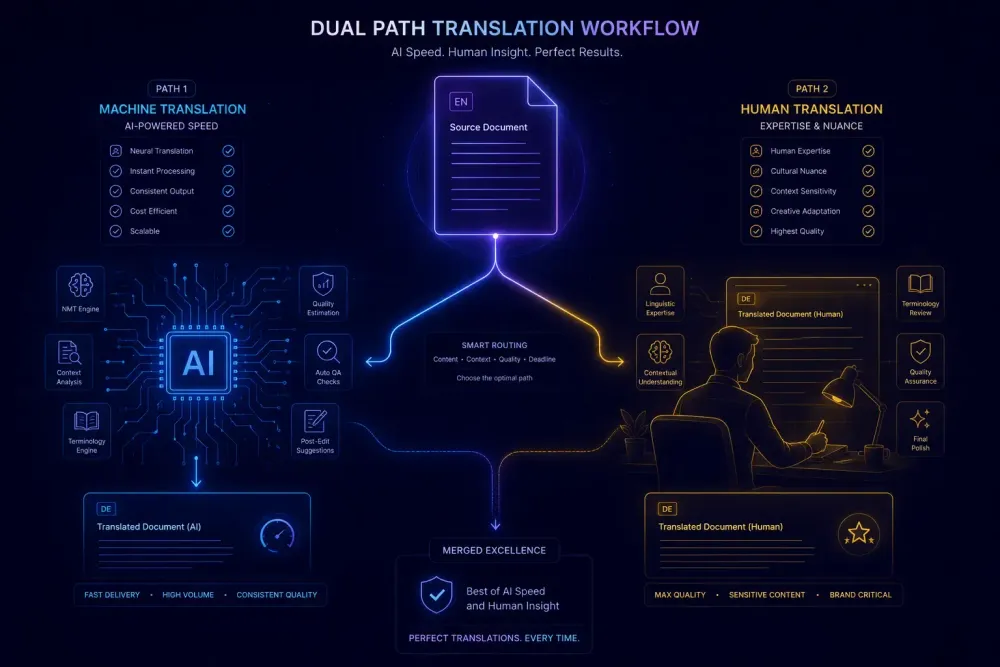
The question of MTPE vs human translation comes up on almost every project brief we see: tight deadlines, fixed budgets, or both pushing toward machine translation post-editing as the default choice. It's tempting to treat the decision as a simple fork. You either run the content through an MT engine and have someone clean it up, or you hand the whole document to a human translator. In practice, the choice is more granular, and getting it wrong in either direction creates real problems. We've seen agencies spend more time fixing machine output than a full human translation would have taken. We've also seen teams insist on full human translation for internal reports that would have been fine with light post-editing at half the cost.
The decision isn't arbitrary, and it doesn't have to be stressful. It comes down to content type, quality requirements, MT engine fit, and what your team can actually execute within the given deadline. This article walks through the factors that matter and ends with a practical framework you can apply project by project.
What MTPE actually involves
MTPE stands for machine translation post-editing: a trained MT engine produces a first draft, and a professional post-editor reviews and corrects it. That correction step is where the variation comes in.
There are two recognized types. Full post-editing (FPE) targets the same quality standard as conventional human translation. The post-editor fixes everything — meaning, terminology, style, fluency, and formatting inconsistencies. Light post-editing (LPE) targets only accuracy and comprehensibility. Stylistic problems and awkward phrasing are left in place as long as the content is not misleading or incorrect.
That distinction has significant practical implications. A light PE engagement is faster and cheaper. A full PE engagement takes longer and costs more, and in some language pairs and content types, it approaches the cost of straight human translation. When MTPE is pitched as a way to cut costs, it's almost always LPE being implied. If the project actually requires FPE, the budget math looks different.
One thing that often gets missed: MTPE is not a synonym for fast translation. Poorly matched MT engines, weak glossary coverage, or low-quality source text can produce output that's harder to fix than to translate from scratch. The post-editor ends up rewriting rather than editing. We've seen this pattern most often when generic MT engines are applied to domain-specific content without any terminology preparation. A legal document run through a general-purpose engine without a subject-matter glossary will generate plausible-looking but terminologically unreliable output that a competent post-editor cannot fix quickly.
The efficiency argument for MTPE holds when the engine is well-matched to the content. It falls apart when it isn't.
When human translation is the right call
There are content categories where MTPE isn't appropriate, regardless of budget pressure.
Legal and regulatory documents require specialist translators who understand both the source and target legal systems. A contract clause that a post-editor "corrects" into technically accurate but legally imprecise language can create liability. Patent translation, compliance filings, and court submissions fall into the same category. Errors here are expensive in ways that have nothing to do with revision time.
High-investment marketing and brand content — campaign copy, product launches, taglines — depends on cultural judgment that MT engines don't have. Pattern matching is not the same as knowing what will resonate in a specific market. When a translator has to essentially rewrite a machine-generated sentence to make it work culturally, the efficiency argument for MTPE is gone.
Poor source text also undermines the case for MTPE. MT output quality tracks closely with source quality. When the source document is ambiguous, densely referential, or full of implicit cultural shortcuts, the engine will make guesses. The post-editor then inherits those guesses without the context to resolve them. For messy source content, a human translator makes better decisions at the paragraph level, because they can read around ambiguity in ways an MT engine cannot.
Language pair coverage is another real variable. For high-resource pairs like English-German or English-French, modern neural MT produces clean enough output that light PE is realistic. For lower-resource pairs or those involving non-Latin scripts, post-editing load increases substantially and the time savings shrink. Agencies that assume uniform MT performance across language pairs tend to get surprised on the pairs where coverage is weaker.
None of this means MTPE is inferior. It means MTPE has conditions under which it works well, and ignoring those conditions produces bad outcomes.
When MTPE makes sense
MTPE genuinely saves time and cost when the conditions support it.
High-volume technical content written in controlled language is the strongest case. Instruction manuals, product data sheets, software UI strings, and internal knowledge base articles with predictable sentence structure benefit most. The vocabulary is constrained, the MT engine has trained on similar content, and a domain-specific post-editor can often reach FPE quality at twice the speed of conventional translation. We've seen this hold consistently for EN-DE and EN-ES technical documentation when the source follows style-guide discipline.
Content with significant repetition amplifies the benefit further. When a 40-page document contains 35% repeated segments or high-fuzzy matches against an existing translation memory, those segments can be handled by MT while the post-editor focuses only on new material. Pairing TM savings with MT output means the post-editor is doing meaningful work on the content that actually needs attention, not grinding through boilerplate.
Internal content with lighter quality requirements is another clear fit. When employees across regional offices need a product update or internal policy document translated, they need accuracy and readability. They don't need the prose to read as polished prose. Light PE delivers that at much lower cost and turnaround time, and the quality difference relative to full human translation is rarely noticeable for internal audiences.
Time-critical projects with moderate content risk are also good candidates. When a deadline is fixed and the content is not high-stakes, MTPE with FPE standards often gets a good translation out faster than waiting for a full human translation slot. The faster turnaround has real value, particularly when a client has a hard publication date.
The realistic caveat: all of this works when the MT engine is appropriate for the language pair and content type. Skipping the evaluation step — assuming MT will be good enough because it usually is — is where MTPE projects go wrong most often. A 200-word sample test at project intake costs almost nothing and saves the kind of mid-project failures that are expensive to fix.
How to measure quality across both approaches
Comparing MTPE and human translation on quality requires a framework, not a gut feeling.
MQM (Multidimensional Quality Metrics) is the most widely adopted quality framework for professional translation. It breaks errors into dimensions — accuracy, fluency, terminology, style, locale convention — each with severity levels (minor, major, critical). When you need to demonstrate to a client that MTPE reached the agreed standard, MQM scoring gives you defensible data rather than a subjective assessment. If your current QA process doesn't produce MQM-aligned error counts, you're making quality comparisons that are harder to defend.
COMET is a neural MT evaluation metric that correlates better with human quality judgments than older metrics like BLEU. Translation teams that run regular MTPE workflows increasingly use COMET scores to benchmark MT engine performance per language pair before deciding whether MTPE is viable for a given project type. It's not a replacement for human review, but it gives you an objective signal early in the decision process.
The most useful internal benchmark we've found is a controlled side-by-side. Take 200–300 source segments from a representative document, run them through MT, have a senior post-editor bring them to FPE quality, and measure time per segment and error rate before and after PE. Run the same segments through full human translation. The resulting data is specific to your language pair, your content type, and your post-editors — which is what actually matters for your workflow.
One variable that tends to get underweighted: translator acceptance. CSA Research has consistently found that post-editor adoption of MTPE varies significantly by domain and MT engine quality. Post-editors who feel they are rewriting rather than editing slow down, produce inconsistent output, and resist the workflow. If your post-editors are deleting and restarting more than they're correcting, that's a signal the MT engine isn't fit for the content type — not a signal that the post-editors are underperforming. Building a feedback loop where post-editors flag language pair and content type combinations that consistently produce poor MT output is one of the more practical things an agency can do when scaling an MTPE practice.
How pricing changes the calculation
MTPE rates vary considerably, but the typical pricing model charges per source or target word with a rate reduction that reflects the expected post-editing workload. Light PE generally runs at 40–60% of the full translation rate. Full PE rates sit closer to 70–85%, sometimes higher, depending on language pair and MT quality.
Where the math gets complicated is when actual PE workload doesn't match the assumed rate. If you price a project as LPE but the MT output is weak enough that post-editors are doing FPE, you're paying full PE effort on LPE pricing. That's a workflow cost problem, and it compounds on longer projects. Agencies that have learned from this tend to base rates on documented MT performance for specific language pairs and content types rather than on general assumptions about how good MT is.
Translation agencies that are building sustainable MTPE pricing in 2026 are also accounting for the turnaround time value. If you're working through how agencies are structuring AI-assisted project pricing, our breakdown of current models covers the range of approaches in practice. Getting a 10,000-word document out three days faster than a full human translation run has a concrete impact on client satisfaction and on what you can take on in a given week. That value doesn't appear on the per-word rate line, but it affects the economics of the workflow.
One underappreciated factor on the cost side: setting up MTPE properly takes time that isn't billed directly. Evaluating MT output on a new content type, configuring domain glossaries, briefing post-editors, and establishing PE quality standards all absorb hours. For a high-volume, long-term client relationship, that setup cost amortizes quickly. For a one-off project, it often doesn't, which is why defaulting to MTPE on small or novel projects can create more overhead than the approach saves.
A practical MTPE vs human translation decision framework
When a project comes in, the following questions get you to a defensible answer faster than reasoning from general principles.
What are the consequences of a translation error? For user manuals and internal reports, the risk is moderate. For legal opinions, clinical documentation, or anything that creates contractual or regulatory obligations, the risk is high. High-risk content defaults to full human translation regardless of budget pressure. This isn't a quality preference; it's a risk management decision.
Is this content type suited to MT? High-volume technical content with controlled language and significant repetition is the strongest candidate. Creative content, marketing copy, and anything with heavy cultural reference is not. Mixed documents — part procedural, part narrative — require a judgment call on which sections can go through MTPE and which need a human translator.
Have you tested this MT engine on this language pair and content type? If the answer is no, build in a sample evaluation step before committing to MTPE on a deadline-driven project. This doesn't need to be elaborate. A representative 200-word segment, run through the engine you plan to use, reviewed by one of your senior post-editors, tells you what you need to know before the full project starts.
What do your post-editors say about the MT output? Post-editors know within the first few hundred words whether the output is workable. If they're flagging a language pair or content type as consistently poor, that's the most reliable signal you have. Track those flags. Over time, you build a picture of where MTPE works for your team and where it doesn't.
Does the client allow MT use? Some clients specify no MT in their contracts. Others require ISO 17100-compliant human translation. If the client relationship hasn't addressed this, the question should be raised before work starts, documented in the project brief, and factored into pricing. Discovering after delivery that the client didn't know MTPE was used is a relationship problem regardless of output quality.
Is the deadline actually served by MTPE? This sounds obvious, but the setup overhead for MTPE on a new content type can eat into the time advantage. For a client you translate for regularly in a well-established language pair, MTPE is fast. For a one-off project in a new domain, the evaluation and briefing time may mean the deadline advantage is smaller than expected.
Working through these questions consistently turns the MTPE vs human translation decision from a case-by-case judgment call into a repeatable process. That's what building a translation workflow that scales actually requires: documented criteria that your team can apply without having the same conversation every time a new project lands.
What to do right now
If you're still making the MTPE vs human translation decision project by project without documented criteria, the most practical first step is to write down your current implicit rules. What content types do you currently route to MTPE? Which language pairs have you tested? What PE rate do you apply for light versus full post-editing? What do you tell clients about MT use?
Writing that down takes maybe an hour. It will immediately surface inconsistencies in how different project managers on your team are making the same decision. Those inconsistencies are where quality variance comes from.
The second step is empirical: run a parallel test on one real project before scaling a new MTPE workflow. Compare a full human translation and an FPE pass on 1,000 source words from the same document. Have a senior reviewer assess both for accuracy and fluency without knowing which is which. The output from that test is more useful than any industry benchmark, because it reflects your specific MT engine, your post-editors, and your content type.
The agencies that manage MTPE well aren't using better technology than everyone else. They're making the MTPE vs human translation decision deliberately, testing their assumptions, and building criteria that hold up project after project.