How translation agencies are pricing AI-assisted projects in 2026
How translation agencies are pricing AI-assisted projects in 2026: per-word models, MTPE rates, and practical frameworks for client billing
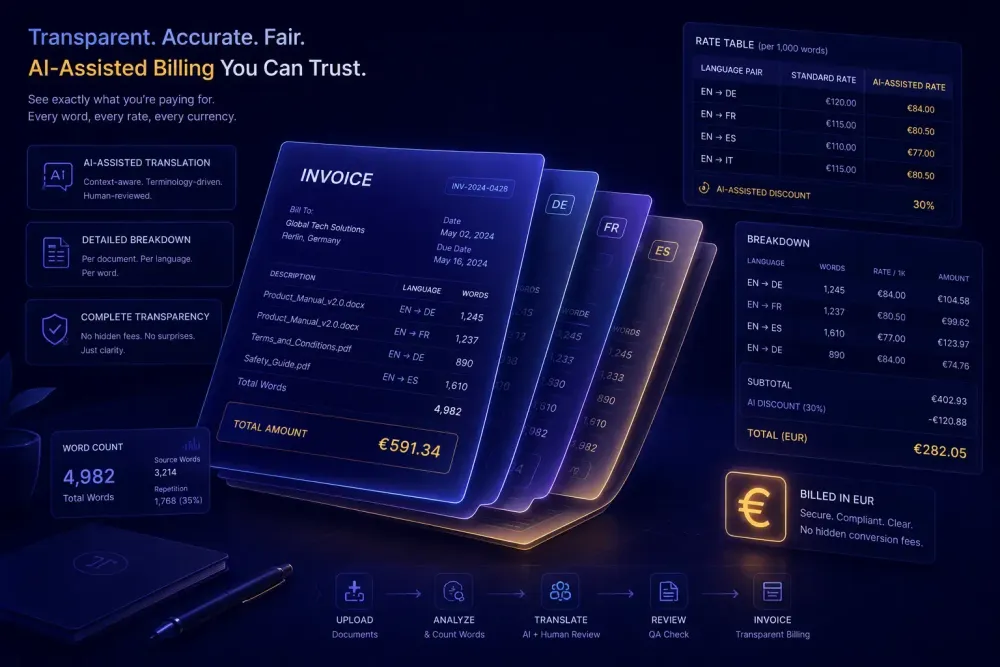
The pricing conversation most agency owners dread has become unavoidable in 2026. A client sends a large document batch, you run it through your AI-assisted workflow, your post-editors clean it up, and then the client asks: "If you're using AI, shouldn't this be half the price?" Getting a clear, defensible answer to that question—while protecting your margins—is what translation agency ai pricing in 2026 is really about.
This isn't a new tension. Machine translation has been part of professional workflows for years. But the pace of AI adoption, combined with clients who now regularly use ChatGPT themselves, has made the pricing question sharper. Clients have a rough mental model of what AI costs, and many assume it's close to zero. The gap between that assumption and your invoice can erode trust if you haven't thought through how to explain it.
Why the old per-word model is showing its age
Per-word pricing made sense when cost and time scaled linearly with word count. More words meant more translator hours, and a flat rate per word gave both sides a predictable formula. That model worked because the primary variable—translator time—tracked closely with volume.
AI disrupts that relationship. A skilled post-editor working on well-calibrated AI output can process two to three times as many words per hour as a translator working from scratch, depending on content type and language pair. Your cost per word drops. Your client's intuition that prices should follow is not entirely wrong.
But the intuition misses what the cost model actually looks like now. AI API costs, quality control overhead, and glossary management don't disappear—they redistribute. A project that looked like 80% translator time and 20% overhead in a full human translation workflow might now look like 40% post-editing, 25% AI tooling and review, and 35% project management and delivery. The total cost per word often drops, but rarely by the 70–80% clients sometimes expect.
Consider a concrete example: an agency handling a 15,000-word legal document in English to German. Under full human translation, that might take a senior translator four to five days and cost $0.18 per word at a quality level appropriate for contract review. Under an AI-assisted workflow with machine translation post-editing (MTPE) by a specialized post-editor, the same volume might take two days. If the agency adjusts to $0.12 per word, their per-project revenue drops by 33% while their actual margin may only improve by 10–15% after accounting for the post-editor's hourly rate, QA steps, and the higher density of attention legal content demands. The math almost never works out as favorably as the client assumes.
What "AI-assisted" actually means on an invoice
One reason pricing conversations get messy is that "AI-assisted" covers a wide range of actual workflows, and most agencies don't specify which one applies. There are at least three distinct approaches in active use.
Full AI pre-translation with light MTPE. The AI generates a complete draft; a post-editor reviews and corrects. This is fastest and cheapest, but works best for repetitive, structured content—technical manuals, product catalogs, or instructional material with consistent terminology. Expect post-editing to take roughly 40–60% of the time a full translation would require.
AI as a drafting aid with substantive human translation. The translator sees the AI output as a suggestion and rewrites extensively. Common for marketing copy, legal language with jurisdiction-specific nuance, or content where brand voice matters. Cost savings over full human translation are modest—typically 20–30% faster—but quality expectations are maintained.
Hybrid by segment, using the CAT tool's translation memory and AI logic together. Exact and high-fuzzy TM matches are applied automatically; the AI handles mid-complexity segments; the translator takes the rest. This is the most precise approach but requires a well-configured workflow to show clear results.
When you invoice a client, the category matters. An MTPE rate for a marketing localization project isn't appropriate. A full human translation rate for a regulatory product manual you processed entirely through AI pre-translation is also hard to justify. Being specific about which workflow applies to which content type—and pricing accordingly—is one of the more practical changes agencies can make in 2026.
Three ways agencies are structuring AI pricing in 2026
From what we've seen working with agencies across Central Asia and Eastern Europe, three structures have emerged as workable in practice.
Differentiated per-word rates by content type
Rather than a single rate or a blanket AI discount, agencies are building rate schedules: one rate for marketing and creative content (effectively full human or AI-light rates), a second rate for technical and structured content (MTPE-appropriate), and a third for regulated content like legal and medical (higher than technical, often with a flat review fee added). This gives clients transparency without exposing your margin structure.
The value of this approach is that it creates a defensible logic. You're not saying "AI makes it cheaper"—you're saying "technical manuals have a different rate than contract translations, because the workflow and risk profile are different." That framing holds up.
Project-based fixed pricing
For recurring clients with predictable document types, some agencies are moving away from per-word entirely. A fixed monthly or per-project fee absorbs the variability in AI performance, covers QA and delivery, and lets the agency capture efficiency gains without relitigating the "but AI is cheaper" argument on every invoice cycle. This works best when you have enough volume history to price confidently.
A real-world example: one agency standardized a rate of $450 for any document package under 10,000 words in their primary language pair (English to Russian). That covers import, AI translation, one round of MTPE, a QA report, and delivery. Actual margin per project varies with document complexity, but across 15–20 projects per month the average is predictable. The client gets cost certainty; the agency benefits when a fast AI run on a simple document offsets a harder one the same week.
Cost-plus with a transparency layer
A smaller group of agencies—typically those working with enterprise clients who expect audit trails—are moving toward itemized pricing: AI processing cost (actual API spend or subscription allocation), post-editing hours at an hourly rate, QA and review at a fixed fee per project. This is more work to present, but it addresses the "show me your costs" request directly and can win contracts that black-box pricing loses in procurement-heavy industries.
Having the AI pricing conversation with clients
The most common version of this conversation starts with a client saying something like: "We noticed you're using AI now, so we'd expect the rates to come down." The worst response is to be defensive or vague. The most effective response addresses what the client is actually paying for.
What clients pay for isn't translation generation—any tool can produce text in a target language. What they pay for is accuracy in context, consistency across a document set, terminology that matches their glossary, a QA check that catches errors before delivery, and accountability for the output. AI generates the raw material. Your workflow and your team make it usable.
A framing that holds up in practice: "Our AI integration means we can deliver this faster than we could with full human translation. Our rate reflects the post-editing, quality checking, and delivery work that makes the output ready to use—not just the AI generation step." This is accurate, non-defensive, and shifts the conversation from "how cheap is the AI" to "what are you actually getting."
If a client pushes back and asks for a specific AI discount, you have two options. Offer a modest reduction—15–20%—on clearly MTPE-appropriate content, positioned as a rate for structured technical material rather than an "AI discount." Or hold your rate and explain that your quality process is the same regardless of how the draft was generated. Either approach can work. What consistently doesn't work is offering large discounts on AI output and then struggling to maintain margin as volume grows.
For individual translators navigating the same pressure from clients, the post on how to price your translation services when AI is part of your workflow covers rate-setting logic that applies just as well to agencies building internal cost models.
What your cost structure actually looks like now
To price AI-assisted projects correctly, you need a clear picture of what costs have changed and what hasn't.
Post-editing time doesn't disappear—it shifts. Good AI output reduces time spent per segment, but post-editors also spend time on consistency passes, glossary verification, and decisions about segments the AI handled poorly. For MTPE-appropriate content, expect roughly 40–60% of the time a full translation would take. For creative or sensitive content, it's closer to 70–80%.
QA overhead persists regardless of whether AI or a human produced the initial translation. In some cases, AI-generated text introduces category errors—terminology mismatches, hallucinated proper nouns, register shifts—that a human translator wouldn't make, which can add QA time rather than reduce it. A thorough QA pass after AI pre-translation often costs more attention than a spot-check after experienced human translation.
Software and tooling costs continue. CAT tool subscriptions, AI platform access, glossary management, and project management overhead all remain. If you're using a BYOK (bring your own API key) setup, API costs per project are real and variable depending on document length and model used.
What does decrease is the proportion of cost that scales purely with word count. For agencies doing high-volume, repetitive-content work, this is where the efficiency gains appear. For agencies handling diverse, high-complexity content, the gains are smaller and margins need more active management. The agencies pricing AI-assisted work most successfully in 2026 are the ones that have actually done this math for their most common project types, rather than applying a uniform discount or holding full human translation rates without a clear rationale.
For a framework to track whether your pricing is translating into actual profitability, the post on KPIs every translation agency should track to stay profitable covers the metrics worth monitoring as your cost structure shifts.
Building a pricing framework that holds up
The practical output of thinking through all of the above is a rate card or pricing framework that gives your team clear guidance on which rate to quote for which type of work. Without that, every project becomes a negotiation, and the "AI discount" pressure erodes margins gradually.
Define two to three content categories with distinct rates. Technical and structured content gets your MTPE rate. General business content gets a mid-range rate. Regulated or creative content gets your full human translation rate or close to it. Add a brief internal description of what falls in each category so project managers quote consistently.
Decide whether you'll itemize or package. For enterprise clients, itemized pricing may be a requirement. For SMEs, a clean per-word or fixed-project rate is easier to sell and support. Pick one approach per client segment and be consistent within it.
Set a floor on per-word rates that reflects your actual cost floor. If your MTPE cost—post-editor time plus AI tooling plus QA—runs to $0.07 per word at current volume, a rate of $0.09–0.10 gives you workable margin. If a client pushes below that floor, the project isn't profitable regardless of what AI does to the speed.
Review quarterly. AI costs and post-editing norms are shifting fast enough that a rate built on 2024 assumptions may be wrong in mid-2026. Build a review cycle into your calendar so your pricing reflects your actual workflow rather than a snapshot from the last time someone updated the rate card.
This doesn't apply if you're still mostly doing full human translation with minimal AI involvement—your per-word model is still working, and the pressure to discount is easier to resist. It also works differently if you specialize in content types where AI performance is consistently poor: literary translation, sworn legal documents, or highly idiomatic marketing copy. In those areas, MTPE rates aren't appropriate, and holding your human translation rate is straightforward.
The agencies handling AI pricing well in 2026 aren't necessarily those with the most sophisticated setups. They're the ones that have been honest about what their costs actually are, and have found a way to explain their value without apologizing for using the tools available to them.