How to price your translation services when AI is part of your workflow
Figuring out translation pricing in an AI workflow? Here's how to calculate your floor rate, when to charge MTPE rates, and what to tell clients.
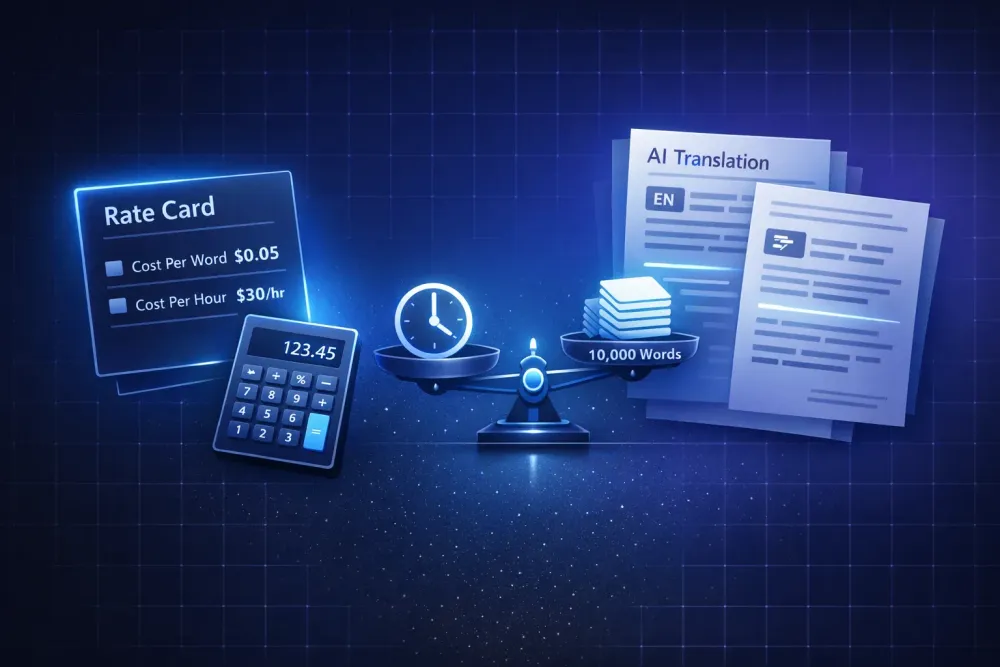
The translation industry is having an awkward conversation about money. When AI enters your workflow whether through a CAT tool's built-in engine, a standalone model you prompt manually, or a tool that takes a DOCX and returns a translated draft the time it takes to produce a translation changes. Sometimes dramatically. That creates an obvious question: do your rates change too? The short answer is yes, but not always in the direction clients expect. Working out where to land requires more than instinct. It requires a framework for thinking about what you're actually selling and how much of your time a given project truly costs you.
Why the per-word rate is struggling to keep up
The per-word rate became the default in translation because it roughly tracked effort. A translator working 250 source words per hour at 0.10 USD earned about 25 USD per hour. That made sense. The rate was a proxy for time.
AI breaks that proxy. When you feed a document through an MT engine and spend your time reviewing and correcting the output instead of generating translation from scratch, your words-per-hour figure changes completely. Post-editors typically process 400 to 1,000 source words per hour depending on the domain, the language pair, and the quality of the initial AI output. If you keep billing at your full human translation rate while processing twice as many words per hour, you earn more in the short term. But only until a client or agency works out the math and starts expecting lower prices.
The problem is not that AI makes your work less worth paying for. The problem is that the per-word rate conflates your productivity with the value you deliver, and those are different things. Faster work does not automatically mean less skill or fewer years of specialized knowledge. A senior medical translator reviewing AI output for a drug approval dossier is doing something fundamentally different from a junior translator running the same process on general business correspondence. The per-word rate captures none of that distinction.
This is why pricing in an AI-assisted workflow is not purely an accounting question. It's a positioning question.
The three pricing approaches translators are using right now
When we talk with translators who have integrated AI into their practice, three billing models come up consistently. None of them is the right choice for every situation.
Per-word rates, tiered by content type
Some translators keep the per-word model but introduce explicit tiers: a rate for full human translation, a lower rate for MTPE (machine translation post-editing), and sometimes a light post-editing rate for documents where AI output needs only surface correction. The upside is transparency and easy comparability for clients. The downside is that once clients know a cheaper tier exists, they often push to put everything in that tier regardless of whether the content actually suits MT-first workflows.
Hourly billing
Charging by the hour decouples your income from word count and ties it directly to time spent. For complex projects technical manuals, legal contracts, highly domain-specific content where AI output requires significant intervention hourly billing better reflects the actual effort involved. The friction here is that many clients, particularly agencies, resist hourly billing because it removes their ability to predict project costs upfront.
Per-project pricing
A flat fee for the whole job, regardless of word count or hours spent. This works best when scope is well-defined, the domain is familiar, and AI assistance is predictably useful. Project pricing rewards efficiency: if AI saves you three hours on a well-structured document, you keep the benefit. The risk is underestimating projects where AI output turns out to be weaker than expected for a specific language pair or domain.
The right model depends on your client mix, your specialization, and how accurately you can predict post-editing effort before the work starts.
How to work out your floor rate for AI-assisted work
Before you set any AI-assisted rate, you need to know your minimum viable hourly rate the number below which the work does not support your business. This sounds obvious, but many translators have never calculated it directly.
Start with your target annual income. Add your business costs: software subscriptions, professional memberships, equipment, continuing education, insurance, and taxes. Divide by the number of working hours you actually bill per year not available hours, but billable hours. For most freelancers that figure sits between 1,200 and 1,600 per year once you subtract time spent on admin, client communication, unpaid revisions, and time off.
That gives you your floor hourly rate. Then measure your actual post-editing productivity on representative content. Track a few projects carefully: note the source word count, the total time spent from opening the file to delivering the final version, and the AI tool used. Calculate your effective words per hour.
Once you have that figure for your typical AI-assisted work, you can back-calculate the per-word rate you need to stay above the floor. If your floor is 40 USD per hour and you post-edit 600 words per hour, your minimum viable MTPE rate is roughly 0.067 USD per source word and that is the floor, not a market rate. Build in a margin for projects where AI output is worse than average.
Do this calculation for your specific situation rather than adopting published averages. CSA Research and Slator both publish data on MTPE adoption and rate trends, but those figures reflect the market broadly. Your floor depends on your cost structure, your location, and how efficiently you work within your domain.
When to charge MTPE rates and when to hold your standard rate
Not every project that involves AI output qualifies as post-editing. This distinction matters for pricing, and it catches translators out repeatedly.
MTPE rates make sense when AI output is genuinely useful: when it handles domain terminology correctly, produces grammatically sound sentences in the target language, and requires mostly fluency and register editing rather than full retranslation of segments. For common European language pairs with well-established training corpora and standard business content, this is often achievable. For less-resourced language pairs, highly technical domains, or documents with poor source writing, the AI output may need so much intervention that translating from scratch would have been faster.
If you find yourself retranslating more than 20 to 30 percent of segments, you are doing human translation with extra steps. Billing at a post-editing rate in that scenario undervalues your work and, over time, anchors client expectations to rates that do not reflect the actual effort.
It helps to set parameters upfront. Tell clients that your MTPE rate applies when AI output meets a defined quality threshold. If the output falls short for a particular document, you bill at your standard rate. This protects you and keeps the agreement explicit from the start rather than leaving it to be negotiated after delivery.
For a more detailed look at the technical differences between AI-assisted work and raw machine translation output, our article on AI-assisted translation vs. machine translation covers the mechanics in a way that may also help when you need to explain these distinctions to clients.
What to tell clients about AI involvement
Transparency around AI is increasingly expected, but there is a difference between being transparent and narrating your workflow in more detail than clients need to make a good decision.
You do not owe clients a tool inventory. What you do owe them is clarity about what the deliverable is, what quality standard it meets, and how you stand behind the output. Clients who ask whether you use AI are usually asking a deeper question: can I trust this translation? The answer to that question is your professional experience, your review process, and your domain knowledge not a disclosure that you ran a file through a particular model.
That said, if you charge different rates for different levels of AI involvement, those tiers need to be described in terms clients can act on. "Light post-editing" means different things to different people. Define it in your proposal: what you check, what you guarantee, what falls outside scope. "Full fluency and terminology review against a project glossary" communicates something more useful than "AI-assisted translation." It tells the client what they are buying.
One practical frame: describe your service in terms of output quality rather than process. This approach also holds up better if a client later asks pointed questions about how the work was produced. You can answer honestly without giving the impression that your professional contribution was minimal.
Clients who are purely shopping on an AI-versus-human distinction often care more about price than precision. That is not always the kind of client relationship that sustains a translation practice over time.
Thinking beyond word count: project-based and value-based pricing
The translators we see most insulated from AI-related rate pressure have one thing in common: they stopped selling words and started selling outcomes.
Project-based pricing is one step in that direction. You quote the full scope delivery format, number of review rounds, terminology management, certification if required as a single number. The client knows the total cost; you know what you are committing to. This model works especially well with repeat clients on predictable content types, because your cost intuitions sharpen with experience and you spend less time explaining line items.
Value-based pricing goes further. It starts from the question: what is this translation worth to the client? A patent filing translated with technical precision may prevent legal exposure worth many times your fee. A marketing campaign localized with real cultural understanding may reach a market segment that a cheaper translation would have alienated entirely. These outcomes are worth more than the word count implies. Clients who understand that tend to pay accordingly.
Getting to value-based pricing requires positioning work, not just a rate change. It means building enough specialization in a domain to articulate outcomes rather than word counts. It means working with clients who care about quality rather than only cost. That shift takes time, but it starts with knowing your floor rate clearly and being willing to turn down work that falls below it.
The broader guide on working smarter as a freelance translator has more on building a sustainable freelance practice as AI becomes a standard part of the toolkit.
One concrete step to take this week
Review your last ten projects and calculate the effective hourly rate you earned on each total invoiced divided by total hours spent, including review, communication, and file handling. If AI-assisted projects show a significantly higher effective hourly rate than your floor, your current pricing is working in your favor. If any of them fall below the floor, you have a specific number to address rather than a vague sense that something is off.
From there, write down three figures: your floor hourly rate, your standard human translation per-word rate, and the minimum MTPE rate you are willing to accept. Once those numbers exist on paper rather than as intuitions, pricing conversations get less stressful. You know what you need, you know what is fair, and you know when a client's expectation is genuinely out of range.
Pricing well is a skill that takes the same kind of refinement as translation itself. AI has changed the inputs the speed, the nature of the review work, the conversations with clients about what the process involves but the underlying question is the same it has always been: what does it actually cost you to produce this work, and what is it worth to the person receiving it?