Marketing translation vs. localization: understanding the difference
Marketing translation and localization are not the same project. Here is the real difference and how to scope each type correctly from the first brief.
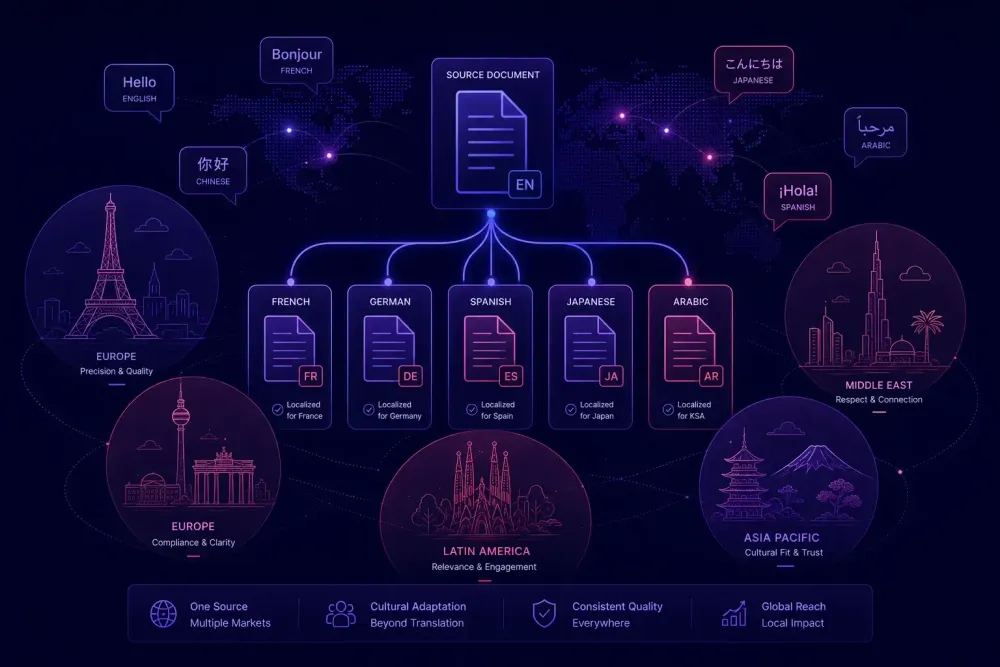
Marketing translation and localization are often used interchangeably. In casual conversation, that slippage is harmless enough. In project scoping, it creates real problems. Every few months, a client sends a brief asking to "translate this campaign into French" — and what they actually need is something closer to a market-specific content rebuild. The confusion between marketing translation and localization runs deep enough that we see it on almost every client intake. A translated tagline that falls flat in the target market. A web page that passed QA but never connected with the intended audience. Getting clear on the distinction before work starts is how you avoid most of those outcomes.
What marketing translation actually covers
Translation, in the strict sense, is the conversion of source text into a target language while preserving meaning. In marketing work, that definition is almost never sufficient on its own.
A translator working on a product brochure or an advertising headline is not just swapping words. They are making constant micro-decisions: does this idiom carry the same weight in the target language? Does this register match the brand voice? Would a native speaker read this as natural or as translated? Those decisions are part of translation work. The question is how far they extend before the project crosses into something that translation alone cannot handle.
Marketing translation sits on a spectrum. At one end: functional copy. Terms and conditions, product specifications, data sheets. Accuracy is the primary requirement; the style is constrained; cultural adaptation is minimal. At the other end: campaign slogans, brand manifestos, and social content where the source text is more of a brief than a fixed input. Most marketing copy lands somewhere between those poles — website copy, email sequences, advertising headlines, and landing pages that need to carry meaning accurately but also read as though they were written for the audience rather than about them.
A working definition that holds up in practice: marketing translation converts source content into a target language with appropriate adjustment for tone, idiom, and register, while keeping the structure and content intent of the original intact. The translator adapts, but the source document still governs what the output says and how it is organized.
This is the right approach when the brand voice in the source market transfers reasonably to the target market. Translating B2B software copy from English into German, Polish, or Dutch often stays in this category. The product is the same, the buyer has similar professional expectations, and the main job is producing accurate, natural-sounding copy. The translator does not need to reinvent what the content is. They need to make it feel at home in a new language.
The real scope of marketing localization
Localization goes further. Where translation asks "how do I say this in the target language?", localization asks "what does this content need to be in the target market?" That shift in question changes the shape of the entire project.
In a full localization effort for marketing content, the source document becomes a reference rather than a template. Dates, currency formats, and units of measurement change. Humor, cultural references, and analogies that feel natural in one market can be meaningless or awkward in another. Visual descriptions, color associations, and specific examples may need to be replaced entirely. Some content gets cut; new content may need to be written from scratch for the target market.
We have seen this play out clearly with SaaS clients entering multiple markets at once. One company wanted their marketing site converted into Brazilian Portuguese and Japanese. The Brazilian Portuguese project behaved like a translation job. The brand voice carried over, the B2B software context was familiar, and the changes were mostly tonal and idiomatic. The Japanese project was different. The company's direct, benefit-first copywriting — short punchy claims, outcome-focused headlines — ran up against Japanese business communication norms where indirect framing and context-setting tend to read as more credible than bold assertions. Several sections of the site needed to be restructured from the ground up, not just translated, to land correctly in that market.
That is the localization boundary. Once the project requires decisions about what the content should be, not just how to say it, you have moved beyond translation. The work is still language work. But the question driving it is different, and so is the deliverable.
Where the line falls in practice
The distinction matters practically because translation and localization require different resources, different timelines, and different expertise. A translator with strong marketing instincts can handle most marketing translation work competently. A localization project may need a native-market content strategist, a copy reviewer with real local market experience, and a project manager who understands the target culture well enough to flag when a translated draft is technically correct but contextually wrong.
Some places where this line shows up in marketing work:
Taglines and slogans almost always require localization, not translation. Source taglines are typically built on wordplay, rhythm, or cultural shorthand that breaks down in direct conversion. The advertising industry has produced a memorable collection of cases where a translated slogan became meaningless or awkward in the target market. Trying to translate a tagline word-for-word is a reliable path to a result that nobody wants to put in front of customers.
Product naming is another area where localization thinking is needed even when the task appears to be translation. A name that sounds clean and modern in English can carry different phonetic or lexical associations in another language. This is worth knowing before it appears on packaging or a homepage.
Legal disclaimers and terms and conditions typically stay in translation territory. Accuracy is the main requirement; the register is highly constrained; cultural adaptation is not the point.
Email marketing copy sits in the middle. Subject lines often require localization-level attention because they depend on tone, familiarity, and cultural timing. Body copy is frequently translation-appropriate when the brand voice is neutral and the offer is structured clearly.
Domain experience matters here too. A translator who has worked extensively in B2B marketing for a specific industry has very different instincts about where this line falls than a generalist would. For more on how domain expertise shapes translation scoping decisions, see our overview of domain specialization in translation.
When clients ask for translation but mean localization
Clients rarely use "translation" and "localization" the way translation professionals do. In our experience, a client who says "just translate the website" often means "make this work in our new market." A client asking for "full localization" sometimes wants careful translation with adapted idioms and nothing more. Neither is unreasonable; they just have not needed to think about the distinction before.
The way to surface the real scope is to ask about the content's purpose and the audience's expectations. A few questions that reliably clarify things at intake:
"Is the source content performing well in its existing market?" If yes, the client usually wants to reproduce something that already works. If not, they may actually need a content overhaul, which is a completely different deliverable from translation.
"Are there cultural references, humor, or idiomatic phrases in the source?" These are reliable markers that localization work is likely required, regardless of what the brief says.
"How much flexibility does the brand have in the target market?" A brand entering a new market for the first time has more room to adapt. A brand with an established local presence and existing voice expectations has less.
Brief intake is where most scope problems either get resolved or get baked in. A simple comparison of source content characteristics against target market context catches most mismatches before any translation work begins. When you see US cultural references paired with a formal European B2B audience, or brand-specific humor aimed at a conservative industry sector, that is a localization project. Pricing and timeline should reflect that from the start, not after the first round of revisions comes back with comments about tone and cultural fit.
Glossary management across both project types
One practical area where the translation/localization distinction creates real workflow differences is glossary management, and it is worth understanding before you brief anyone.
In standard marketing translation, a glossary of brand terms, product names, and approved translations covers most consistency requirements. The translator follows the list, and the output stays coherent across documents and across translators working in parallel. Clean and predictable.
In localization work, the glossary question gets more complicated. The question shifts from "what is the approved translation for this term?" to "does this term need to be adapted, replaced, or explained for the target market?" Some terms translate directly. Some need a local equivalent. Some do not exist in the target market at all and need workarounds or expanded explanations.
Translators with strong localization experience often push back on glossaries built with a pure translation mindset when the actual project requires localization. Following an approved list rigidly in those cases can produce copy that is technically consistent but locally wrong. That pushback is usually a good sign — it means the translator understands what the project actually needs, and that the glossary should be rebuilt for the target market rather than applied as-is.
The argument for building target-market glossaries on localization projects, rather than just translation glossaries: a translation glossary lists source terms and their target equivalents. A localization glossary adds usage notes, market-specific guidance, and flags for terms that require judgment calls. That extra layer pays back when you return to the same market across multiple campaigns or when multiple translators are briefed simultaneously. For a practical framework on how to structure and maintain glossary work across both project types, the complete guide to translation terminology management covers both the initial setup and the ongoing maintenance in detail.
How to scope and price the two differently
Pricing marketing translation and marketing localization at the same rate, and treating them as equivalent amounts of work, is one of the more reliable ways to lose money on a project.
Marketing translation can generally be scoped by word count with a per-word rate, adjusted for content formality and subject complexity. A website with 3,000 words of structured copy, an existing style guide, and a consistent brand voice is a predictable job. You can estimate hours, brief a translator, and hold the rate without much risk.
Localization requires a different model. Per-word pricing still applies to the translation component, but localization includes time that word counts do not capture: market research, cultural review, content strategy calls, copy adaptation beyond what translation covers, and revision cycles driven by market feedback rather than linguistic correction. Some agencies handle this with a two-phase structure: phase one is translation, priced per word; phase two is localization review and adaptation, priced at a project or hourly rate. Others apply a localization premium from the start, built into a higher effective word rate that accounts for the additional work.
Either model can work. The more important point is transparency. Clients who ask for "translation" need to understand when they are commissioning a localization project, because those are not the same deliverable. A translated website and a localized website do not carry the same business risk or the same potential upside when entering a new market. Being honest about the distinction, and about what you are actually delivering, builds more trust than absorbing the extra work into a flat rate and hoping it stays manageable.
This matters particularly in marketing work because the output is public-facing. A translation error in an internal document is an annoyance. A localization failure on a company homepage, or in a campaign that runs for three months in a new market, is a different kind of problem.
The one intake question that prevents scope creep
Before accepting any marketing brief, ask one question most agencies skip: does the source content need to be reproduced in the target market, or does it need to work in the target market? The first question points toward marketing translation. The second points toward localization. Those are different deliverables with different resource requirements, different timelines, and different risk profiles for both parties. Building that question into your intake process, and using the answers to set scope explicitly before work begins, will prevent more expensive conversations than any revision-round policy could.