Domain specialization in translation: how to match the right translator to the right project
Translation domain specialization determines quality outcomes more than language pair. A practical guide to matching translators by domain for agencies.
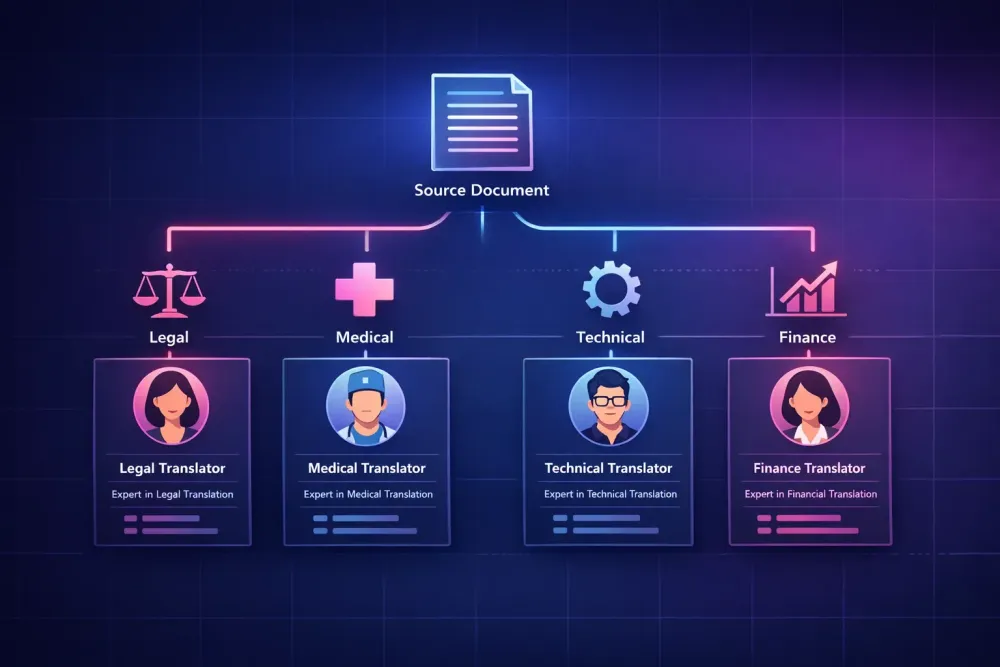
The question of which translator to assign to which project sounds like a logistics problem. It isn't — it's a quality problem. We've seen fluent, technically clean translations fail client review because the translator approached a medical device directive the way they'd approach a marketing brochure: accurate word by word, completely wrong in register and terminology. Translation domain specialization is the difference between a text that reads correctly and one that actually works in its professional context. What follows is how agencies and project managers can think about this systematically, rather than by feel.
Why domain matters more than language pair
Most translation buyers filter on language pair first: "I need French to English" or "I need a Russian technical translator." Language pair is a necessary filter. It's not sufficient. Within any language pair, the variance in output quality across domains is enormous.
A translator excellent at marketing copy may produce fluent, engaging French — and completely wrong terminology in a pharmaceutical regulatory submission. The word choice for a clinical trial protocol isn't arbitrary; it follows specific conventions that regulators expect to see. An experienced medical translator knows that "adverse event" and "adverse effect" are not interchangeable. A general translator may not even register the distinction as relevant.
This gap gets wider as technical depth increases. Legal translation involves not just terminology but structural reasoning: understanding the legal tradition of both source and target jurisdiction, recognizing when a legal concept has no direct equivalent, and making defensible translation choices rather than convenient ones. Financial translation requires familiarity with accounting standards and the specific conventions of financial reporting across markets. Technical manuals require understanding how mechanical or software processes actually work — not just what the words mean in isolation.
The practical implication for agencies: your linguist roster needs domain tags, not just language pairs. When you're assigning a medical device translation, the question isn't "who speaks German and English" — it's "who speaks German and English and has documented, sustained experience with medical devices specifically."
How to assess domain expertise in a translator
Credentials help but don't tell the full story. A translator with a medical degree who has spent five years translating general content is not necessarily the right choice for a clinical study report. Domain expertise in translation is built through sustained practice in that domain, not background knowledge alone.
When we evaluate domain expertise, a few things matter. First: does the translator reach for the right term without prompting, or do they use a plausible but non-standard equivalent? A short glossary test using a real excerpt from a document in your domain tells you more than a resume does. This is worth doing, not skipping.
Second: familiarity with the document types specific to the domain. Legal translators who have worked primarily on contracts may struggle with litigation filings that follow a different structural logic. Medical translators who know clinical trial protocols may not know pharmaceutical labeling conventions. Domain expertise often has sub-domain boundaries that matter more than people expect.
Third — and this applies particularly to agencies managing freelance rosters — track quality over time. Post-delivery QA reports for specific translators on specific domains tell you far more than any upfront assessment. If a translator consistently has terminology errors flagged in legal texts but produces clean output in technical documentation, that data is the signal. Use it.
Legal translation: where a word can change the outcome
Legal translation carries a level of consequence that most other domains don't. A poorly translated contract clause doesn't just read oddly — it may be unenforceable or mean something completely different in the target jurisdiction. Courts have ruled on contractual disputes based on translation ambiguities. That makes this domain one of the least forgiving for terminology errors or register mismatches.
Good legal translators understand that equivalence here is rarely word-to-word. Common law and civil law systems use different structural concepts for the same legal phenomena. "Consideration" in English contract law has no direct German equivalent — a translator has to make a defensible decision about how to handle that gap, and the decision affects legal interpretation. This requires not just bilingual fluency but legal reasoning in both systems.
Agencies handling legal translation should also think carefully about certification and verification requirements. Some jurisdictions require certified translations for court filings, contracts with public entities, or immigration documents. The translator's own sworn certification may not be sufficient; notarized verification may be required. These requirements vary enough across jurisdictions that a checklist specific to each target country is worth maintaining and keeping current.
Medical and pharmaceutical translation: terminology as compliance
Medical translation sits at the intersection of language and regulatory compliance. The terminology used in clinical trial documents, patient information leaflets, package inserts, and regulatory submissions isn't just convention — it's often specified by regulatory guidance. The European Medicines Agency and the FDA publish specific guidance on how certain concepts must be expressed. A translation that uses non-standard terminology in a regulatory submission can draw reviewer questions or require costly revision before approval.
For patient-facing documents — consent forms, patient information leaflets, medication guides — there's an additional layer: plain language. Regulatory bodies increasingly require that these documents be readable by someone with limited health literacy. That means a translator who can write clearly in plain language, not just translate accurately from technical source text. Those are different skills.
Medical translation also deals with rapidly evolving terminology. New treatments, diagnostic categories, and regulatory classifications generate new terms faster than any glossary can be updated. Translators working in this domain need to actively read the literature in their language pairs, not just reference existing glossaries.
Technical and engineering translation: accuracy over style
Technical translation — manuals, engineering specifications, software documentation — has a different quality profile than legal or medical work. The primary requirement is accuracy and consistency, not stylistic fluency. A reader using a maintenance manual to service industrial equipment needs correct procedure. Elegant prose is irrelevant.
This makes terminology management especially important in technical domains. The same component called different things across document versions creates dangerous inconsistency for anyone following the manual in a maintenance or repair context. Good technical translators and the agencies managing them invest heavily in termbases and translation memory for exactly this reason — consistency within and across documents is a safety issue, not a style preference.
The CAT tool and glossary workflow matters more in technical translation than in almost any other domain. A translator working with a well-maintained glossary and TM built from previous versions of the same document is starting from a structurally better position than one working from scratch on every project.
Building a domain-matched linguist roster
For agencies, the practical challenge is maintaining a roster that covers the domains you actually work in without over-extending into areas where you can't genuinely vouch for quality. Generalist claims on a roster don't help when a client needs legal translation reviewed by someone who knows the difference between a covenant and a condition in English contract law.
A manageable approach: define the domains you want to serve seriously, build depth of at least two or three vetted translators per domain per language pair, and document their specific experience in a way that makes assignment decisions visible and defensible. When a project arrives, the domain tag drives the assignment decision — not familiarity or availability alone.
QA processes should also be domain-sensitive. The error categories that matter in legal translation are different from those that matter in marketing content. A quality assurance checklist not calibrated to domain will miss the specific errors that cost you client trust. Our guide to translation quality assurance covers how to build those processes.
Long-term outcome tracking is the only honest signal
Whatever process you build for domain matching, systematic tracking of outcomes is the most useful thing you can do. Which translator, in which domain, produced how many revision requests? Where did QA reports flag terminology issues, and in what pattern? That data, accumulated across months and projects, tells you which parts of your roster are actually reliable by domain — and where you have a gap that needs to be filled.
This doesn't require complex tooling. A spreadsheet with project type, translator, language pair, post-delivery revision count, and QA flags gives you the pattern over time. The agencies with the clearest picture of their roster quality by domain are, in our experience, the ones doing this consistently and using the data to drive assignment decisions. Intuition and familiarity are not substitutes for outcome data, and this is an area where the substitution is expensive.