Machine translation vs human translation: when each one actually wins
Machine translation vs human translation: when MT wins, when human is non-negotiable, and how to decide what a specific project actually needs.
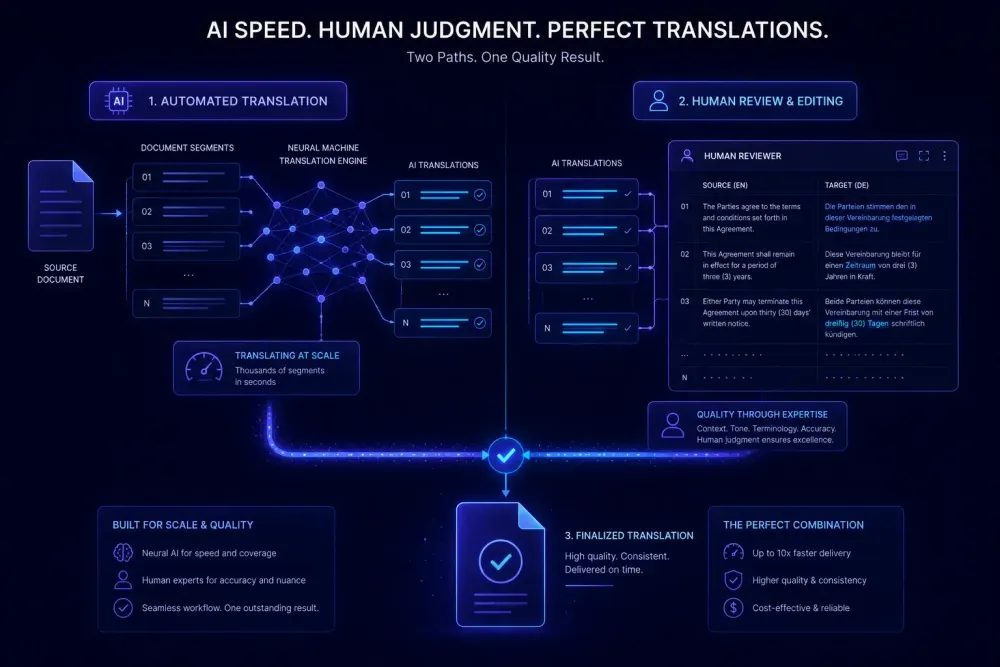
The comparison between machine translation vs human translation has changed more in the past three years than in the previous decade, and a lot of published advice hasn't caught up. Much of what circulates — "use MT for volume, humans for quality" — is too blunt to be useful when you're actually making a project decision. MT quality varies enormously by engine, language pair, content type, and configuration. "Human translation" covers everything from a rushed freelancer working without a glossary to a senior specialist with fifteen years of domain experience. The real question is which combination of tools and human expertise gets you the right output for this specific project, at acceptable cost, within your deadline.
What machine translation actually delivers in 2026
The neural MT era didn't start with large language models, but LLMs have shifted expectations considerably. Today's MT ecosystem includes several distinct technologies that behave very differently. Neural MT engines like DeepL work segment by segment, optimizing each sentence for fluency and accuracy but often losing cross-sentence consistency. LLM-based document translation processes longer chunks, handles discourse-level patterns better, and adapts to register more readily. The difference matters when you're choosing what to use for a given project.
For high-resource European language pairs — Spanish, French, German, Dutch, Portuguese — modern MT is genuinely capable. Not perfect, but capable enough that post-editing effort per 1,000 words has dropped measurably over the past few years. For lower-resource pairs, structurally distant combinations like English to Japanese or Arabic to German, and content with high cultural density, the gap with human translation remains substantial.
What agencies consistently underestimate is how much MT quality depends on configuration. A domain-specific glossary integrated into the translation workflow, a style guide the system is asked to follow, and consistent document structure all push output quality significantly higher. Raw MT from a generic public interface is not representative of what a properly configured workflow produces.
One factor that gets overlooked: MT quality also depends on how much context the system receives. A standalone sentence containing the word "bank" can be translated several ways. The same sentence inside a financial services document, with a glossary defining "bank" as a financial institution, will be translated correctly every time. This is why MT quality should be measured in context, not by feeding isolated segments to a generic engine and evaluating the output.
MT is also better than humans at specific things: consistency across a long document, exact terminology matching from a controlled glossary, and eliminating variation in repeated phrases. A human translator can drift on terminology over the course of a 100-page manual. A configured MT system won't.
Where human translation has no real substitute
Some content categories fail with MT consistently enough that the question isn't whether to use human translation, but which translators and at what level of review.
Marketing and brand copy is the clearest case. Taglines, product descriptions with a specific voice, campaign copy — these require cultural adaptation, not just linguistic conversion. A technically accurate sentence in French can read as awkward or tone-deaf if it's missing the cadence the audience expects. MT engines don't have this intuition. We've seen cases where MT produced translation that parsed correctly but landed wrong — the rhythm was off, a pun didn't carry over, the formality level was subtly mismatched. These are exactly the errors that damage brand perception, and they're the ones editors often miss because they're scanning for mistakes rather than listening for resonance.
Legal and regulatory documents are a different kind of requirement. Contracts, compliance filings, sworn translations — errors here have real consequences. A mistranslation in a contract clause can affect its interpretation or enforceability. Certified translations typically require a human translator to attach their name and professional credentials to the work. MT can't do that.
Medical content is where the stakes argument becomes obvious. Drug labels, informed consent documents, clinical trial materials — the regulatory frameworks governing these require human accountability. Beyond the regulatory requirements, the risk of patient harm from an undetected MT error makes comprehensive human review non-negotiable for anything that reaches a patient.
Content where tone is itself the message also tends to fail. Humor, irony, politically sensitive material, any text that depends heavily on what's not being said — MT systems have no reliable model for these. They translate what's written, not what's meant.
The practical test: if post-editing the MT output would require a domain expert to review every sentence anyway, the MT step may have added time and cost without reducing effort. This doesn't apply if expert review was going to happen regardless — in that case, MT as a first pass can still speed things up on the straightforward segments.
What MT is genuinely the better choice for
Rather than treating MT as a fallback for when budget runs out, there are project types where MT plus a defined review step consistently delivers better results than human-from-scratch on the combined measure of cost, speed, and output quality.
High-volume internal content is the strongest case. HR announcements, internal operational documents, knowledge bases, inter-office communications — content that employees need to understand but that carries no external legal, regulatory, or reputational risk. Full human translation here is rarely justified by the stakes involved.
Technical documentation with significant repetition is another strong fit. Product manuals, API documentation, software help text — these have high segment overlap within and across documents. When a CAT tool has captured translation memory from previous projects, MT on new content needs a much lighter post-editing pass because the consistent segments are already confirmed. According to CSA Research's industry surveys, agencies report the most efficient MT workflows in this combination: technical content with a well-maintained translation memory and strong glossary coverage. The time saved on repeated segments allows human reviewers to focus on genuinely new or technically complex content.
Time-sensitive requests at scale are where MT often becomes unavoidable. If a client needs 80,000 words localized in 48 hours for a product launch, human-only workflows can't staff that quickly even with the budget to try. MT plus a structured light post-editing pass, with editors focused on terminology and the most visible content, is sometimes the only viable path. The output won't be as polished as human-from-scratch — but it will meet the timeline.
Understanding the gist of foreign-language documents before committing to a full translation is a lower-profile but common use case in both agency and corporate workflows. MT quality for this purpose is almost always sufficient, and paying for a full human translation before a client has decided whether they need one is hard to justify.
MTPE as the practical middle ground
For many real projects, the most accurate answer to "MT or human?" is both, in sequence. Machine translation post-editing (MTPE) starts with MT output and has a human editor review and correct it to a defined quality standard. The result is typically faster than human-from-scratch and more reliable than raw MT.
MTPE comes in two distinct levels, and picking the wrong one is a recurring mistake.
Light post-editing targets minimum acceptable quality. The editor fixes outright errors, terminology mismatches against the project glossary, and anything that would confuse the reader, without rewriting fluent sentences. This works when MT output is already close to acceptable — which tends to be true for well-resourced language pairs on technical content with solid glossary coverage.
Full post-editing targets output quality equivalent to human-from-scratch. Editors rework any segment that needs it, verify consistency throughout the document, and apply the style guide. This takes longer than light MTPE but still produces output faster than starting from scratch on most project types where the underlying MT quality is reasonable.
The trap: if MT quality is low (wrong engine, mismatched language pair, content type without enough training data), full post-editing can take longer than translating from scratch. We've seen projects where agencies chose MT to reduce costs and ended up paying more in post-editing time than they would have spent on direct human translation. The calculation only works when the starting MT quality is genuinely good. Running a representative sample through the pipeline and measuring the editing effort before committing the full batch takes a few hours and is worth every one of them.
This breakdown of MTPE vs human translation goes into more depth on how to make that call at the project level.
Deciding between machine translation vs human translation: questions that matter
The useful question isn't "MT or human?" in the abstract. It's a set of more specific questions asked before any particular project starts.
What's the risk of an error in this content? Legal, medical, and compliance content has high error stakes. An MT error in a contract can affect clause interpretation. An MT error in a drug label creates a liability. For high-risk content, human review of every translated segment is required regardless of what the MT output looks like at the document level.
Who is the end reader, and what standard will they apply? A reader using a document for internal decision-making will tolerate more imperfection than a native speaker encountering brand copy for the first time. These are different bars, and conflating them leads to either overspending on internal content or cutting corners on customer-facing material.
How much repetition does the content contain? Technical documentation with high segment overlap, controlled terminology, and consistent structure is MT-friendly. Narrative content and creative writing, where each sentence is doing something slightly different, benefits much less from MT as a starting point.
Is your MT setup actually configured for this content type? A generic MT engine without glossary integration, domain prompting, or QA checks is a different tool from a configured MT workflow. Comparing human translation to generic MT output is not a fair test of what MT can do when properly set up. This look at AI translation accuracy in 2026 gives useful baseline numbers across different language pairs and content types.
Do you have quality data from previous similar projects? If the decision is based on intuition rather than measured post-editing effort and error rates, you'll eventually be surprised. Agencies that track MTPE effort per project type, per language pair, and per content category build the most useful decision support over time.
What the agencies getting this right actually do differently
The agencies that handle MT decisions well have a few things in common.
They don't apply one blanket MT policy across everything. The ones with the most reliable results have explicit policies — based on actual quality data from completed projects — about which content types and language pairs go through MT-first workflows. They update those policies when the data says they should.
Before committing a full project to MT, they run a sample first. Five hundred words through the pipeline, a quick look at the actual post-editing effort. This matters especially with a new language pair, a new engine, or a content type the team hasn't run through MT before. It takes a few hours. The alternative is discovering the problem at batch three of ten.
MT configuration is part of project setup, not an afterthought. Domain glossaries, terminology constraints, translation instructions that specify the target register and audience — these aren't optional extras. Generic MT produces generic output.
Post-editor skills get specific attention. MTPE requires a different mode than translating from scratch. Post-editors need to evaluate what's already there and decide what needs fixing — which means resisting both the urge to rewrite everything and the equally problematic urge to approve segments without reading carefully. Teams that track post-editor throughput separately from translator throughput tend to see where the MTPE workflow is paying off and where it isn't.
When a project goes poorly — MT quality issues, post-editing overruns, client complaint — the better agencies trace it back to the decision made at the start and update the policy for that content type and language pair. MT decision-making gets better through feedback, not through general rules applied once and forgotten.
The machine translation vs human translation question doesn't have a universal answer. But for any specific project type, with consistent data from your own workflows, the right call stops being a guess.