How accurate is AI translation in 2026? An honest look at the numbers
How accurate is AI translation in 2026? Real benchmarks, language pair gaps, domain limits, and practical ways to measure quality in your workflow.
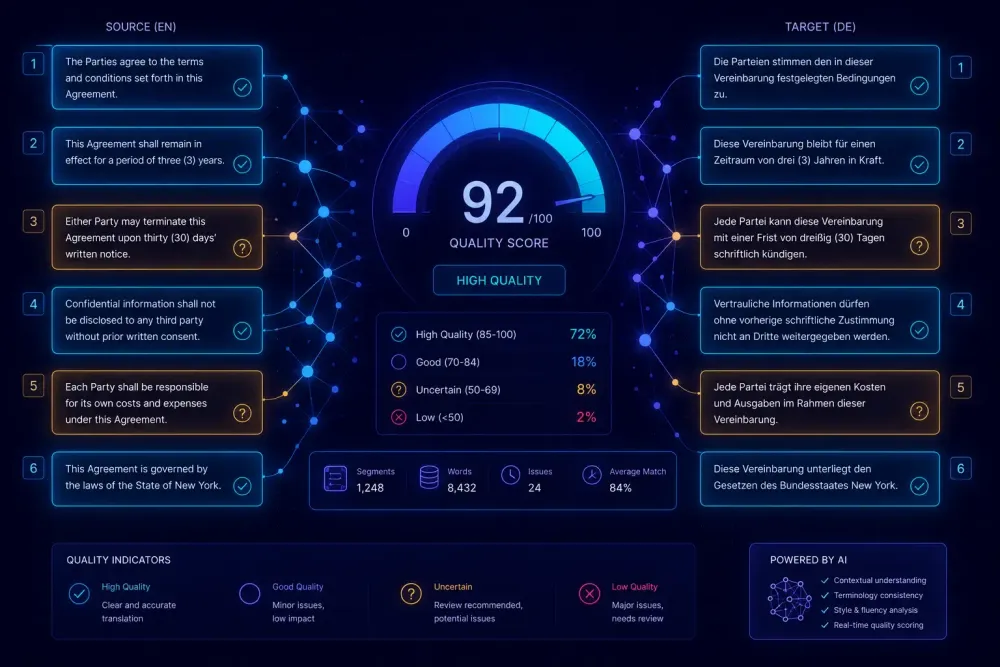
Every few months, a headline appears claiming AI translation has achieved human parity. We've watched this cycle repeat for a few years now, and we've also watched clients receive documents that read fluently but failed a bilingual accuracy review in ways that weren't obvious at first glance. The question of how accurate is AI translation doesn't get a single clean answer — it depends on the language pair, the domain, the document type, and how the job was prepared. Here's what the research actually shows, and where it stops being useful.
How accurate is AI translation: what the benchmarks actually show
The standard measure of machine translation quality in professional and research circles is the COMET score, developed at the University of Lisbon in collaboration with Unbabel. Unlike the older BLEU metric — which counted overlapping word sequences — COMET compares outputs against human references using learned sentence embeddings, making it far more sensitive to meaning alongside fluency.
At the annual WMT shared task (Workshop on Machine Translation), the most widely cited public benchmark for MT research, modern large language models reach COMET scores in the 85–92 range for well-resourced European language pairs translating out of English. At that level, top systems approach what professional human translators score on the same test sets when evaluated blindly.
The improvement is real. The models have gotten meaningfully better, and for straightforward content in the best-served language pairs, the quality gap between AI and professional human translation has narrowed in ways that affect how agencies can staff and price projects.
The benchmark fine print, though: WMT test sets draw from news domain text. Sentences are short, clean, and largely unambiguous. Parallel training data for pairs like English-Spanish or English-French runs into tens of billions of aligned sentence pairs. These are close to ideal conditions. The moment you move to legal contracts, technical manuals, or formatted DOCX files with footnotes and cross-references, you're no longer operating under benchmark conditions — and the score stops predicting what you'll actually get.
We've run AI translation on client documents where segment-by-segment quality appeared strong but the full document accumulated terminology inconsistencies and register shifts that required substantial post-editing. Benchmarks measure local correctness. Production documents require global consistency.
What the benchmarks miss about document translation
COMET and BLEU are both segment-level metrics. They score each sentence independently and average the result. Neither captures whether a translation stays consistent across a full document, whether a pronoun resolves correctly 15 lines later, or whether a technical term introduced on page 3 gets rendered the same way when it reappears on page 47.
Nimdzi's research on AI translation production workflows has documented that when agencies move from segment-level automated evaluation to document-level human review, error rates typically increase substantially — particularly for terminology consistency and cross-reference accuracy. That gap explains most of the frustration teams experience when they try AI translation without a preparation step.
One agency we worked with was translating a 70-page medical device installation manual, English to Polish. The AI output scored well on individual segments — fluency was high, obvious mistakes were absent. A full bilingual review against the client's glossary found 31 instances where the same English source term had been rendered as two different Polish equivalents in different sections of the document. Neither was wrong in isolation. The problem was inconsistency across 70 pages, which the AI had no mechanism to enforce without an approved glossary.
This type of error is entirely preventable. When you supply a pre-approved glossary covering your 150–200 most critical domain terms and pair it with a domain-specific translation prompt, consistency problems like these drop sharply. Without that preparation, you're relying on the model's in-context inference at document scale — and that's not reliable enough for professional delivery.
Language pair matters more than the AI model you pick
Of all the factors that affect AI translation accuracy in production, language pair has the most predictable influence. This is primarily a function of training data volume.
Models have been trained on hundreds of billions of sentence pairs for the most common European pairs — English-Spanish, English-French, English-German, English-Portuguese. For these pairs, AI translation of standard business documents can reach a level where post-editing focuses on style and register rather than correcting meaning. That's a workflow gain that changes how you can scope and price translation projects.
For mid-resource pairs like English to Finnish, Czech, Hungarian, or Ukrainian, the picture is more mixed. Output fluency tends to hold up, which is actually part of the problem — a fluent-sounding translation that's off by one degree can slip past a quick read. Slator's production data tracking consistently shows that post-editing time for mid-resource pairs runs significantly higher than for high-resource pairs, even on the same translation system.
For low-resource pairs, AI output can still be useful as a first draft, but it needs to be positioned that way — to the client and to the post-editor. Agencies that have set this expectation explicitly report fewer revision disputes than those that promised near-complete output without qualifying which language pair they were working in.
For any pair outside the best-resourced 10–15, budget for a full machine translation post-editing (MTPE) workflow rather than a light review. Our practical guide to efficient post-editing covers what that workflow looks like when you're actually doing it.
Domain specificity and the terminology problem
Even within high-resource language pairs, accuracy drops when the subject matter becomes specialized. Legal, medical, financial, and technical documents depend on controlled vocabulary where a single wrong term can change the meaning of a clause, a dosage, or a contractual obligation.
An AI system trained on general text and news will produce plausible-sounding output on specialized documents, but plausible-sounding and accurate aren't the same thing. CSA Research has documented that domain expertise gaps are sharpest in fields where terminology is governed by regulatory requirements — clinical trials documents, legal instruments, financial prospectuses — because the model must simultaneously get the terminology right and use the register appropriate for that document type in that jurisdiction.
The most common failure pattern in specialized text is false fluency: the translation reads well, doesn't flag obviously as wrong, but a reviewer with domain knowledge catches a term that's one degree off from the correct standard translation. In a product manual, that's a style issue. In a clinical protocol, it can be a regulatory one.
The correction here isn't a better AI model. It's better job preparation. A domain glossary of 100–200 critical terms, combined with a prompt that specifies the regulatory framework, target audience, and expected output register, makes a measurable difference to accuracy on specialized text. This doesn't take hours to set up — but it has to happen before the translation job runs, not after reviewing the output.
This also changes how you approach projects where no existing reference glossary exists. If a client sends you a highly technical document in a domain you haven't worked in before, building even a basic glossary from their reference materials before running AI translation is worth the time. The alternative is discovering inconsistencies at the delivery stage.
How to actually measure AI translation quality in your workflow
If your evaluation method is reading the translated document and deciding it sounds reasonable, you're measuring fluency, not accuracy. These aren't the same thing, and treating them as equivalent leads to quality problems that only surface at delivery.
A useful accuracy check has three distinct layers. First, run a bilingual source/target comparison using a neutral spreadsheet export — read source and target side by side at the sentence level, not just the translated document on its own. You'll catch meaning errors that a fluency read misses entirely. Second, spot-check terminology: take 30–50 terms from your domain glossary and verify that each was used correctly in context, not just that it appears somewhere in the document. Third, for any project where errors carry real consequences, back-translate a representative sample. Back-translation isn't foolproof — meaning errors that survive the round trip won't surface — but it reliably catches gross accuracy failures that other checks miss.
Automated QA tools run parallel checks for number consistency, glossary violations, missing translations, and tag errors. We went through the main options in our review of the best translation QA tools in 2026. These tools don't produce an overall quality score, but they catch specific error types that human reviewers miss on a first pass — especially on long documents reviewed after several hours of work.
For teams that want a replicable accuracy baseline to compare tools or providers, the FLORES+ dataset from Meta AI is publicly available and lets you run standardized evaluations on your own conditions.
What accuracy limits mean for scoping and pricing
Understanding where AI translation accuracy holds and where it falls apart changes how you scope work and what you tell clients.
For standard business documents in high-resource language pairs with a proper glossary and domain-specific prompt, AI translation plus professional post-editing is a genuinely efficient workflow. The post-editor handles consistency and register, not reconstruction. You can price this as light MTPE and actually deliver on it.
For legal, medical, or certified translation, AI output needs accuracy-level review, not just style review. The time saved on the initial translation is real, but the review step can't be compressed to match light MTPE economics. Agencies that have priced the review correctly report sustainable margins. Those that haven't have absorbed revision hours they didn't budget for.
For low-resource language pairs or specialized text without an existing reference glossary, AI translation is still worth running as a starting point — but communicate this clearly to clients: the value is helping the translator work faster, not replacing their domain judgment.
If you need a structured AI translation step with built-in preparation — domain analysis, glossary review, and prompt approval before the job runs — SnapIntel handles DOCX and XLSX documents and returns a QA report with per-segment quality ratings rather than a single aggregate score. That's more useful when you're deciding how much post-editing a specific document actually needs.
Treat pilots as infrastructure
The most reliable way to understand AI translation accuracy for your specific work is to run a controlled pilot on a representative 500–1000 word sample before committing a new project type, domain, or language pair to a production workflow. Evaluate the output with a bilingual side-by-side comparison, check it against your glossary, and record the post-editing time.
If you work with post-editors regularly, ask them directly: how long did reviewing this output take versus what you expected? Post-editing time is one of the most honest proxies for real translation quality — more honest than reading the target text and deciding it sounds fluent.
Published benchmarks reflect near-ideal test conditions. Your production conditions aren't ideal, and the gap between the two is different for every language pair, domain, and document type you work with. The pilot is how you find out where that gap actually sits.