LLM translation vs neural machine translation: which is better for business documents in 2026
LLM vs neural machine translation for business documents: where each one wins on DOCX and XLSX files, how they fail differently, and how to choose per job.
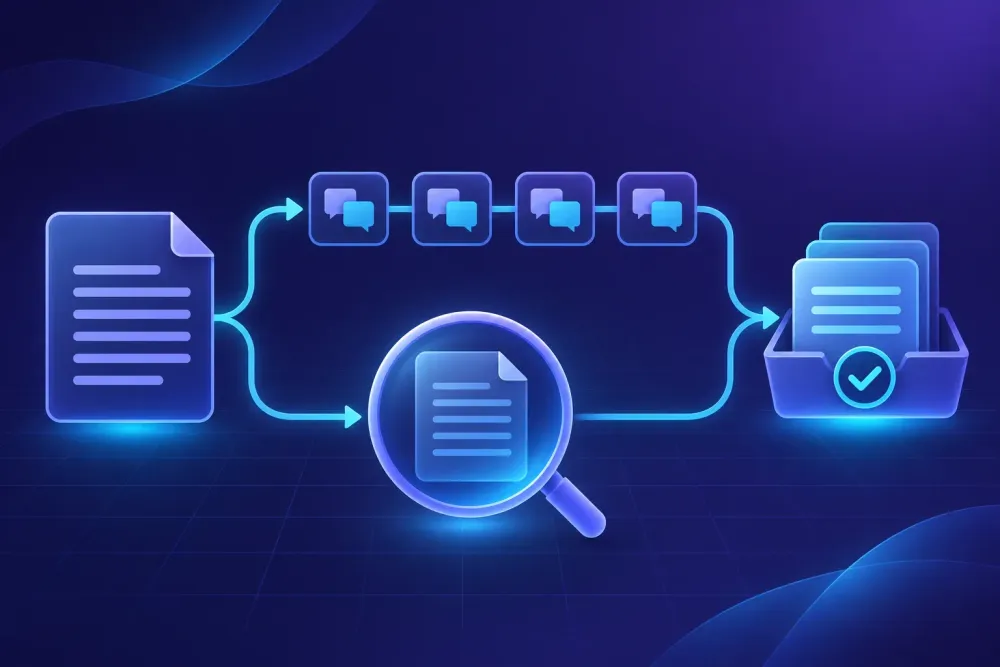
Ask ten translation buyers what engine sits behind their document translation and most of them cannot tell you. The llm vs neural machine translation question has become the one that decides whether a 40-page supplier manual comes back usable or comes back needing two days of repair, and almost nobody is asked to choose. The tool picks for you. We think that is the wrong way round, because the two technologies fail in opposite directions, and the file on your desk usually makes the choice obvious once you know what you are looking at.
What the llm vs neural machine translation difference comes down to
Neural machine translation, the technology behind Google Translate, DeepL and the MT engines plugged into every CAT tool, is trained to do one thing: take a source segment and produce the target segment. One sentence in, one sentence out. It is very good at that. It is also structurally blind to everything outside the segment it is working on, which is why a sentence containing "the unit" has no way of knowing whether the unit in question is a pump, a department or a rental apartment.
Large language models work differently. They are general text predictors that happen to translate well, and they can hold a large amount of surrounding text in context while they do it. A model can read the previous twelve paragraphs, your glossary, and an instruction telling it the document is a maintenance manual for industrial pumps, then produce a sentence that fits all of that.
The gap is narrower than the marketing suggests. In the WMT general translation task, the annual benchmark run by the Conference on Machine Translation, LLM-based systems have been ranking at or near the top for high-resource pairs since 2023, and the specialised NMT systems are still right there with them. On a single clean sentence of ordinary business prose, English into German, you would struggle to pick which output came from which. The difference shows up in the places document translation actually lives: terminology that has to hold across 60 pages, cells with two words in them, headers that repeat 40 times, and instructions the engine is supposed to follow.
One more thing muddies the comparison: a lot of what gets sold as LLM translation in 2026 is a chain rather than a single engine. NMT produces a first pass, an LLM edits it with context and a glossary, and sometimes a second model scores the result. Slator and Nimdzi have both tracked language service providers moving in this direction, and it means the question you are asking a vendor is often not which technology they use but how many passes your text goes through and what each pass is allowed to change. Ask that. The answer tells you more about your output than the engine name does.
So the useful framing is not which technology is better. It is which one degrades in a way you can live with on this document, this week.
Where neural machine translation still wins on business documents
Start with speed and cost. NMT engines are small, specialised and cheap to run. For a high-volume register, a parts list, a product catalogue in XLSX with 14,000 short cells, an NMT engine will finish in a fraction of the time and a fraction of the spend of an LLM making 14,000 context-rich calls. We have watched agencies try to move everything to LLM translation and quietly move the bulk formats back.
Second, and underrated: NMT is repeatable. Run the same segment through the same NMT engine twice and you get the same string. That matters more than it sounds. If a product name appears in 300 cells, you want those 300 cells identical, and you want next month's update to match last month's file. LLM sampling introduces variation, and even with temperature pinned low you can get two renderings of the same short header in one run. Repeatability is also what makes a translation memory worth reusing. A TM built from NMT output is internally consistent in a way that an LLM-built TM often is not, which means the saving you booked on a 40 percent repetition rate is real rather than theoretical.
NMT is also conservative. It rarely adds text that was not in the source. For a short string in a user interface, a column header, a form label, a legal boilerplate line, conservative is exactly what you want. An LLM asked to translate the cell "Qty" will sometimes decide you meant "Quantity ordered" and help you out.
Latency is the quiet one. If your translators work in a CAT tool and expect a suggestion the moment the cursor lands in a segment, NMT delivers it in well under a second and an LLM with a filled context window does not. For interactive pre-translation inside an editor, that gap decides whether people use the suggestion or stop looking at it.
The limits of this are real. NMT gets worse the further the content sits from the newswire and parliamentary text it was trained on, and it has no mechanism to follow an instruction. You cannot tell a classical NMT engine to use the formal register, keep brand names untranslated, or prefer your client's term over the dictionary one. You can only post-edit afterwards. For some document types that is the cheaper trade. For others it is the whole problem.
Where LLM translation pulls ahead
Document-level context is the honest differentiator. An LLM can see that paragraph 3 defined "the Agreement" as a specific contract and keep that reference straight 20 pages later. It can carry a decision about how to render a job title through an entire employee handbook. NMT translates page 20 as though pages 1 to 19 do not exist, because for it they do not.
Then there is instruction-following, which is the part that changed professional AI translation workflows more than raw quality did. You can hand an LLM a glossary of 200 terms and say use these, prefer Latin American Spanish, keep measurement units in metric with the imperial value in brackets, do not translate anything inside double braces. It will mostly do that. Mostly is doing real work in that sentence, and we will come back to it, but a 70 to 95 percent hit rate on instructions you could not previously express at all is a different kind of workflow. Our own notes on how to make AI translation actually follow your glossary go into what makes that rate go up.
Ambiguity and register come next. Marketing copy, internal comms, anything where the source is loose or idiomatic, is where NMT produces the technically-correct-but-wrong output that reviewers hate. "We're looking at a tight Q3" is not a statement about eyesight. An LLM with the document type in context tends to get this right; an NMT engine has nothing to reason with.
The one that surprises people: LLMs cope better with a damaged source. Documents that arrived as scanned PDFs, were OCR'd, and now contain broken line breaks mid-sentence are the normal case in corporate translation, not the exception. NMT translates the fragment it is given, so a sentence split across three segments comes back as three unrelated clauses. An LLM reading the surrounding text can often reassemble the intent. This is also where it is most likely to invent something, so the benefit comes with a review cost attached.
Where LLMs are weaker than people expect: low-resource languages, where a specialised NMT engine trained on the pair often still beats a general model, and very long documents, where context windows fill up and the model starts losing track of decisions it made earlier. The second problem is managed with chunking and retrieval rather than solved.
Two documents that went opposite ways
A 60-page equipment manual, English into German
The source used "the unit" throughout, defined once on page 4 as a specific pump assembly. NMT translated it as "die Einheit" everywhere, which is not wrong in a dictionary and is wrong in a German maintenance manual, where the reader expects "die Pumpeneinheit" or the product designation. The source also used an abbreviation introduced on page 7 and then used bare for the rest of the document. NMT rendered it inconsistently across chapters because each segment was a fresh decision.
The LLM run, with the first ten pages as context and a short glossary, held both the term and the abbreviation across the document. The post-editing time difference was not small. Roughly four hours of terminology repair against about 50 minutes of ordinary review.
A pricing workbook in XLSX, English into French
Eleven sheets, around 9,000 cells, most of them one to four words: product codes, units, column headers, short spec values. Here the LLM was the worse choice on two counts. It expanded short strings into explanatory phrases, so "Unit" became "Unité de mesure" in some rows and "Unité" in others, which broke the column. And the same header text in different sheets came back in two forms, because each chunk was an independent generation.
The NMT run was boring and consistent, which is what a price list needs. We ran a glossary pass over the 60 or so recurring strings afterwards and the file was done in under an hour. The lesson we took: cell-level content with no surrounding sentence gives an LLM nothing to use its advantage on, and plenty of room to improvise.
The failure modes are different, so the review has to be different
If you only remember one thing from the llm vs neural machine translation comparison, make it this: the two technologies break in ways that need different checks, and most QA processes were designed for only one of them.
NMT fails loudly and consistently. The error is usually a wrong word choice, a mishandled negation, or a term rendered the same wrong way everywhere. It is visible to a reviewer reading the target, and because it repeats, finding one instance finds all of them. Search and replace works.
LLM failures are quieter. Three recur often enough that we check for them every time. Omission: a sentence, a table row, or a whole bullet list disappears, and the output reads perfectly because the model produced fluent text around the gap. Drift: the model renders a term one way for 30 pages and another way for the last ten. Invention: a plausible sentence that was never in the source, usually in a spot where the source was fragmentary or badly OCR'd.
None of these are caught by reading the target text and asking whether it sounds right. They are caught by comparison. Segment count against the source, a check for untranslated or dropped content, and a terminology consistency pass across the whole document rather than per chapter. A step-by-step QA checklist for AI-translated documents is more useful here than any amount of fluency review, precisely because fluency is the thing LLM output is never short of.
One more asymmetry: an LLM failure is harder to explain to a client. "The engine chose the wrong word" is a conversation people understand. "The engine invented a sentence that was not in your document" is a conversation that costs you trust.
How to choose per document instead of per tool
The decision is usually made by file shape, not by language pair. Our working rule, which has held up across enough projects that we now treat it as a default:
Long-form prose with running context, manuals, reports, contracts, handbooks, training material, goes to LLM translation with a glossary and a document-type instruction. The context advantage is worth the cost and the extra QA.
Short-string and high-repetition content, price lists, parts registers, UI strings, spreadsheet cells with no sentence around them, goes to NMT, with a glossary or find-and-replace pass over the recurring terms. Repeatability beats reasoning when there is nothing to reason about.
Low-resource pairs: test both on a real 500-word sample before committing. The general assumption that LLMs win does not hold reliably below a certain volume of training data for the pair.
Recurring monthly documents where consistency with last month's file matters: whichever engine you used last month, unless you are prepared to re-translate the whole series. This one catches people. Switching engines mid-series makes every update look like a quality regression.
And the case for running both: on documents where the stakes justify it, translating with both and comparing is cheap relative to a bad delivery. Disagreement between the two outputs is a good error detector. Where NMT and an LLM independently produce the same rendering, you can usually stop looking. Where they diverge, that is where your reviewer's time should go.
Where to start this week
Take one document type you translate repeatedly, the one that generates the most post-editing complaints, and run a 1,000-word extract through both an NMT engine and an LLM with your glossary attached. Time the post-editing on each, and count three things in the LLM output specifically: dropped segments, terms that changed partway through, and sentences present in the target that are not in the source.
That gives you a number for one document type, which is worth more than a general answer to the llm vs neural machine translation question. Repeat it for your second-biggest document type next month. After three of these you will have a routing rule based on your own files rather than on anyone's benchmark, and you will know which of your documents were quietly going to the wrong engine all along.