Legal translation: how to maintain accuracy when the stakes are high
Legal translation accuracy demands more than fluency. Learn how to manage terminology, QA, and client expectations in high-stakes legal projects.
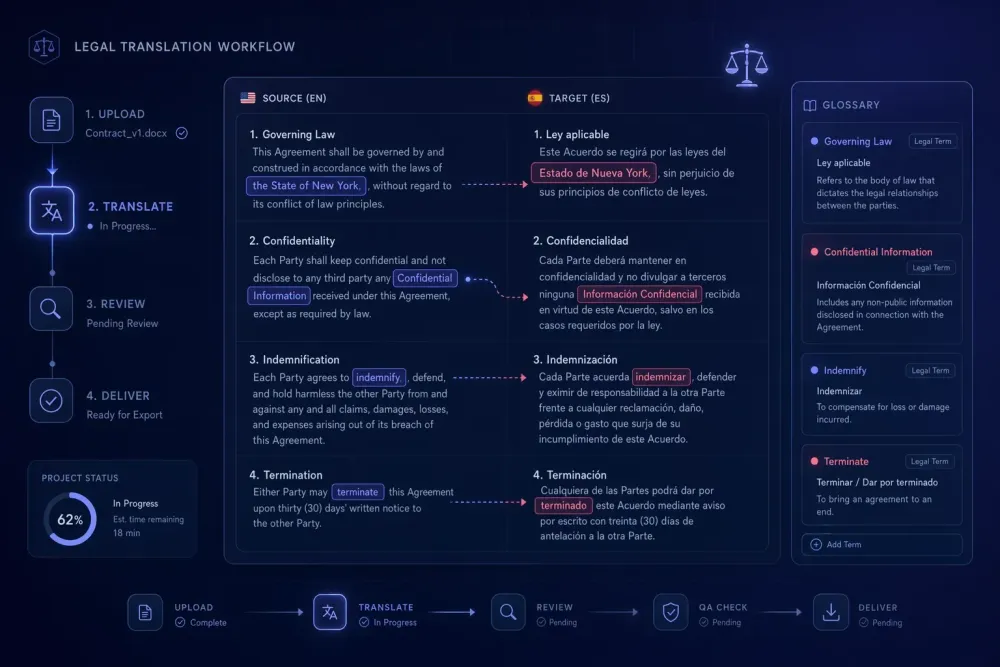
Legal translation accuracy is not just a quality benchmark — it is a professional obligation. A mistranslated clause in a contract, an ambiguous term in a court filing, or a wrong equivalence in a regulatory submission can have consequences that go far beyond a revision request. We’ve worked with agencies and translators who treat accuracy in this domain differently from how they approach any other content type, and they’re right to do so. Legal text carries weight in a way that a marketing brochure never does, and the workflows that produce it need to reflect that.
Why legal translation is different from other domains
Most translation work involves a trade-off between speed, cost, and quality. Legal document translation shifts that balance significantly. The cost of an error in a contract or a court document isn’t measured in client satisfaction: it can mean voided agreements, failed submissions, or liability exposure for the client and, in some jurisdictions, for the translator as well.
The difference starts with text structure. Legal documents are dense with defined terms, cross-references, and dependent clauses. A phrase like "subject to" or "notwithstanding the foregoing" carries precise legal meaning that differs from its plain-language reading. The source text is often deliberately rigid: courts and regulatory bodies use this rigidity as a feature. Your translation has to preserve that rigidity even when it produces awkward target-language text.
There’s also the document type question. Contracts, court orders, regulatory filings, patent claims, and notarial certificates all have their own conventions and terminology norms. What holds for a US securities filing doesn’t apply to a French notarial deed. Translators who work across multiple legal systems without specializing in both tend to produce technically fluent but jurisdictionally inaccurate results.
We’ve seen agencies assign legal documents to their best general translators and get passable output that failed the moment a lawyer reviewed it, not because the translator was careless, but because legal translation requires domain knowledge that goes beyond language competence. Fluency and legal literacy are different things.
The terminology problem: why legal terms don’t translate cleanly
Legal translation accuracy problems are usually terminology problems in disguise. The challenge is that legal systems are jurisdiction-specific. Common law and civil law traditions use different conceptual frameworks, and many legal concepts in one system have no direct equivalent in another.
Take the English term "trust," a legal structure central to common law jurisdictions. Civil law systems have no direct equivalent, and translating "trust" into French, Spanish, or German requires either a loan word, a functional equivalent, or a descriptive phrase. Each choice has implications for how the translated document will be interpreted.
The same issue appears at the contract level. "Representations and warranties" as a phrase in English-language M&A documents gets split into "représentations" and "garanties" in French, but the legal interpretation of each term differs between the two systems. A translator who maps mechanically without understanding this produces text that reads correctly but means something different to a French lawyer reading it.
This is one reason why relying on a generic translation memory can be dangerous in legal work. TM is useful for consistency within a client’s document portfolio. If a client consistently uses "indemnification" and you’ve confirmed your preferred translation for their jurisdiction, reusing that segment in the same client’s documents is correct practice. But applying a TM built on general legal documents to a new client’s contracts introduces someone else’s terminology choices, which may not match the target jurisdiction or the client’s own legal counsel’s preferences.
The safest approach is a per-client, per-jurisdiction glossary that has been reviewed and approved by a qualified legal professional on the client side before translation begins.
Building a glossary that holds up in legal work
Building a glossary for legal translation is more involved than for most other domains, because many terms need to be validated by someone with legal authority, not just linguistic competence.
Start by extracting candidate terms from the source documents before translation begins. If you’re working in a CAT tool, the glossary function lets you flag terms that require consistent handling and tag them for translator attention. For legal documents, this list should include defined terms (those the source document explicitly defines in a Definitions section), jurisdictionally sensitive terms, and any technical or regulatory vocabulary that appears repeatedly.
Then comes the validation step. For client-facing legal documents, the glossary should ideally be approved by the client’s legal team or their external counsel before translation starts. This isn’t always possible under tight project timelines, but the closer you can get to it, the fewer revision cycles you’ll have after delivery.
We’ve seen this work well in agency settings where the agency builds a master glossary for a given client over multiple projects. The first project is expensive in terms of terminology review time. By the third or fourth project, the glossary is largely stable, and new documents move through faster because the core terminology decisions have already been made and validated. The real payoff of glossary management in legal translation is not the individual document, but the institutional knowledge you build project by project.
Two things to avoid: don’t accept a glossary from the client without reviewing it (client-supplied glossaries often contain mistakes or outdated terms), and don’t let translators add to the glossary unilaterally without a review step.
For more on how terminology management fits into translation workflows broadly, see our translation terminology management guide.
How QA supports legal translation accuracy
QA in legal translation is not the same as QA in general commercial translation. The stakes change the process, and the checklist changes with them.
At a minimum, a QA pass on a legal document should cover terminology consistency against the approved glossary (every instance of a defined term must be translated the same way throughout), number accuracy (dates, amounts, article numbers, and case references must match the source exactly), structural completeness (numbered clauses, subsections, and cross-references must be present and correctly aligned), omission and addition checks (legal translators sometimes paraphrase dense source text without realizing they’ve dropped a material phrase), and target-language legal compliance (does the translated text make sense within the target legal system?).
That last check is where many agencies fall short. They run a language-level QA but don’t route legal documents through a reviewer who understands the target jurisdiction’s legal conventions. For a non-certified translation intended for internal use, this may be acceptable. For a certified translation or one submitted to a court or regulatory body, it isn’t.
The QA report at the end of the process should document which checks were performed and by whom. If something was flagged and resolved, that should be on record. Clients who receive translated legal documents as part of litigation or M&A due diligence often need to show that a structured QA process was followed, not just that the translation was reviewed.
For a broader framework on QA approaches, our translation quality assurance guide walks through the full spectrum from error categories to process design.
When to use MT and post-editing in legal work
MTPE has become standard practice in many translation domains, but its role in legal work requires careful judgment. The answer isn’t "never use MT in legal translation." It’s "know specifically what you’re using it for."
MT works reasonably well for repetitive legal boilerplate. Standard contractual language, warranty disclaimers, and notice clauses that appear with minor variations across many contracts are reasonable candidates for pre-translation with a reliable MT engine, followed by a post-editing pass. The translator reviews the MT output rather than translating from scratch, which is faster, and the boilerplate content is low-risk enough that a careful edit will catch what MT gets wrong.
MT becomes more problematic in the substantive clauses: the liability provisions, the definitions, the conditions precedent. These are the clauses where legal meaning is concentrated and where a plausible-sounding but inaccurate translation does the most damage. We’d recommend against using MT output as the starting point for substantive legal clauses unless the translator is experienced in MTPE for the specific language pair and legal domain.
A practical dividing line: if the clause would be reviewed by a lawyer before the document is executed, treat it as high-risk and invest in full human translation or very careful post-editing. If the clause is standard boilerplate that hasn’t changed across many similar documents, MT with a post-editing pass is defensible.
This applies when working with legal translation clients who aren’t requiring certified output. For certified translations, the rules around MT use may be determined by the certifying authority or jurisdiction. Check before assuming MT is permitted.
Working with lawyers and legal teams
Legal translation clients differ from most other clients in one specific way: they’re not the end reader of the document. The translated contract, filing, or deed will be used by lawyers, judges, notaries, or regulators, all of whom will read it with subject-matter scrutiny. This shapes what legal clients actually need from you.
First, they need transparency about the translation’s scope and limitations. If you’ve translated a German court order into English and there are jurisdictional concepts that don’t map cleanly, the client’s legal team needs to know. A translator’s note, either embedded in the document or delivered as a cover memo, is standard practice in high-stakes legal translation. It shows that the translator understood the text and made deliberate choices rather than just converting words.
Second, legal clients often need the translation in a format that closely matches the source document. A notarized German deed being certified for use in a US proceeding has specific formatting requirements. Ignoring those requirements creates problems that go beyond the translation itself.
Third, legal turnaround times are driven by external deadlines: court filing dates, contract signing windows, regulatory submission dates. Rush legal translation is common. The right response at project intake is an explicit conversation about what QA coverage is and isn’t possible within the available time. If a client needs a contract translated in four hours, be clear about what you can verify and what you can’t. That conversation protects both parties.
What a certification actually guarantees — and what it doesn’t
Certified translation is a specific deliverable that certain legal contexts require. The certification attaches a sworn statement from the translator or agency affirming that the translation is accurate and complete to the best of their knowledge. It doesn’t guarantee legal equivalence between two legal systems. It guarantees that the translation faithfully reflects the source document.
This distinction matters for client communication. Clients who request a "certified translation" sometimes believe they’re getting a legally validated document. They’re getting a linguistically validated one. If the source document has legal deficiencies, the certified translation inherits them.
Certification requirements vary significantly by jurisdiction and document type. Immigration documents, academic records, and international commercial contracts each have different requirements depending on where they’ll be submitted. What a US immigration authority accepts differs from what a Dutch notary requires, which differs again from what a Kazakh government body expects. Agencies that handle certified translation across multiple jurisdictions typically maintain jurisdiction-specific checklists for exactly this reason.
One practical step: if a client’s request for "certified translation" is vague, ask specifically where the document will be submitted and to whom. The answer changes what you need to produce, and sometimes it changes whether certification is even the right service for their situation.
Build the glossary first, then translate
The most consistent finding from working with legal translation clients is that problems surface during review by the client’s legal team, not during translation itself. That’s partly because legal translators know their work, and partly because meaningful legal QA requires legal knowledge that’s separate from language skill. The practices that reduce late-stage revisions — per-client glossaries with practitioner sign-off, structured QA against a documented checklist, clear scope conversations about MT use, and transparent notes on jurisdictional ambiguities — slow a project down at the start but save significant time at the end.
If you’re taking on legal translation work and haven’t built a client-specific glossary yet, start there before the next project begins. Extract the defined terms from their most recent document, draft your preferred translations, and send the list to their legal contact for validation. Even partial sign-off on core terminology will improve the accuracy of everything that follows.