How to write a translation style guide your translators will actually follow
A translation style guide only works when it answers real decisions. Here's how to structure one your team will use every project, not just once.
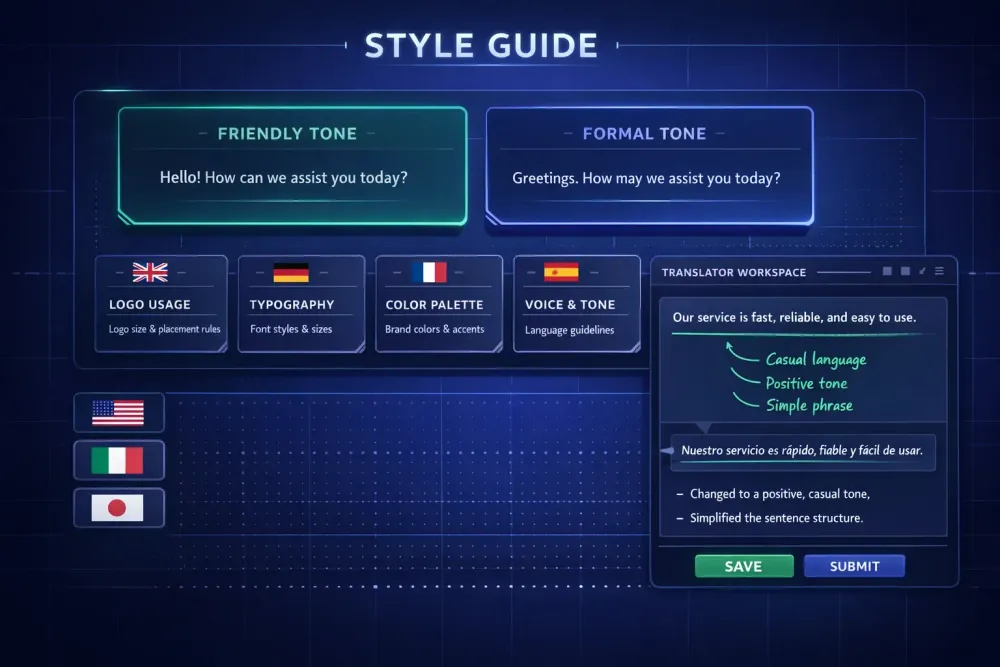
A translation style guide that sits in a shared folder and gets opened once is not a style guide—it's a document. Most style guides fail at the practical level: they're either too abstract to be useful during active translation work, or too long for any translator to read through before starting a project. We've helped agencies rebuild their style guides from scratch after noticing that different translators on the same client account were making opposite decisions about form of address, register, and capitalization on product names. The fix wasn't writing a better document. It was writing a differently structured one, organized around specific decisions rather than brand philosophy.
What a translation style guide actually needs to do
A style guide has one practical job: give translators enough information to make consistent decisions without asking the project manager a question. That's a more specific goal than it sounds.
Most style guides are written as brand documents repurposed for translation teams. They describe the brand in positive terms—"warm, professional, direct"—and leave the translator to figure out what "warm" means when choosing between two grammatically equivalent sentence structures in French. That doesn't work in practice. The translator needs answers to specific questions: Do we use formal or informal second-person address? Do we capitalize product feature names? Do we adapt idioms for the target culture or translate them literally? Can we use passive voice, and if so, when?
A good translation style guide answers those questions directly, in the language of translation decisions rather than brand positioning.
The sections that matter most are: form of address by language pair, punctuation conventions specific to the target language, number and date formatting, capitalization conventions for product and feature names, register and tone described through examples rather than adjectives, what to do with untranslatable phrases or cultural references, and which brand terms must not be translated at all.
A useful diagnostic for whether a style guide is working: give it to a translator who has never worked with that client, ask them to read it for five minutes, then present five ambiguous translation decisions. If the guide answers those decisions clearly, it's working. If the translator is still guessing, the guide needs more specific rules—not more content. Length doesn't solve the problem that vagueness creates.
The sections translators actually reference
When we ask translators which parts of a style guide they return to during active work, the same sections come up consistently.
Form of address. In languages with formal and informal second-person pronouns—French, German, Spanish, Russian, and many others—this single decision ripples through potentially hundreds of choices in any given document. A style guide that doesn't specify this by language pair forces translators to guess. Different translators guess differently, which produces the inconsistency agencies get client complaints about.
Tone examples with before/after comparisons. "Conversational but professional" means almost nothing in practice. The most useful format is two or three sample sentences in the source language with two translations: one that represents the approved tone and one that doesn't. The comparison demonstrates the distinction concretely. This is worth more than any amount of tone adjectives.
Do-not-translate terms. Product names, brand slogans, trademark phrases, technical identifiers, and legal entity names that must remain in source language. These should be listed explicitly. If the list is long, keep it in a linked separate document rather than in the main guide.
Sensitive terminology. Any terms the client has strong preferences about—how they refer to competitors, what language they use for certain product capabilities, terminology they've specifically said to avoid for legal or brand reasons. These are often the translation decisions that generate client feedback when they go wrong.
Formatting rules. Punctuation inside or outside quotation marks, use of serial commas, date format conventions, number formatting (thousands separator, decimal notation), measurement units. Seemingly minor, but formatting inconsistencies are among the most common complaints that come back in translation QA reports.
The sections translators rarely reference during work: long introductions about the brand's history and values, vague descriptions of brand personality without specific examples, and instructions that apply to the source copywriter but don't translate into any concrete translation decision.
How to format a guide translators can actually use mid-project
The structure of the guide matters as much as the content. A style guide that translators have to read linearly from top to bottom isn't practical during active work—they need to look up a specific answer fast, often with a segment open in the CAT editor and a deadline running.
The format that works best in practice is a short reference document organized by decision type, not by brand chapter. Each section answers one practical question: What form of address do we use? What happens with product names? How do we handle idioms? One decision per section, stated as a rule with an example, then any exceptions.
We recommend:
- A summary at the front with the 10 most important rules—the decisions that affect the most translation choices across a typical project for that client
- Separate handling for each language pair, or at minimum clear flags for language-specific exceptions
- A term list at the end or as a linked separate document, not embedded mid-paragraph
- A version date on every revision of the document
The version date is often skipped but matters considerably once a client updates their brand terminology or reverses a decision on tone. With a dated guide, you can tell translators "use v2.3 or later" without any ambiguity about what's current.
One format mistake that reliably degrades usability: embedding style rules inside long explanatory paragraphs. Rules should be scannable. A translator mid-project doesn't have time to parse three sentences to extract the instruction. Lead with the rule; add context after, briefly, only if it's genuinely needed to prevent misapplication.
Digital-first formats work better than Word documents passed by email. A shared wiki page, a bookmarked PDF, or a well-structured collaborative document with a stable URL—whichever your team will actually keep updated—ensures the guide is findable when needed.
Building from the client's existing materials
Trying to write a style guide from scratch using abstract brand principles takes time and often produces content the client doesn't recognize as accurate. The faster approach extracts concrete rules from materials the client already uses and has already approved.
The most useful sources are: existing approved translations in the client's language pair, the client's source-language content (website, product documentation, marketing materials), any previous revision or correction requests from that client, and the client's own internal style guide if they have one.
Approved translations are the most direct source. Read through a sample of finished work the client accepted without revisions and note the consistent decisions: form of address, how product names are handled, register choices, punctuation patterns. Those observations become rules in the style guide. You're formalizing what the client has already implicitly approved, rather than asking them to review a document of abstract principles they've never tested against real translation decisions.
Client revision requests are an underused source. Every time a client has sent back a translation with a specific correction, that correction represents a style rule. Agencies that systematically document client corrections and add them to the style guide accumulate a practical, evidence-based set of rules over time—rules they know the client will apply consistently in review because those clients generated them.
When neither source is available—a new client with no existing translation history—start minimal: form of address, do-not-translate terms, and two or three tone examples built from a sample project. Then build from feedback. Starting with ten reliable rules is more useful than starting with fifty uncertain ones that will need revision after the first delivery.
Our guide on translation terminology management covers how to build glossary and term conventions alongside style decisions, as the two inform each other in practice.
Getting translators to actually use the guide
A style guide only does its job if translators consult it during work. That requires more than emailing it before a project starts.
The most effective practice we've seen is a short onboarding step for each new client account—not a full training session, but a 15-minute walkthrough of the client's specific guide with the translator, covering the decisions that matter most and flagging where the guide makes choices that differ from general practice for that language pair. Translators who understand why a rule exists follow it more consistently than those who encounter it as an unexplained constraint.
Making the guide accessible during work is equally important. Some agencies include a direct link to the current guide version in their project brief template, so it's in front of translators at the start of every project without them having to find it. If the guide is hard to locate, it won't be consulted.
Feedback mechanisms matter too. Translators encounter edge cases the style guide doesn't cover. Without a clear way to flag those gaps, they either guess or send ad hoc messages—neither of which scales. A simple process for flagging unresolved style questions and adding the answers to the guide turns the document into a living resource rather than a frozen artifact.
One thing that consistently damages translator compliance is inconsistent enforcement from the review side. If the guide specifies formal address and the project manager accepts deliverables with informal address without comment, translators learn quickly that the rule isn't real. Consistency in review matters as much as clarity in the guide itself.
When the style guide and translation quality come into conflict
This tension is real, and style guides that don't acknowledge it create their own problems.
There are cases where following the style guide literally produces clearly worse output: a formal register instruction that makes a technical procedure hard to follow in the target language, a do-not-translate rule that leaves target-language readers confused by a term that has no recognizable source-language equivalent in their context, a punctuation convention that functions differently in the target language than the guide assumes.
Translators who encounter this conflict and have no escalation path will either apply the guide rigidly and produce an inferior translation, or override the guide on judgment without flagging it—which produces inconsistency across the project.
The most functional approach is to document the conflict resolution path in the guide itself: what the translator should do when following the guide produces a clearly worse outcome, and who to contact. In most agencies, the answer is a brief message to the project manager presenting both options—the guide-compliant version and the better-reading version—so the client or PM can make an informed decision.
This approach keeps translators out of the position of making unilateral decisions that create invisible inconsistency, and keeps them out of the position of following a rule into a clearly problematic output to avoid raising the issue.
For a fuller view of how style consistency fits into the QA review process, our guide on translation quality assurance covers how agencies structure review to catch style and consistency issues systematically before delivery.
Starting (or restarting) your style guide
Begin with an audit of your current pain points. What client feedback has come in about inconsistency? What translation decisions do translators regularly ask the project manager about? Those recurring questions are your first rules—the ones that will prevent the most repeated conversations.
Structure the guide around answers, not chapters. Form of address, do-not-translate terms, tone examples with before/after pairs, formatting rules by language pair. Keep the first page to ten rules or fewer—the decisions that affect the most translation choices on a typical project for that client.
Date every version. Link to the term list rather than embedding it. Set up a mechanism for translators to flag gaps, and assign someone to close those gaps before the next project cycle.
A style guide isn't finished—it's current. Agencies that treat it as a living document that improves with each project cycle find that it requires less maintenance over time, not more, because the most common decisions get resolved early and stop generating questions.