How freelance translators win direct clients without relying on agencies
How freelance translators win direct clients: what agencies take, how to get found by the right companies, and how to make the first project lead to more.
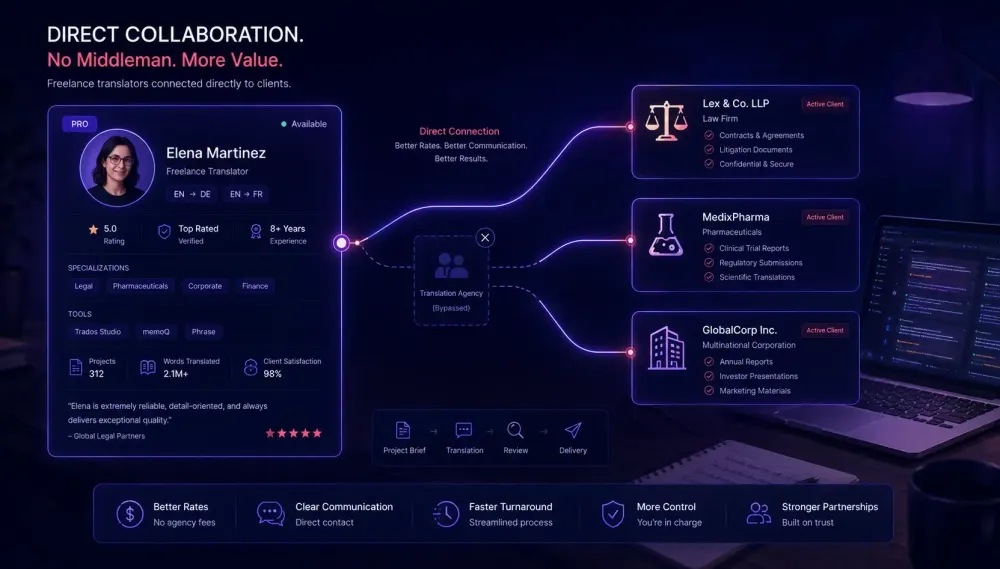
Every freelance translator who has worked through a large agency knows the math. The client pays $0.18 per word. You get $0.07. The agency keeps the difference. Their cut covers coordination, sales, and project management, which are real functions, but you are often doing half of that coordination yourself when you answer briefs, handle revisions, and chase feedback at 11pm.
Moving toward freelance translator direct clients is one of the most repeated pieces of advice in the industry, and one of the least actionable. Most articles about it tell you to "build your personal brand" or "use LinkedIn" without getting into the specifics that actually produce work. We have talked with enough translators who made this transition successfully — and watched others try and give up — to have a clearer picture of what the difference usually comes down to.
Why the per-word rate is only part of the story
The most obvious benefit of working directly with clients is the rate difference. A corporate legal department that hires a translator directly pays full market rate, not the rate that has been discounted through the agency chain. For common language pairs in specialized domains (German-English for medical devices, Spanish-English for contracts), that gap can run from $0.06 per word on the agency side to $0.14 or higher on the direct side for the same type of work.
But the rate is not the whole story. What agencies also provide is managed infrastructure: steady project flow, invoicing through a single party, and a project manager absorbing difficult client conversations before they reach you. None of this is free. It is worth knowing what you are actually paying for when you work through an agency, because you give up all of it when you go direct.
What direct clients give back is continuity. A pharmaceutical company that has found a reliable translator for their regulatory submissions does not want to find a new one. A patent law firm that trusts a translator's understanding of electronics IP will keep sending work for years. Once a direct relationship is established, the volatility drops — and that stability has real significance that per-word comparisons do not capture.
We have also seen translators undercharge direct clients because they internalized agency rates as "what translation costs." Recalibrating your pricing for the direct market can feel uncomfortable at first. Our post on freelance translator rates in 2026 covers how to price confidently when you are dealing directly with the client, not through an intermediary.
Why most translators stay on agency work longer than they want to
It is not laziness. Agency work is genuinely easier to start and maintain. The agency handles the sales cycle, manages client expectations, deals with payment disputes, and delivers a mostly predictable stream of projects. When you are building a translation career, that infrastructure matters.
The problem is that agency dependency becomes self-reinforcing. The more you rely on one or two agencies for most of your income, the less bandwidth you have to develop direct relationships. Direct client work has a longer lead time. You might spend months building visibility before a project materializes, and that is hard to sustain when you are already filling an agency workload.
The translators we have seen make this shift successfully almost always did it gradually. They kept agency work as a baseline while building direct contacts in parallel over 12 to 18 months. The first direct client rarely feels like a breakthrough. It is usually a small project from someone who found you through a referral or your website, paid somewhat above agency rates, and came back a few months later with something larger.
There is no fast version of this. Translators who expect a quick win from a LinkedIn campaign or cold outreach tend to get discouraged. Those who treat it as a long build, incremental and not dependent on any single effort paying off, are the ones who eventually have a stable direct client base.
Why "German-English translator" makes you invisible
You cannot be found by clients who do not know how to look for you. And most clients do not search for translators by language pair alone.
A procurement manager at a biotech company searching for help with a clinical study report is not typing "German-English translator" into Google. They are searching for "clinical trial document translation," "regulatory submission translation German," or something close to that. A managing partner at a law firm is searching for someone who translates their specific type of contract, not a general translator.
Most translator websites and LinkedIn profiles still describe services in terms of language pairs rather than document types and client industries. The result is that they are technically present but practically invisible to the clients who would pay the most to hire them.
The adjustment is specific. A translator who rewrites her LinkedIn headline from "Freelance German-English Translator" to "German-English Medical Translator | Regulatory Documents, Clinical Trials, CE Marking" is not just adding words — she is inserting herself into the search vocabulary of the people most likely to hire her.
We have seen this produce real changes. One translator who specialized in patent translation rewrote her LinkedIn headline and about section to describe exactly the document types she handled and the industries she covered: electronics, software, and semiconductor IP. Within a few months, she was receiving direct inquiries from patent attorneys who found her through LinkedIn search rather than through an agency. The volume was modest. The quality of the projects was higher, the rate conversations went differently, and the relationships are ongoing.
Specificity also filters out mismatches. You get fewer inquiries for work outside your area, which saves time and avoids the conversation of declining projects that are not the right fit.
What a translator's website needs to actually do
Most translator websites do not generate direct client inquiries because they are written for other translators, not for clients. They explain what translation is, list language pairs and tools, and present a contact form. That is not a website that does acquisition work.
The translator websites that produce inquiries speak to the client's problem from the first sentence. "I translate German legal contracts and corporate governance documents for European law firms and multinational companies" is useful to a potential client in a way that "certified German-English translator with ten years of experience" is not.
Domain clarity matters most: your specialization should be visible above the fold, not buried in an about page. Credibility comes through specificity — "I have translated over 200 shareholder agreements and merger filings for German-headquartered clients listing on US exchanges" tells a prospective client more than "I have worked with Fortune 500 companies." Make it easy to reach you. Interesting content with no clear next step loses the people who got interested.
Portfolio samples help, but confidentiality limits what you can publish. What you can do is describe past projects concretely without identifying the client: "Translated a 90,000-word Phase III clinical trial dossier from German to English for a European biotech preparing an EMA submission." That is more convincing than a general testimonial or vague reference to pharmaceutical experience.
If you write content on your site, focus it on topics your target clients actually search for. A post on "what to include in a translation brief for a clinical study report" attracts exactly the right client type through organic search and positions you as someone who understands their work before they even make contact.
Using LinkedIn without turning it into a second job
LinkedIn generates the most questions from translators about direct client acquisition, and the most frustration. People post content regularly, get engagement from other translators, and receive no client inquiries.
The reason is usually a misdiagnosis. Profile content does the work for direct clients, not posted content. The decision to reach out to a translator often comes after someone else mentions them, or after finding them through search, not after seeing a post in a feed. Your profile has to work when you are not online.
That means a headline stating your specialization and language pair, an about section describing who you work for and what documents you handle, and a work history that reads like a service track record rather than a CV for an employment application. People who may hire you want to know whether you have done their type of work before. Make it easy for them to find out.
Connections matter more than follower count. A targeted set of connections in your client industries, legal counsel, procurement managers, or regulatory affairs leads, puts you in a position to be found and referred. You do not need thousands. A few hundred connections with the right people in the right industries is more useful than a large generalist network.
Posted content does help at the margins. The kind that reaches potential clients is usually domain-specific: something about a terminology challenge in a recent project (without breaching confidentiality), a note about a regulatory change that affects translation in your domain, or a reaction to something specific happening in your client industry. That content surfaces in the right feeds. Content about the translation profession mostly reaches other translators.
How to make one direct client lead to more
Keeping a direct client is different from keeping an agency relationship, and most translators underinvest in it once the first project is done.
Direct clients want to know the timeline and have it met. They want a finished file that does not require corrections. When something goes wrong, whether it is a term you need to clarify or a delay you need to flag, they want to hear it from you proactively. Unlike in agency work, there is no project manager absorbing those conversations. You are the first contact, and how you handle uncertainty is part of what they remember.
After completing a project, a brief follow-up goes further than most translators expect: a note confirming delivery, a summary of what was translated and at what length, and a question about upcoming needs. Not aggressive. Professional. Most ongoing direct relationships build one project at a time, not through a sales campaign.
Referrals from direct clients are the most reliable path to more direct work we have seen. A client who has worked with you and had a good experience will mention you to colleagues when the situation comes up — but only if they can describe what you do specifically enough to be useful. "She's the translator we use for regulatory filings" sends the right signal. "She's a translator" does not.
For the operational side of running a mix of agency and direct work — managing timelines, separating client types, structuring your workflow — our post on the freelance translator's complete guide to working smarter in 2026 covers that in more depth.
A concrete starting point
Pick one industry where your language pair and domain knowledge are both strong. Rewrite your LinkedIn headline and about section to speak directly to that industry's document needs. Connect with a small number of relevant people each week — legal counsel, procurement managers, technical specialists — not dozens, just deliberate ones. Follow up with past clients to let them know you are available for direct work. Ask if they know anyone else who translates similar documents.
A realistic timeline to go from zero direct clients to a meaningful share of direct income is 12 to 24 months. That shortens if you already have domain expertise, completed projects in the specialization, and at least a handful of existing professional relationships to build from.
The translators who have done this well are not the ones who made one impressive push. They made small consistent adjustments over enough time that the relationships accumulated. One good project, done well, for someone who tells a colleague, is usually how it starts.