Freelance translator rates in 2026: how to price your services confidently
Freelance translator rates in 2026 vary widely by domain and language pair. Here's how to calculate your real floor and raise rates without losing clients.
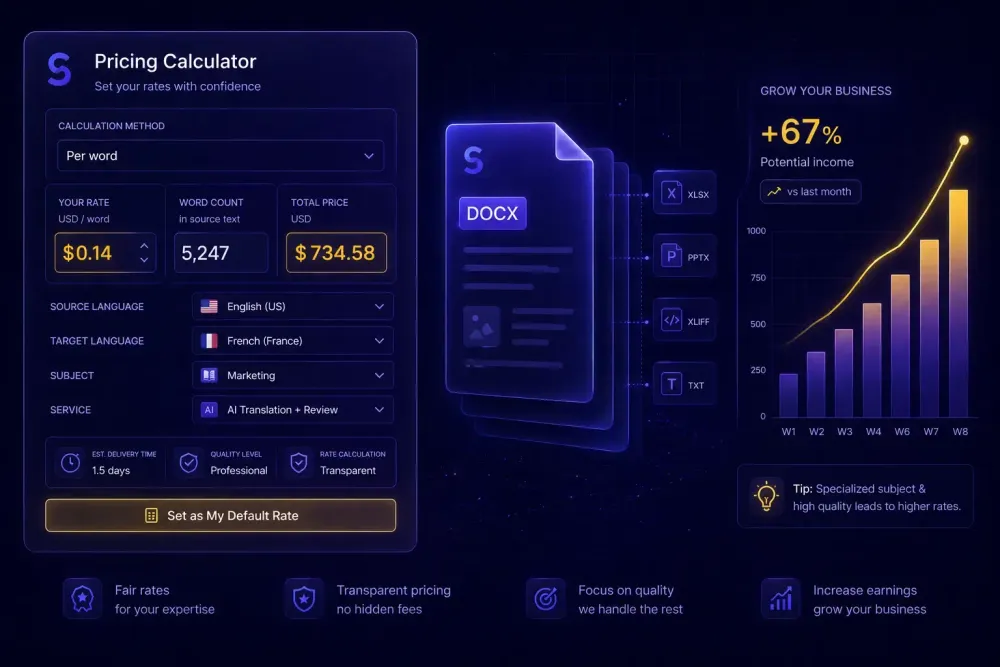
Setting your freelance translator rates in 2026 starts, for most people, with a number they picked years ago and never seriously revisited. AI tools are compressing margins in commodity translation segments while demand for specialized, accountable human translation holds up better than the forums would have you believe. We've talked with translators across several language pairs who've rebuilt their pricing logic in the past couple of years. The pattern is consistent: the people who get paid well don't necessarily translate better. They think about rates differently.
Why most freelancers get the initial rate wrong
The most common way a freelancer sets their first rate: scan job board postings, pick a number in the middle of what clients are advertising, and start there. Which makes sense in year one. The problem is that job board rates reflect what clients broadcast, not what working translators actually accept. They say nothing about the overhead that makes a freelance business financially viable.
Overhead gets underestimated consistently. Every hour spent invoicing, chasing payments, managing client communications, and staying current in your field is an hour that doesn't appear on a timesheet. A translator billing at a rate that looks reasonable for 40 hours of translation may effectively be working 55 hours a week once the administrative layer is counted. The real hourly figure drops significantly.
Then there's the psychology. Many translators treat a rate increase as something you earn through accumulated experience, rather than something you set based on what your time currently costs. The result is experienced professionals, sometimes with a decade of specialized work behind them, still charging a rate they adopted in year two because no particular event forced a rethink.
We spoke with a legal translator working in German-English contracts who had eight years of specialized experience and was still on the rate she'd set when she first narrowed into her niche. She'd stayed with it because her clients accepted it, which she read as evidence the rate was right. Then she compared her effective hourly income to what a local paralegal earns. The gap was significant. She raised her rates, gave her clients 60 days' notice, and retained all but one.
That one client found someone cheaper. She considered that a reasonable outcome.
What freelance translator rates actually look like in 2026
Benchmarks are partially useful and partially misleading, worth saying upfront. Slator and CSA Research track rate movements across the industry and consistently confirm the same structural pattern: commodity segments are under more pressure than they were five years ago, while specialized and regulated domains have held up substantially better.
For major European language pairs, general content has experienced meaningful rate pressure partly because AI-pre-translated material arriving for post-editing has become normalized. Rarer language pairs tend to command higher rates because the qualified translator pool is smaller relative to demand. Central Asian languages and less commonly taught African languages often sit at the higher end of what the market will pay precisely because supply is limited.
Domain matters as much as language pair. Legal translation carries a premium because the liability exposure is real and clients know it. Errors in contracts or court documents have consequences that are easy to quantify. Technical translation of engineering documentation or patent applications requires subject-matter fluency that takes years to develop. Medical and pharmaceutical content sits under regulatory weight that gives clients financial incentive to take accuracy seriously.
The segments most affected by downward rate pressure are repetitive, high-volume, lower-stakes content: product descriptions, internal communications, marketing boilerplate. Post-editing MT output has become a normalized service in these areas, and the pricing for it is different from translation from scratch. Pretending otherwise confuses clients who understand the difference.
If your work sits mostly in the commodity tier, rate strategy alone won't fix the problem. The more sustainable move is repositioning toward specialized work.
Per word, per hour, or per project: which model fits the work
The per-word model is familiar and defensible for most translation work. It gives clients predictable costs and lets you estimate a project before starting. Its weakness is that it rewards speed in ways that feel arbitrary: two translators producing equally accurate output may earn different effective hourly rates depending on how fast they work, which isn't a useful proxy for skill.
Per-hour billing makes more sense for post-editing and revision. When reviewing machine translation output, the time required doesn't scale with word count. A paragraph needing light cleanup and one that needed to be substantially rewritten can have identical word counts but take completely different time. Charging per hour for MTPE work protects you when MT quality is poor enough that your effective rate would otherwise collapse. The tradeoff is transparency: the client needs to trust your time tracking, and you need to be clear about what the invoice reflects.
Project-based fees work well for contained, predictable deliverables. Certified translation of a diploma or review of a defined document set fits a flat fee because both parties can agree on what "done" looks like before work starts. The risk is scope creep. Specifying the page count or document list in writing before beginning protects both sides.
Most experienced freelancers run a mix: per-word for standard translation, per-hour for revision and post-editing, per-project for certified or administrative documents where the work pattern is predictable.
How to calculate the minimum rate you can actually afford
The most reliable way to set a rate isn't to benchmark against what other translators charge. It's to reverse-engineer what you need to earn per billable hour for your business to work.
Start with your target annual take-home income. Add your tax liability, which varies by jurisdiction and business structure. Add professional expenses: CAT tool subscriptions, hardware amortization, professional development, software, and accounting costs if you outsource them. Add health insurance if it's not covered elsewhere. That total is your minimum annual revenue target.
Now divide by your realistic billable hours for the year, not your total working hours. A full-time freelancer works roughly 1,800 hours annually, but the billable portion is lower. Subtract administrative tasks, client communication, invoicing, and the inevitable gaps between projects. A realistic billable figure for a solo practice is usually between 1,200 and 1,400 hours.
A concrete example: a freelancer targeting $60,000 in take-home income, estimating $15,000 in taxes and $6,000 in business expenses, needs $81,000 in annual revenue. Divided by 1,300 billable hours, the minimum effective rate is roughly $62 per hour. If their average translation speed is 400 words per hour, the minimum viable per-word rate is around $0.155. If they're currently charging $0.10 per word, the math explains a lot about why the business feels tight.
Many translators run this calculation and get a number higher than what they're currently charging. That's uncomfortable. It's also information.
For context on how AI tools affect this equation, specifically whether integrating AI assistance actually improves take-home income, we wrote about it in how AI is helping freelance translators earn more per hour.
How specialization changes what you can charge
The freelancers who report the strongest rates are almost always specialists. That's not accidental.
When a client needs a clinical trial protocol translated with consistent terminology for a regulatory submission, cost per word is not the primary concern. They're looking for a translator who understands the domain well enough not to introduce terminology inconsistencies that could trigger a rejection or a retranslation request. The cost of finding the right specialist is small relative to the cost of getting it wrong.
Specialization also creates the conditions for embedded client relationships where repeat work is the norm. A translator who handles all the contract work for an international law firm isn't competing on rate for each new project. They've become part of a workflow, and the switching cost for the client is real. That's a structurally different business from continuously acquiring new clients at market rates.
Building a specialization means choosing a domain where you have prior expertise or the patience to develop it, accumulating specific work in that area, and being selective enough about what you take on that a reputation can actually form. The last part is hard in the early years when the reflex is to accept anything that arrives.
Formal credentials help in certain domains, particularly medical translation where professional associations offer specific certification paths. But translators who've worked in a domain for years, invested in reference materials, and participated in domain-specific professional communities often develop comparable depth without a prior academic background in the subject. Clients who need accurate regulatory documents or engineering manuals care more about track record than credentials.
How to raise rates without losing the clients you want to keep
Raising rates with existing clients is uncomfortable. It's also necessary for any freelance practice that started below its real floor or hasn't revisited rates in several years.
Clients who have consistently received good work rarely leave over a reasonable rate increase. Those who leave immediately over a modest change often weren't relationships worth keeping long-term anyway. That's easier to say in retrospect, but it's still true.
The approach that works most reliably: give enough notice (60 to 90 days for regular clients), communicate directly, and frame it as a business decision. "My rates will increase to [new rate] starting [date]. I look forward to continuing to work on your projects." Full stop. No elaborate justification, no apology paragraph. Clients who treat you professionally respond to professional communication.
Timing matters. Announcing a rate increase right after delivering a strong project is a better conversation than one that arrives after something difficult. The start of a new year or a contract renewal is a natural moment. Raising rates simultaneously with a change in delivery quality or turnaround creates noise you don't need.
It also helps to be deliberate about which clients you actually want to keep. Some relationships are worth holding even at a modest rate because of consistent volume, reliable payment, or because the work is substantive. Others can move to the new rate or leave the roster without significant impact. Knowing which is which before you start the conversation reduces how stressful it feels.
We've covered the broader pricing picture, including how the AI layer of translation work is changing what clients will pay and what freelancers can realistically earn, in how to price your translation services when AI is part of your workflow.
One practical step for this week
If you haven't done the backward rate calculation recently — working from your actual income target and real expenses to a minimum effective rate — do it before accepting any new project or agreeing to terms with a new client.
Once you have the number, compare it to what you're currently charging. If there's a gap, close it in one place: one incoming inquiry where you quote the correct rate, one existing client where you open the rate conversation, one project type where you've been consistently underpriced.
Pricing in freelance translation doesn't require better tools or longer hours. It requires treating rates as something you manage deliberately, not something you settled on once and left there.