Why document-level AI translation beats segment-by-segment: how context changes everything
Document-level AI translation processes the full document before any segment is translated. Here's how that context gap shows up and why it matters.
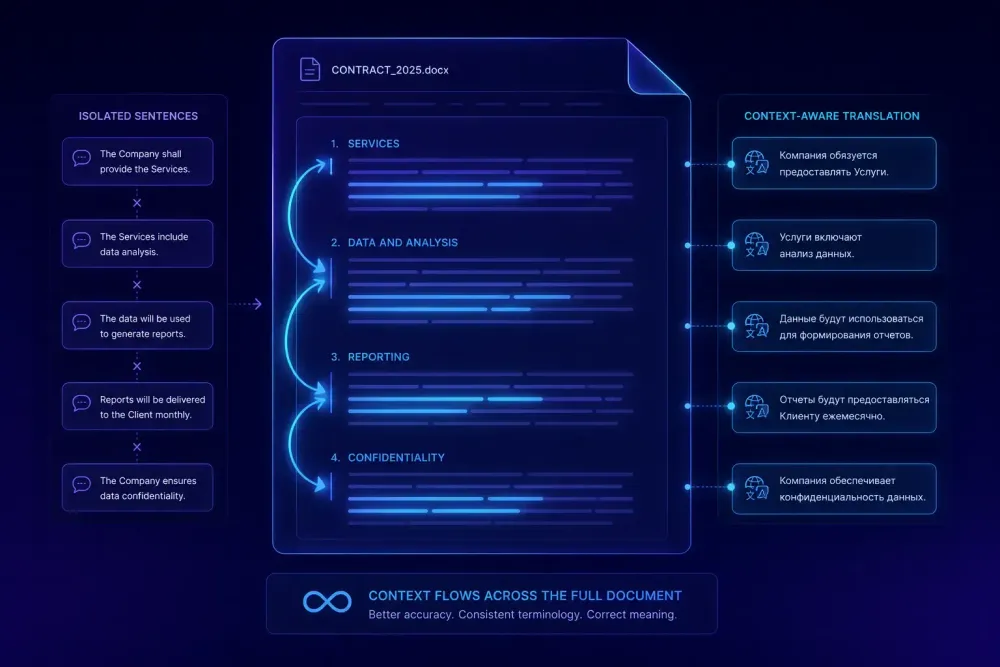
The phrase "document level AI translation" gets used loosely, often as marketing copy for any tool that runs AI somewhere in the pipeline. What it describes is more specific: a system that holds a representation of the whole document before it starts translating, rather than processing one sentence and immediately moving to the next. That distinction changes what the AI can produce. Once you've seen where segment-by-segment processing fails, the gap is hard to miss.
We've worked with enough translation files across enough document types to have a clear view of where context makes the difference. Technical manuals, financial reports, legal contracts, software documentation — each one exposes the same underlying limit of isolated-segment processing, just in different places.
What segment-by-segment translation actually does
When a CAT tool imports a file, it splits the source text into segments — usually one per sentence. Each segment becomes a discrete item in a queue: matched against a translation memory, passed to an MT engine, or assigned to a human translator. The system knows nothing about what came before or after. The segment is the entire context.
This architecture wasn't a mistake. TM databases are organized by segment. Early statistical MT engines were trained on sentence pairs. Neural MT followed the same data structure. The CAT editor interface shows one source-target row at a time. Building translation workflows around the segment was the natural outcome of how every piece of the infrastructure was designed.
The problem is that language doesn't work that way. A pronoun in sentence twelve refers back to a noun introduced in sentence eight. A term defined with a specific meaning in section one gets referenced as a given throughout sections three through ten. Register — formal or informal, technical or conversational — is established in the first paragraph and maintained or deliberately shifted in later ones. These are things a human translator knows by reading the full document before touching the source text. Segment-by-segment systems don't read documents. They process items.
What this produces in practice is inconsistency that compounds across a file. A 400-segment technical manual accumulates small context errors across every segment that references something established elsewhere. Multiplied across a translation run, those inconsistencies make up the majority of a post-editor's actual correction load. The work isn't catching outright wrong translations. It's unifying terminology and fixing pronoun choices that each looked defensible in isolation but produce three or four different renderings of the same referent.
In our experience, post-editors working on segment-level MT output spend roughly a third of their time on exactly this category of corrections — not errors the model made outright, but inconsistencies it couldn't avoid because it never had access to cross-segment information.
How document-level AI translation uses context differently
Large language models process text through a context window: a block of text the model holds in working memory while generating output. Depending on the model and how the tool is built, that window covers multiple paragraphs or entire sections. For translation, this changes the information available when the model produces each target-language phrase.
A model with full-document context can track coreference. When the English source uses "it" in paragraph twelve, the model can trace that pronoun back to the noun introduced in paragraph nine and translate with the correct gender, case, or number for the target language. In German, where nominal gender must agree across clause structures, this is not a marginal improvement. In Finnish or Hungarian, where long-distance grammatical agreement operates across sentence boundaries in ways English doesn't require, segment-level processing produces systematic errors that a post-editor has to correct one by one. Document-level context handles a meaningful portion of these automatically.
Context also stabilizes terminology across the file. If a document introduces "the primary control unit" in the first section and references it 35 times across 25 pages, a document-level model processes that introduction and carries the information forward. A segment-level system processes 35 independent translation problems, each solved from local co-text. The result can be up to 35 different translations of the same referent, depending on which words happen to surround each occurrence.
This isn't only an aesthetic problem. Terminology inconsistency in medical device documentation is a regulatory issue in EU and US markets. In legal contracts, multiple renderings of the same defined term can affect enforceability. Document-level AI translation doesn't make inconsistency impossible, but it makes it significantly less common.
Two document types where context changes the output
Software help documentation
Software documentation is a clear test case because the same technical terms appear in definitions, procedures, and cross-references throughout a single file. In segment-level processing, "tap the button" in step three might produce a different rendering than "tap the button" in step seven, even when the source text is identical, because the surrounding words shifted what the engine considered statistically probable.
With document-level context, the model's representation of "button" stabilizes from the first definition onward. If the documentation establishes in the introduction that this refers to a settings menu control, that context informs every subsequent translation of the term through the rest of the file. Post-editing time on terminology corrections drops noticeably in our experience — the corrections that remain are mostly formatting and punctuation rather than conceptual inconsistencies.
Investor relations materials
Financial documents introduce company-specific terminology in precise ways. An annual report defines a revenue recognition policy by name in paragraph two and references it across twenty pages. Segment-level MT treats each reference as a fresh problem. Document-level AI translation sees the original definition and handles subsequent references consistently.
This becomes especially relevant in language pairs where financial terminology has multiple valid equivalents. Japanese has at least three common renderings of "revenue" depending on whether the context is statutory accounting, management commentary, or investor-facing copy. Without document context, the engine distributes these possibilities across segments based on local probability. With context, the model follows the register and terminology patterns established in the opening section.
One limit applies: if the source document is internally inconsistent, the model amplifies that inconsistency rather than resolving it. A well-structured source file is what makes document-level context work.
When document-level context helps most, and when it doesn't
The approach works best on documents with thematic coherence — files where sentences at page fifteen reference meaning established at page two. Technical manuals, legal agreements, investor presentations, and policy documents all have this property. Document-level context captures the dependency structure that segment-level processing ignores.
It also shows clear advantages in language pairs with rich morphological agreement. Turkish, Finnish, Hungarian, and to a lesser degree German and Polish all have grammatical features that require multi-sentence context to resolve correctly. The accuracy improvement from document-level processing is larger in these pairs than in Spanish-to-Portuguese work, where structural similarity between languages keeps segment-level output relatively clean.
The argument weakens on short files. A 300-word product description doesn't benefit meaningfully from document-level context because there isn't enough document to generate useful context from. For files under about 500 words, the performance difference between approaches falls within post-editing noise, and a segment-level system with a well-maintained TM performs comparably.
It also weakens when the source text is internally inconsistent. A document assembled from multiple authors without editorial review, using four different spellings of a product name and shifting register unpredictably between sections, will produce inconsistent output from a document-level model as much as a segment-level one. Document-level context amplifies what's in the source. A noisy source doesn't give the model a consistent signal to amplify, and asking the model to fix problems that a human editor should have caught first produces unpredictable results.
This doesn't apply if the document is well-structured. The preparation and the model are doing different jobs, and a clean source document is the one thing document-level AI translation cannot substitute for.
The relationship between document-level context and glossary preparation
Document-level AI translation and glossary preparation are sometimes positioned as alternatives. They address different failure modes and work better together than either works alone.
A glossary provides explicit term mappings the model can use even when in-document context is ambiguous. In a technical file that uses a term in multiple valid senses, the glossary defines which sense applies to this specific project. Document-level context then helps the model recognize which instances match the glossary definition and apply it correctly, rather than drifting based on local co-text.
The reverse failure is also real. A document-level model without a glossary infers terminology from what it sees in the source document. If the source uses a term that differs from your client's preferred rendering, the model learns the wrong convention from the document itself and applies it consistently across all occurrences. Consistent wrong terminology is harder to catch than random inconsistency, because it looks intentional.
The practical implication: build your glossary before translation starts, not as a correction step after. If your translation system uses document-level context, that context should include the glossary from the beginning. This matters both for how the model handles known terms and for how it resolves phrases that sit at the boundary between general language and domain-specific vocabulary.
For most projects, you don't need a comprehensive glossary. You need one that covers the 25 to 30 terms where the wrong choice would require a full edit pass — product names, defined technical terms, regulatory vocabulary, and any client-specific naming conventions. That's enough to anchor document-level context and prevent the model from inventing its own conventions from what it finds in the source.
What to look for when evaluating tools that claim document-level AI
Not every tool that claims AI translation uses genuine document-level context. There's a real difference between systems that pass isolated segments to an LLM (which produces AI output without cross-segment memory) and systems that feed the model a full-document representation before processing begins. Both produce fluent-looking output. Only one produces cross-segment consistency.
A few practical tests worth running. Does the tool require a preparation step before translation starts? If the system begins translating immediately on file upload with no context input, it's almost certainly doing segment-level processing. Document-level context needs somewhere to receive that context before the model starts working.
Does the output show cross-segment consistency on repeated terms? Run a test document with a technical term that appears both early and late in the file, surrounded by different co-text each time. Check whether both instances translate the same way. Inconsistency here is a clear signal the tool doesn't maintain document-level context across the run.
Does the glossary mechanism feed into translation, or apply corrections afterward? Post-hoc glossary replacement means the translation step didn't use the glossary as input context. Pre-translation glossary injection — where the model sees the term list before processing the first segment — is what produces genuine consistency rather than retroactive patching.
For DOCX, XLSX, and PPTX workflows where you want domain analysis, glossary, and a translation prompt all confirmed before the AI processes anything, SnapIntel is built around that preparation model. Translation only starts after both glossary and prompt are approved and saved, so the model enters the document with explicit context rather than cold. For a broader look at how current tools compare on document-level handling and other dimensions, our 2026 comparison of the best AI document translation tools covers the field in practical terms.
Start with preparation, not with a different tool
The real change in moving to document-level AI translation isn't switching tools. It's building a preparation workflow that gives the model something meaningful to work with before it touches the source text.
A document-level system with no glossary and no domain context produces output that's more coherent than isolated-segment MT but still inconsistent on the terms that matter to your client. The preparation work — identifying which terms are non-negotiable, writing clear glossary entries, providing domain context before translation starts — is what turns document-level context from a theoretical benefit into a measurable one.
Post-editing after solid preparation is genuinely different work. You're not spending three hours unifying terminology across 400 segments or chasing pronouns through a legal agreement. You're reviewing for fluency, handling edge cases, and fixing the small number of places where the model's inference was wrong. That's one edit pass rather than three.
For teams deciding whether to invest in this approach: the return depends on document type. Highly technical documents, legal agreements, and medical materials show the clearest benefit. Simpler documents with lower terminology stakes show smaller returns. The question to ask isn't whether document-level translation is better in the abstract — it is — but whether your specific document type has enough cross-segment dependencies to make the consistency improvement matter in practice.
The preparation investment is not large. The timing of it is non-negotiable: before translation, not after the model has already made its decisions across the full document.