Why 9 in 10 Enterprises Now Require Bring-Your-Own API Keys for AI Translatio
Nearly 9 in 10 enterprises now require or prefer BYOK for AI translation. What's driving the enterprise BYOK requirement and how agencies should respond.
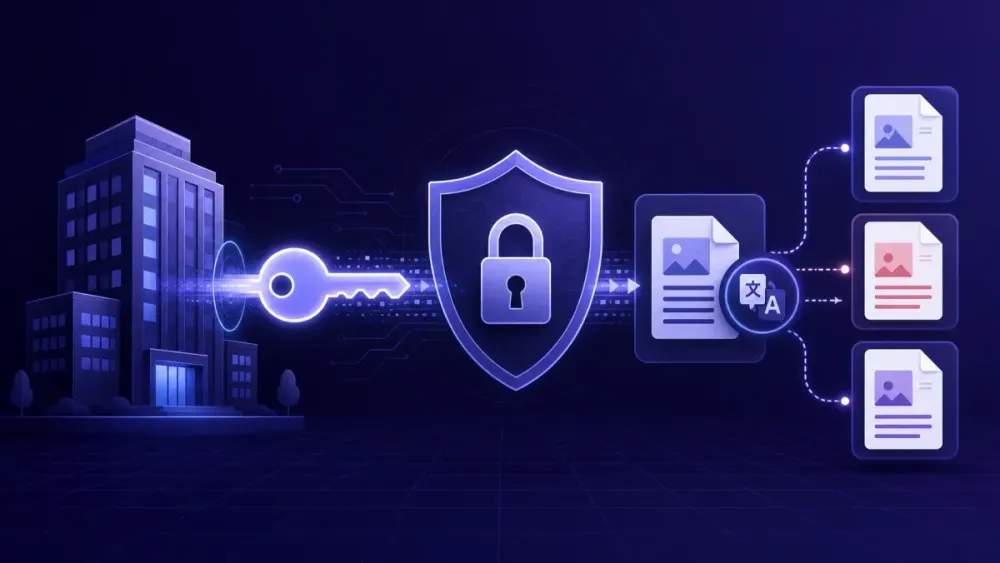
Last winter we watched a mid-sized agency lose an enterprise deal at the security review stage. Not on price, not on turnaround, but on a single question: "Whose API key processes our content?" The agency couldn't answer it cleanly, and the client moved on. Conversations like that one are why the enterprise BYOK requirement has moved from a niche security preference to something close to a default in translation procurement. In Crowdin's 2026 AI Translation Enterprise Survey, 88.8% of enterprise teams said they require or prefer bring-your-own-key before approving an AI translation setup. That is very close to nine in ten. This post looks at what's behind the number, what BYOK actually protects, and how translation agencies should prepare before the question shows up in their next RFP.
What the enterprise BYOK requirement actually means
BYOK stands for bring your own key. In an AI translation context, it means the customer supplies their own API key for the model provider (OpenAI, Anthropic, Google, or an Azure OpenAI deployment), and the translation tool routes all model calls through that key instead of a shared key owned by the tool vendor.
Three things change when that happens. First, the text being translated is processed under the customer's own agreement with the model provider, including whatever data-processing addendum, retention terms, and regional hosting they negotiated. Second, token usage lands on the customer's own bill, so there is no hidden markup on model costs. Third, the customer can revoke access instantly by rotating the key, which gives security teams a kill switch they control.
One clarification, because the acronym causes confusion. In cloud storage, BYOK usually refers to customer-managed encryption keys. That is a different mechanism. In AI translation, BYOK is about API access to the model, not about encrypting data at rest. When an enterprise procurement questionnaire asks about BYOK for AI features, it almost always means the API key.
It's also not the same as self-hosting. A BYOK setup still runs on the vendor's infrastructure; the vendor's software prepares segments, calls the model, and assembles the output. Some enterprises go further and demand on-premise deployment or a private model endpoint, but that remains a minority position because of cost. BYOK sits in the middle: the workflow stays in a SaaS product, while the model relationship, and the data terms that come with it, belongs to the customer.
For translation buyers, that middle position turns out to be exactly what most security teams wanted.
The numbers: what the 2026 survey actually found
The nine-in-ten figure comes from the 2026 AI Translation Enterprise Survey run by Crowdin with ESADigital and ITitov Agency between January and February 2026, covering 152 enterprise professionals in the US and Canada. Slator published the summary in April.
The headline findings: 88.8% of teams require or prefer BYOK to keep control over their data. Within that group, the split is nearly even between a strict requirement (44.7%) and a strong preference (44.1%). 80.9% of respondents refuse to send PII or user data to external AI providers at all. And 91% of organizations either have a formal AI governance framework in place or are building one.
Worth being precise about what this does and doesn't say. "Require or prefer" is broader than "require": roughly 45% of enterprises treat BYOK as a hard gate, while another 45% treat it as a strong plus in vendor evaluation. The sample is 152 respondents, all North American, and about half work in localization roles, so it tilts toward companies mature enough to have localization teams in the first place. A small e-commerce company buying its first translation package probably isn't asking about API keys yet.
But the direction is hard to argue with, and it matches what we hear from agencies. The same survey found that 95% of enterprises now use AI translation and that 65.8% run it inside their TMS rather than in standalone tools. When AI is embedded that deeply into production content flows, the security review stops being about the translation vendor's office WiFi and starts being about where every segment of text travels. The API key is the most concrete, auditable answer to that question, which is why procurement teams anchor on it.
Why procurement teams anchor on the API key
From the outside, insisting on your own OpenAI key can look like security theater. From inside a procurement process it is rational, for four reasons.
Data terms. When translation runs through the customer's key, the content is processed under the customer's own contract with the model provider. Enterprises with a negotiated agreement, or an Azure OpenAI deployment pinned to an EU region, extend those protections to translation without negotiating anything new. One pharma team we spoke with put it plainly: clinical trial documents may only touch their own Azure instance, in their region, full stop. Any translation workflow that can't route through it is disqualified before pricing is even discussed.
Vendor risk. Every shared-key vendor is one more company whose data handling has to be audited. With BYOK, the model relationship collapses back to a provider the enterprise has already vetted. The translation tool still processes content and still needs a DPA, but the highest-risk step, the model call, runs under known terms.
Billing visibility. Token usage on the customer's own bill means finance can see exactly what AI translation costs, separate from software fees. That matters for MTPE pricing conversations, where clients increasingly want model costs and post-editing effort broken out rather than blended into a per-word rate.
Governance consistency. With 91% of enterprises running or building AI governance frameworks, translation is simply being pulled under rules that already exist for other departments. If engineering and marketing must use approved model endpoints, the localization team will not get an exception because their CAT tool ships with a bundled key.
None of this is specific to translation, which is exactly the point. Translation buyers are applying company-wide AI policy to one more content workflow. Agencies that read the requirement as generic security paranoia tend to answer it badly; agencies that recognize it as standard AI procurement answer it well.
What BYOK protects, and what it quietly doesn't
BYOK is real protection, not just a checkbox. But we've seen it oversold, so here is the honest version.
What it covers: the model call. Your text goes to the provider under your terms, your retention settings, your region. If your API agreement includes zero data retention, that applies. You control spend and can cut access at any time.
What it doesn't cover: everything before and after the model call. The translation tool still receives your files, segments them, stores project data, and assembles the output. If the vendor keeps source and target text on their servers indefinitely, BYOK does nothing about that. You still need answers about storage location, retention period, encryption, and staff access. A vendor that supports BYOK but never deletes your documents has solved the smaller half of the problem.
Key handling is its own question. Ask where the key is stored, whether it's encrypted at rest, and who inside the vendor's team can read it. A key pasted into a plain database field is a liability, not a control.
And BYOK does nothing for quality. Glossary adherence, terminology consistency, QA reporting, post-editing workflow: all of it is identical whether the key is yours or shared. We've watched teams spend three procurement meetings on key management and zero on how translation errors get caught before delivery. The 20.4% of survey respondents who reported more quality incidents after introducing AI would probably rather have that time back.
One more limit: if the content is public anyway, marketing pages, published documentation, app store copy, the confidentiality case for BYOK is thin. There the argument is billing transparency, not data protection. Matching the control to the content is easier to defend in a review than demanding maximum controls everywhere.
What this means for translation agencies selling to enterprises
If you run an agency, the practical consequence is that AI questions are now standard in vendor reviews, and they arrive whether or not you advertise AI translation. Clients assume a model is involved somewhere in your workflow. They want to know which one, under whose key, and what happens to their text.
We've seen security questionnaires where the AI section is now longer than the classic infosec section. One agency owner described filling out a 40-question review for a medical device client: two questions about office security, eleven about AI tooling, including "list every subprocessor that receives document content and the retention period for each." If your workflow includes a CAT tool MT plugin, a standalone AI translation step, and an LLM-based QA pass, that's three answers you need in writing from three different vendors.
There's also a pricing consequence. When a client supplies the key, model costs move to their bill. Your quote becomes preparation, project management, post-editing, and QA, with tokens as the client's own line item. Some agencies resist this because blended per-word rates hide margin; others embrace it precisely because transparent MTPE pricing wins enterprise trust. Both positions are defensible, but you need to pick one before the client asks, not during the call.
The upside is real. An agency that can say "your content is processed under your own key, here is the data-flow diagram, here is each vendor's retention policy" has a genuine advantage in an RFP against agencies that answer with "we take security seriously." As AI reshapes how translation work is organized (we wrote about that shift in how AI translation tools are changing the way translators work), security fluency is becoming as much of a differentiator as linguistic quality.
How to get ahead of the question
You don't need a compliance department to answer BYOK questions well. You need a map and vendor answers in writing.
Start with the map. List every step between receiving a client file and delivering it, and mark each point where text leaves your infrastructure: MT plugins inside your CAT tool, standalone AI translation tools, AI QA checkers, even a translator pasting a tricky sentence into a chatbot. That last one is the map's most common unpleasant discovery. If freelancers on your roster use free AI tools ad hoc, client content is traveling under consumer terms nobody ever reviewed.
Then get written answers from each vendor on four points: whether they support BYOK, how keys are stored, what content is retained and for how long, and where processing happens geographically. If a vendor can't answer within a week, that tells you something too.
Fold the results into one page you can attach to any RFP response: a plain-language data-flow description, a vendor list with retention terms, and your BYOK options. Update it when your stack changes. Agencies that do this stop dreading the security section and start using it to knock out competitors.
Here's the concrete version. This week, map every point in your workflow where client text reaches an external AI model, including the informal ones. Then email each vendor on that map and ask for their BYOK support, key storage, and retention terms in writing. You'll end up with a one-page answer to the question that, per the 2026 survey data, roughly nine out of ten enterprise buyers are going to ask. The tenth probably just hasn't scheduled the security review yet.