Translation Agency Marketing: How to Get More Direct Clients Without Relying on Platforms
Translation agency marketing without platform dependency: practical guide to building direct client pipelines through content, SEO, referrals, and LinkedIn.
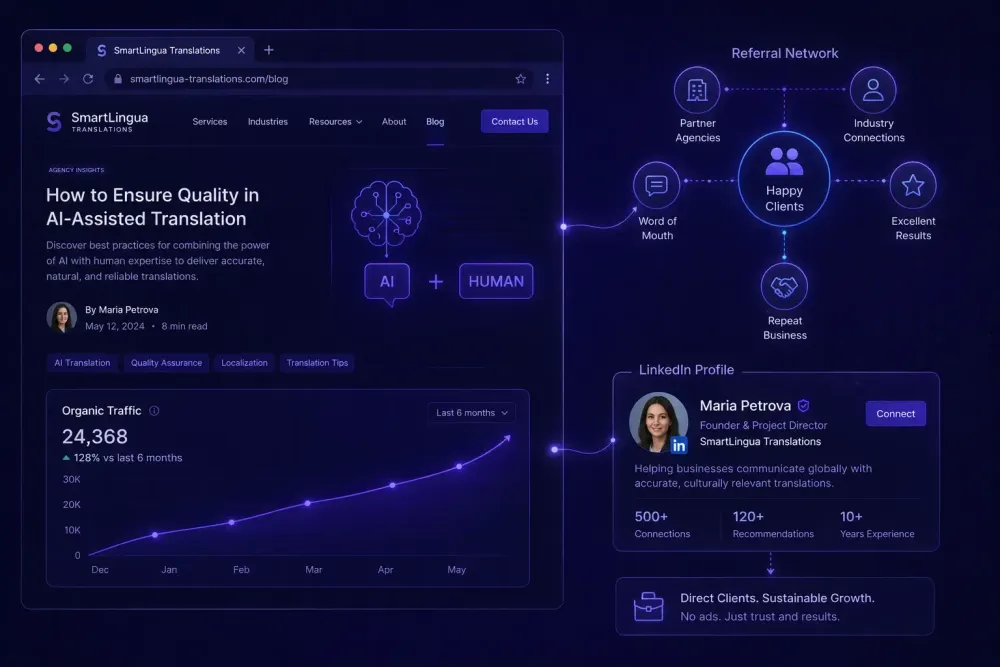
Most translation agency owners we've talked to built their first few years of revenue the same way: a platform client, a referral from a freelance contact, or a one-off project that quietly turned into a retainer. That's how translation agency marketing works at the beginning, opportunistically. The problem is that opportunistic marketing doesn't compound. It resets. This article is about how agencies move from reactive client acquisition to something more deliberate: direct channels they actually own.
Why platform dependency is a structural problem
Platforms generate work, but at a structural cost. The business model requires you to compete on price before the first conversation happens, which compresses margins on the very clients you're working hardest to acquire. You're also effectively invisible: the client relationship belongs to the platform, not you. When the client needs translation again, they go back to the platform, not to your agency specifically.
We've spoken with agency owners who ran stable revenue on a single large platform client for over a year, then lost it in a week when that client moved the work in-house. The quality wasn't the issue. The relationship was. When the platform is the relationship, you're one decision away from zero.
Direct clients are different. They know who you are, credit you for the quality, pay rates that reflect your actual expertise, and send referrals. The acquisition work is harder upfront, but the lifetime value is meaningfully higher and the relationship doesn't evaporate because someone changed a procurement policy.
The approach that works isn't abandoning platforms while you build something else; that's how you lose revenue and momentum at the same time. It's running both in parallel: keeping platform work stable while building direct channels alongside it. That parallel investment is what eventually lets you step back from platform dependency without damaging the business.
One honest caveat: this doesn't apply if you're running a high-volume commodity service where platform traffic is actually profitable and you're not trying to differentiate. That's a legitimate model. But if your competitive position depends on domain expertise, relationship quality, or service depth, platforms will consistently undervalue what you're doing.
Building a content foundation
The most durable translation agency marketing we've seen starts with content. Not generic content about translation being professional and important, but content that targets the specific searches your potential clients actually make.
If you specialize in legal translation, your buyers aren't searching for "translation agency." They're in-house legal teams, law firms, and compliance departments searching for things like "how to handle terminology inconsistencies in contract translation" or "requirements for certified translation for UK court submission." If your site addresses those questions with genuine specificity, you pull in traffic from people already trying to solve your exact problem.
Most translation agency websites are interchangeable. Accuracy, speed, professionalism, many languages: none of that is searchable or memorable. A content strategy built around answering specific questions your target clients are actually asking does two things at once: it drives organic traffic and it demonstrates expertise before any sales conversation starts.
One agency we've seen do this well publishes guides aimed specifically at in-house legal teams preparing documents for translation: how to structure a translation brief, what to do when source terminology is inconsistent across a long document, which formatting choices cause problems for the translator downstream. Their site ranks for searches their actual buyers make, and those buyers arrive having consumed something useful. That's a different starting point than a boilerplate homepage.
Content doesn't need to be high-frequency. Two well-researched, specific articles per month outperform ten thin ones over any 12-month period.
How SEO works for niche translation services
Search marketing for translation agencies is more accessible than most owners expect. The competitive field is genuinely weak. Most translation agencies have no SEO presence at all. The ones that do tend to target generic, highly competitive terms. The gap in domain-specific, intent-driven queries is real.
Locality matters more than people think. Queries like "certified translation [city]" or "legal document translation [city]" carry real commercial intent and limited competition outside major metro areas. These can be among the fastest wins for agencies with local presence or legal specialization.
Domain-specific content builds authority slowly but durably. An agency that publishes consistently on pharmaceutical translation challenges will, over 12 to 18 months, rank for queries its competitors can't touch. More importantly, when a prospective client from a pharmaceutical company reads three of those articles, they arrive in a sales conversation already convinced this agency understands their specific work.
Technical fundamentals matter more than any tactical shortcut: clean site structure, descriptive page titles that reflect actual search intent, fast load times, and proper internal linking between related pieces. A well-structured article targeting "financial reporting translation for compliance teams" will consistently outrank a generic service page over any reasonable time horizon.
The realistic expectation: SEO as a translation agency marketing channel takes 6 to 18 months to produce meaningful results. The agencies that do well with it started before they felt the growth pressure.
Referrals aren't passive
Referrals are the highest-quality leads in translation agency marketing. They convert faster, negotiate less on price, and tend to be a better fit for your services. The problem is that most agencies treat referrals as a passive output of good work rather than a channel they actively manage.
Referrals can be cultivated systematically without becoming awkward about it. The starting point is getting specific about who your referral sources actually are. For most translation agencies, the most underutilized group isn't existing clients: it's complementary service providers who already work with the same buyers. Law firms refer to translation agencies regularly. Accounting firms serving multinational clients and management consultants working on cross-border transactions both interact with companies that have ongoing translation needs.
The mechanism is simple: identify ten to fifteen organizations or individuals who serve your target clients and already have their trust. Introduce yourself and be specific about what you do well. The pitch isn't "send us business." It's "when translation comes up with your clients, I can be someone you can point them toward confidently."
This works best after you've already done the content and credibility work. A referral source who can send someone to your website and have that person find useful, expert content is more likely to refer again. The person they refer arrives in a different state of mind than a cold lead.
We've also seen small agencies build informal partner relationships with three to five complementary service providers: not commission-based arrangements, just acknowledged mutual referrals with consistent follow-through. These tend to hold longer than formal programs because they're based on actual trust rather than financial incentive.
LinkedIn for translation business development
LinkedIn works differently from most marketing channels for translation agencies. It's not about broadcast reach. It's about being visible to a small number of relevant people at the moment they're thinking about your type of problem.
The people who buy professional translation services are not on LinkedIn looking for agencies. But they're on LinkedIn, and they notice credible commentary on topics directly relevant to their work.
What tends to work is consistent, specific posts about the actual work: the challenges of translating financial audit documentation across jurisdictions, the terminology decisions that make patent translation difficult, the places where AI translation produces plausible errors that a non-specialist wouldn't catch. Agency owners who write about the work itself, from firsthand experience, build audiences that convert. Agency owners who post about their services build nothing.
Your LinkedIn presence should lead with what you know. The people who buy from you do so because they believe you understand their specific domain. Demonstrating that understanding in public is more effective than any promotional framing.
On direct outreach: LinkedIn messages work when they're specific and genuinely relevant to the recipient's situation. One message that references something real about the company and connects it to an actual translation challenge gets further than any automated sequence. Response rates are low, but the conversations that happen tend to be with people worth talking to.
Case studies and social proof that convert
Translation agencies sell expertise, discretion, and reliability. None of those are easy to demonstrate in advance. Case studies are the closest thing to verifiable proof a prospective client can evaluate before committing.
The case studies that convert best share a specific structure: the client's situation, the challenge (domain, volume, timeline, terminology constraints), what the agency did differently, and the concrete outcome. The outcome part is what separates a useful case study from a testimonial. "Client was happy" tells a prospect nothing. "We translated 40,000 words of pharmaceutical regulatory documentation in seven days, enabling the client to meet an EMA submission deadline that would otherwise have slipped" tells them a great deal.
Case studies work without client names when confidentiality is required. Translation buyers generally understand NDA constraints, and a case study that describes the situation in category terms — "a European automotive supplier needing bilingual user manuals for a German product launch" — retains its credibility without identifying anyone. The specificity of the challenge and the concrete result are what carry weight.
Where case studies do their most useful work is in late-stage sales conversations. When a prospect is weighing two agencies and one of them can say "here's a situation very similar to yours, and here's exactly what we delivered," that agency closes more often. Having consistent operational infrastructure is what makes those claims believable. Our post on how to build a translation agency operations system that scales gets into the process foundations that make repeatable delivery possible.
Measuring what your marketing is actually doing
Most translation agency marketing fails not because it doesn't work, but because it isn't tracked, so it either gets abandoned before it produces results, or it keeps running without improving.
The metric that matters most is pipeline source: where are your new direct clients actually coming from? Agencies that track this even informally — asking new clients how they found you, logging it somewhere reviewable, reviewing it quarterly — develop a clearer picture of which investments are paying off. What they typically find is that one or two channels are generating most of the qualified opportunities, while others are absorbing time without much to show for it.
Secondary metrics depend on the channel. For content and SEO: organic traffic and keyword rankings on specific target terms. For referral relationships: active referral partners and conversations generated per quarter. For LinkedIn: connection growth within your target industry and direct conversations started through content.
Measuring marketing output is easier when you already have a clear view of your financial baseline. Knowing your revenue per project, margin per language pair, and output per translator gives you the context to evaluate whether new clients are actually improving the business or just adding volume. Our post on KPIs every translation agency should track to stay profitable covers the financial metrics that connect marketing activity to business health.
If there's one thing we'd push back on when talking with agency owners, it's the assumption that marketing is what you activate when business gets quiet. The channels that reliably produce direct clients — content, SEO, referral cultivation, a specific LinkedIn presence, case studies worth sharing — all need consistent work before they pay off. The agencies that do best with these built them during periods of relative stability, not urgency. Pick the one that matches how your target clients actually find service providers, give it six months with specific tracking, and then adjust.