How to build a translation agency operations system that scales
A practical guide to translation agency operations — intake, resource management, quality control, project tracking, and how to scale without proportional headcount growth.
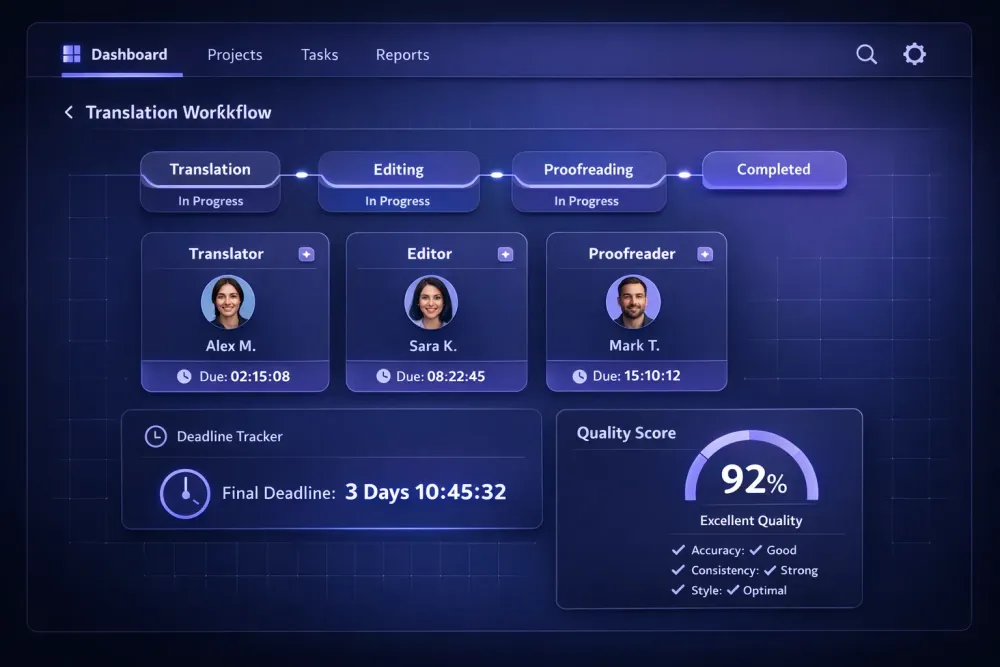
Most translation agencies don't fail because of bad translations. They fail because the operational system surrounding the translation work can't keep up with growth, client complexity, or staff turnover. A project manager leaves and takes three client relationships with them. Quality control is inconsistent across PMs because there's no shared standard. A client complains about terminology that was correct six months ago but changed when they updated their style guide — and nobody caught it because the glossary wasn't maintained. These are operations problems, not translation problems. This guide covers how to build a system that holds.
What a translation agency operations system actually needs to do
A functioning operations system for a translation agency captures client requirements accurately at intake, routes work to the right resources consistently, maintains quality standards across projects and people, produces deliverables on time, and generates data that lets you improve over time.
Most agencies do some of these well and some poorly. Intake is often inconsistent — experienced PMs know what to ask; newer ones don't. Quality standards exist as policies but aren't enforced at the workflow level. Data on project profitability, error rates, and revision frequency is either not collected or not acted on.
The operational bottleneck is almost never the translation itself. It's the coordination overhead — tracking status, chasing resources, managing client expectations, fixing problems that better process would have prevented. An agency that gets its operations right can grow without proportional headcount increases. One that doesn't will find every new client and every new PM adds coordination overhead that grows faster than revenue.
Client intake: where most operational problems start
Poor intake is the root cause of more project problems than most agencies realize. When scope isn't clear at the start, the ambiguity multiplies downstream.
A functional intake process captures the source files and target languages, the subject domain, the audience and register, the deadline and any intermediate review milestones, the client's existing terminology resources (glossary, style guide, previous translations), and the scope of any review or revision steps.
This sounds obvious, but most agencies handle intake through email exchanges that leave some of these questions unanswered. The PM fills gaps from experience or guesses. When the guess is wrong, the result is either a revision round that wasn't priced, or a client complaint that wasn't anticipated.
The fix is a structured intake template that makes these questions standard, not optional. Keep it short enough that clients actually complete it — five to eight fields for straightforward projects. For complex or high-value projects, a scoping call before intake is worth the time. The information gathered there should be documented and referenced throughout the project, not kept in the PM's head.
One category that consistently gets skipped: terminology resources. Clients who have been translated before often have materials that reflect their preferred terminology — previous translated documents, a product glossary, a brand style guide. Getting those materials at intake and loading them into the project before translation starts is the single highest-value quality intervention available. It costs fifteen minutes and prevents the most common client complaint.
Resource management: matching work to capability
Translation agencies manage two kinds of resources: internal staff (PMs, in-house translators if any, quality reviewers) and external freelancers (translators, revisors, domain specialists).
The operational challenge with freelancers is maintaining a roster that covers the domains and language pairs you actually work in, with enough depth that a busy week or a deadline conflict doesn't leave you scrambling. Agencies that rely on a small set of trusted translators for everything will eventually hit a capacity or domain coverage gap at the worst possible time.
Building a roster that works requires tracking which translators cover which domains and language pairs, which clients they've worked with and how those projects went, their typical turnaround times, and their rates. This doesn't need to be sophisticated — a spreadsheet with consistent fields and a habit of updating it after every project is sufficient. What it needs is to be maintained.
For new domain requirements, the Smartcat marketplace provides access to linguists with specific expertise on demand. Their AI matching algorithm considers subject expertise and project content fingerprint, which makes matching for specialized content more reliable than manual searching. The practical pattern for agencies: use your roster for familiar clients and content types, use the marketplace for specialist content or volume overflow.
Resource allocation for ongoing work should be deliberate. For a recurring client, the same translator builds knowledge that improves with every project — familiar terminology, known style preferences, understanding of the client's audience. Rotating translators on recurring clients for no operational reason throws away that accumulated knowledge and extends the time before the translator reaches full efficiency.
Quality control: building consistency across a team
Quality control in a translation agency means different things depending on who you ask. A translator thinks of it as accuracy and terminology. A PM thinks of it as on-time delivery without client complaints. A senior manager thinks of it as a consistent client experience regardless of which PM handles the project.
The third definition is the right one for operations purposes. Quality that depends on individual PM skill is fragile. Quality built into the workflow is durable.
At minimum, a functioning QA system has a documented standard for what "done" means — what a project needs to have completed before it leaves the building. File validation, glossary check, revision completion, formatted output review, delivery confirmation. Written down, not assumed. It also requires a current client glossary loaded for every project, because terminology inconsistency is the top client complaint and the glossary is the fix. The revision scope needs to be specified at intake and reflected in the price — light post-editing and full revision are different work, and when scope is undefined it gets interpreted inconsistently. And an automated QA report should be reviewed before delivery. Whether you're using CAT tool QA checks or the report from an AI translation workflow, reviewing flags before delivery catches errors that manual review misses.
SnapIntel includes a QA report and quality rating as standard output from AI translation jobs. For agencies running Smartcat bilingual DOCX files through AI translation, that report is part of the pre-delivery review — not an optional extra. It surfaces number errors, missing segments, and glossary violations before the translated file goes to the client.
Project management: tracking without overhead
Translation project management has a specific challenge: projects are short, volume is high, and the coordination overhead per project needs to stay low. A system designed for software development — detailed ticket tracking, sprint planning, retrospectives — is too heavy for most translation workflows.
What agencies actually need from project tracking is simpler: status at a glance (what stage, who's working on it, when it's due — visible without clicking through multiple screens), deadline tracking with early warning (projects at risk visible before they actually miss, not after), deliverable confirmation (was it delivered, to whom, which files — the record that matters when a client says they didn't receive something), and cost per project (which clients and project types produce the worst margins, something you can't know without collecting it).
Most agencies use a combination of a project management tool and a spreadsheet for this. For agencies handling more than fifty projects per month, a dedicated translation project management system pays off in coordination time saved. For smaller agencies, a well-structured spreadsheet works — as long as it's maintained.
Scaling without proportional headcount growth
The standard growth path for a translation agency is: win more clients, hire more PMs, hire more translators, repeat. This model works until margins compress — at some point, coordination overhead grows faster than revenue.
The alternative is building systems that let the same team handle more volume without proportional effort increases.
Standard workflows that don't require PM discretion on every decision reduce the judgment overhead per project. If a PM has to make ten discretionary calls per project that a more systematized workflow would make automatically, you need either fewer judgment calls or more PMs.
Quality systems that don't depend on individual expertise are scalable. A PM who knows a client's preferences is valuable. A PM whose knowledge is documented in the client file, the glossary, and the project brief can be replaced or supplemented without starting over.
AI translation as a throughput tool changes the turnaround economics. An agency that can deliver a 10,000-word project in 24 hours instead of 72 has a competitive advantage that justifies rates, not just a cost reduction. The speed advantage is often more commercially valuable than the cost reduction.
Clear handoff points between roles prevent dropped balls. Where does one person's responsibility end and another's begin? Unclear handoffs create accountability gaps. Defined handoffs make problems visible immediately.
The agencies that have built genuinely scalable operations aren't necessarily using the most sophisticated tools. They've documented their processes, trained their team to follow them, and built feedback loops that let them improve when something goes wrong. The tools help. They don't substitute for that foundation.
For more on how AI translation fits into an agency workflow, see our guide to Smartcat for translation agencies.