The AI Translation Backlash: Why Companies Are Bringing Human Translators Back in 2026
The ai translation backlash is real: companies are reinvesting in human translators after AI-first workflows failed in legal, medical, and marketing content.
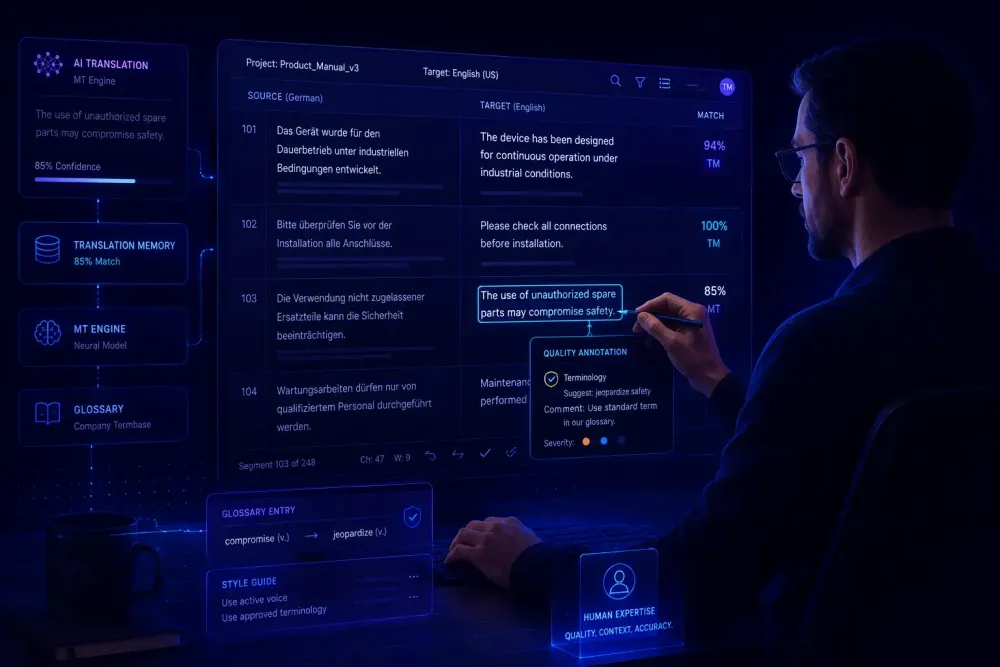
The ai translation backlash is a real thing now, and it's awkward for a lot of agencies. Not long ago, the story was: AI handles the volume, post-editors clean up the edges, costs fall. That held up better for some content than others. In 2026, a visible number of companies (some of them publicly) are rowing back from AI-first translation strategies and reinstating human translators for the work that actually matters. We've been watching this happen, and the reasons are more specific than a general loss of confidence in AI.
How the ai translation backlash began
The early push toward AI translation made economic sense. Per-word rates were under pressure, turnaround expectations kept tightening, and neural MT quality had improved enough to pass basic fluency checks in many language pairs. Agencies sold AI-first workflows as cost reduction with minimal quality tradeoff. Some clients cut human review budgets entirely and accepted MT output with the lightest post-editing tier they could get away with.
The core mistake was treating fluency as a proxy for accuracy. AI-translated text can read smoothly in the target language while being wrong in ways that matter. A medical consent form in Portuguese that sounds natural but mistranslates a dosage threshold. A contract in German that flows well but introduces ambiguity in a liability clause where that ambiguity is expensive.
These failures don't surface immediately. They show up in customer complaints, legal disputes, and the slow loss of trust from international audiences who sense something is off about the content. By the time a company traces the problem, the brand damage is already there. We've heard this described enough times to recognize the pattern: client goes fully into AI translation, things appear fine for six to twelve months, then something breaks in exactly the content where the cost of failure is highest.
The failure modes that accumulated quietly
What's driving the reverse migration in 2026 isn't a general sense that AI translation is bad. It's specific failure modes that weren't being tracked.
Terminology drift is the most consistent one. Even well-prompted AI systems don't maintain term consistency across large document sets without active enforcement. A pharmaceutical team preparing an EMA submission found the same chemical compound name translated three different ways across 200 product data sheets. That kind of inconsistency doesn't happen when a human translator is working in a CAT tool with a live termbase and a maintained glossary for the client.
Cultural register is harder to catch. AI models trained mostly on general-domain text often settle on a neutral register that doesn't fit the audience. A legal brief in Brazilian Portuguese that reads as if written for European Portuguese speakers. Marketing copy in Korean that's grammatically fine but tonally off in a direction that a native speaker would immediately feel but a non-specialist reviewer might not notice. These failures pass automated QA checks and light human review. The problem surfaces with the actual target audience.
The third pattern is hallucination in structured content. In documents with tables, footnotes, numbered lists, and cross-references, large language models sometimes produce plausible-sounding content that doesn't exist in the source. Not obvious fabrication — more like a paraphrase of a technical specification that quietly changes the meaning. A non-specialist reviewer can miss this entirely. In regulatory and technical translation, a quiet change in meaning is exactly the kind of error you can't afford.
What "good enough" actually cost
The economic case for AI translation rested on lowering per-word input costs by 60–70% and accepting some quality tradeoff. That calculus broke down when teams started tracking what errors actually cost downstream.
One terminology inconsistency in a regulatory submission can trigger a clarification request from a regulatory body, adding weeks of delay and consultant fees that exceed the translation budget entirely. A marketing localization failure that generates negative press coverage at scale costs more than years of human translation spend. A legal document with an ambiguous liability clause carries financial exposure orders of magnitude larger than the translation fee.
CSA Research noted in 2025 that the total cost of localization failures, including rework, downstream errors, and reputational damage, is chronically underestimated by buyers who measure translation quality by per-word cost alone. The market was pricing AI translation on input costs while the failures were compounding in outputs. That mismatch is what the backlash is correcting.
What the reverse migration actually looks like
"Bringing human translators back" is a shorthand. Most of what's happening is a tiering of content by risk profile, not an abandonment of AI.
AI translation continues to handle internal communications, low-stakes marketing updates, support content, and anything where errors are correctable and the audience will tolerate imperfection. Full human translation or MTPE with real post-editing effort is being reinstated for legal documents, regulated content, public-facing marketing in sensitive categories, and anything that will face external scrutiny.
Some companies that moved to AI-only in-house workflows are contracting human translators again, not to replace AI but to restore the review layer they cut. Agencies that shifted to minimal MTPE billing are seeing clients request more substantial post-editing and pay for it.
In-house localization teams that over-rotated toward AI are hiring again. Specifically: language leads and subject-matter translators who can evaluate AI output, not just process it. The job looks different now. Instead of producing translations, these professionals review, correct, and maintain the terminology resources that make AI translation perform at an acceptable level. That work still requires genuine expertise in the language pair and the subject matter. It doesn't disappear because the AI is doing the first pass.
Where the industry is landing
The market is converging on something that experienced translation professionals said was likely from the start: AI translation is a productivity tool for human translators, not a substitute for human judgment in content where errors have consequences.
What changed between 2023 and 2026 is that the evidence is concrete. There are documented cases in healthcare, legal, and financial translation where AI-first workflows produced errors with real consequences. Regulatory bodies in several jurisdictions are asking questions about AI use in compliance documents. Enterprise procurement teams that had quietly adopted AI translation are requiring explicit disclosure of AI use and documentation that proves human review occurred.
This is creating demand for something the translation industry has always needed to provide: verification. How do you know the translation is correct? Who reviewed it? What terminology resources were used? What QA process ran? Professional translation workflows have always answered these questions. AI-first workflows often couldn't.
We covered how AI translation tools are changing the way translators work in 2026 earlier this year, and the backlash doesn't contradict that analysis. AI is changing translation workflows. The change isn't replacing human translators; it's shifting what human translators need to do and where their expertise is most necessary.
When human translation still wins, and when the answer isn't obvious
The easy version of this conversation ends with: AI bad, human good. That's not what the data shows, and it's not what the companies doing the reverse migration are actually saying.
Human translation has its own failure modes. A translator working under time pressure on a technical domain outside their expertise will make errors a well-prompted AI system would avoid. Terminology inconsistencies across a multi-translator project without shared resources are common, and some evidence suggests more so than AI hallucination in structured content. For some language pairs and content types, AI quality has now passed the average quality floor for human translation under typical production conditions.
Domain and risk profile still determine most of the answer. In legal and regulated content where errors carry accountability, human translation with proper QA remains the defensible standard. In marketing content where cultural authenticity matters more than literal precision, human translators with actual knowledge of the target market outperform AI on the dimensions that affect results. In technical documentation, quality depends heavily on how well the terminology resources were built and maintained, which is true whether the first draft came from AI or a human.
This doesn't apply if the content is low-stakes, the audience is forgiving, or the errors are cheaply correctable. But in the territory where the backlash is happening, the calculus is different.
What the ai translation backlash is surfacing is that the real question was never AI versus humans. It's which content, which workflow, which quality gate, and what the cost is if this particular translation fails.
What to do if you're reassessing your workflow
If you're an agency or in-house team that has gone heavily toward AI translation and is now asking hard questions about it, here's what the available evidence suggests.
Start by auditing where AI translation output goes after delivery. If it flows directly to publication, regulatory submission, or legal use without a human review step, that's the highest-risk part of your process. Documented failure cases concentrate in exactly those paths.
Look at your terminology resources. AI translation quality degrades predictably when running without glossaries maintained for the specific client and domain. If your workflow doesn't include that, you're accepting variance you probably aren't measuring.
And don't assume automated QA is catching what matters most. QA tools are good at finding missing tags, numeric inconsistencies, and glossary violations — if you've defined the terminology. They aren't built to catch hallucinations, register failures, or subtle accuracy problems in specialized content. A bilingual human reviewer with subject-matter knowledge is still the most reliable final check for high-stakes translation.
The ai translation backlash is a correction, not a retreat. The teams handling it well are using it as a forcing function to build more intentional workflows: clear about which content AI handles, which needs human review, and which stays fully human regardless of the time or cost pressure.