Smartcat vs XTM Cloud: which TMS scales better for growing agencies?
Smartcat vs XTM Cloud compared on workflow, AI translation, pricing, and integrations — a practical guide for translation agencies choosing their next TMS.
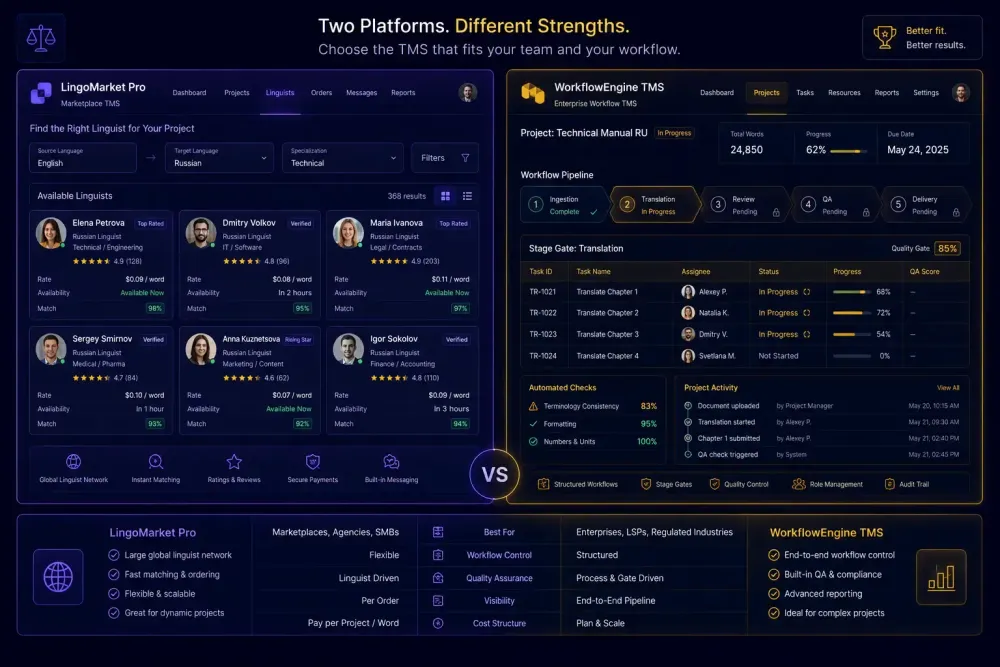
At some point, most growing translation agencies hit the same wall. Shared drives stop working. Project status lives in someone's head. Freelancer coordination happens over email. The spreadsheet that tracked everything at launch now takes fifteen minutes to update. When agencies start looking for a proper TMS, two names come up constantly in those conversations: Smartcat and XTM Cloud. Both are mature platforms. Both handle translation memory, glossary management, and MT integration. But they are built on genuinely different assumptions about what an agency needs, and those assumptions tend to surface at inconvenient moments — mid-project, or when a client escalates. This comparison of smartcat vs xtm cloud is less about feature lists and more about which architectural model fits how your agency actually works.
How smartcat and XTM Cloud approach the market differently
Smartcat describes itself as a combination of CAT editor, AI translation engines, a linguist marketplace, and workflow automation in one platform. The marketplace is not a secondary feature. According to Smartcat's documentation, it includes over 500,000 vetted freelancers, with a matching algorithm that factors in language pair, subject matter expertise, rates, availability, reviews, and a content fingerprint. Agencies that fill project slots by sourcing from an open pool — rather than drawing from a stable roster — get practical value from this. The billing side is convenient too: multiple freelancers can be paid through a single invoice at month-end, which cuts finance overhead.
XTM Cloud, from XTM International, takes a different structural position. It is a workflow orchestration system first. The architecture centers on configurable workflow stages with separate assignment and deadline tracking per stage — translation, editing, proofreading, DTP, client review — and on API access for agencies that need to integrate the TMS into a broader tech stack. A linguist marketplace exists within XTM's ecosystem, but it is not the differentiator. The differentiator is the configuration depth for agencies with complex, client-specific workflows and enterprise reporting requirements.
These structural differences matter more than any feature checklist. If your agency sources translators project by project and wants that process handled inside the same tool where the translation work happens, Smartcat's integrated model fits naturally. If your agency has a stable roster and needs workflow orchestration that matches what large enterprise clients expect in terms of approval stages and audit trails, XTM's design makes more sense.
What we see repeatedly in conversations with agency owners: the wrong TMS choice usually is not about missing features. It is about an architectural mismatch that turns into daily friction — the kind that accumulates quietly until it affects client relationships.
Project management and day-to-day workflow
At the project manager level, both platforms cover the functional basics: file upload, language pair assignment, deadline tracking, and progress visibility. Where they diverge is in how much control you have over what happens between upload and delivery.
Smartcat's CAT editor is browser-based and shows source and target text side by side with TM suggestions, AI output, and glossary matches surfaced in a panel on the right. According to the platform's documentation, the editor supports real-time collaboration, comments, revision history, and QA checks. For agencies where translators sometimes work on the same file simultaneously, real-time collaboration being in the base product — rather than locked behind an enterprise tier — is worth noting. The project dashboard shows progress across files, and freelancers sourced through the marketplace appear in the same view as internal team members.
Smartcat runs AI translation through six pipeline stages automatically: segmentation, TM lookup with exact matches applied without manual confirmation, AI translation with engine selection per language pair, QA flagging for issues like missing tags and glossary violations, an OpenAI-based correction step for flagged terminology, and a fallback to Google NMT if the primary engine fails. Most of this runs in the background. For project managers who want to see and approve each decision point, the process can feel opaque. The system handles a lot of decisions that would otherwise require manual input — which is useful for volume, less so when you need to explain a specific translation choice to a client.
XTM puts more configuration in the project manager's hands. Workflow stages can be defined per client, per project type, or per language pair, with explicit handoffs between each stage. The QA module is a separate configurable layer: agencies can define custom QA rules per client, block segment confirmation until specific error types are resolved, and route QA failures to a designated reviewer role. Setup takes time, but once it is configured, the system enforces client-specific standards automatically without requiring project managers to remember which rules apply to which client.
From a day-to-day usability standpoint: Smartcat asks less of project managers at setup time and covers more automatically. XTM asks more upfront and offers more precision once the work is done.
AI translation and MT configuration
Both platforms run machine translation before human review, but how they do it affects post-editing quality, cost structure, and how much control you retain.
Smartcat uses an AI translation pipeline that selects the MT engine per language pair automatically. Segments are scored using a Translation Quality Score (TQS), a 0-to-100 metric, to determine which get auto-confirmed and which route to human review. According to Smartcat's documentation, the TQS adjusts based on reviewer edits over time. In practice, this means that in a project with stable source quality and a consistent language pair, more segments get auto-confirmed across successive runs as the system incorporates corrections. For agencies doing high-volume machine translation post-editing (MTPE) on predictable content types, this tiering can reduce post-editing load over time.
Smartcat also includes specialized agents for different content types — Document Translator, PDF Translator, Website Translation Agent, Media Translator, Image Translator, Software Localizer, and others — accessible through a conversational chat interface. For agencies handling diverse format mixes, the format-specific agents reduce manual preparation per file type. The platform supports 280+ languages per its public documentation.
XTM takes a more deliberate approach to MT configuration. Project managers or account managers specify which MT engine applies to a given project, client, or language pair — DeepL, Google Translate, Microsoft Translator, or others depending on the deployment. This requires more decisions upfront but lets agencies honor client-specific data processing agreements. If a client's NDA specifies that their content cannot pass through a particular MT vendor's infrastructure, that rule can be enforced per project in XTM's configuration. Smartcat's automatic engine selection does not provide that level of per-vendor control.
Glossary enforcement differs between the two platforms in a way that matters for terminology-sensitive projects. Smartcat applies an OpenAI-based correction step after initial translation when a glossary term is detected as violated — it fixes the term after the fact. XTM can block segment confirmation within its QA module until the flagged term is corrected, preventing confirmed segments from containing violations in the first place. For agencies working in legal, pharmaceutical, or medical content where a term error in a confirmed segment could create a compliance issue, the blocking behavior gives more reliable protection.
Pricing structures and what they actually mean for growth
Direct cost comparison here is difficult, and agencies that treat it as one tend to make poor platform decisions.
Smartcat uses a Smartwords credit model: one Smartword equals translating one word of text. Other actions consume credits at different rates — AI voiceover at 10 Smartwords per word, image text re-embedding at 1,000 Smartwords per image flat. Subscriptions provide a workspace Smartword balance shared across the team; unused credits expire at the end of the subscription term. The per-word cost for standard translation is visible before you commit, which makes early-stage budgeting straightforward.
XTM pricing is quote-based. There is no public rate card. Agencies evaluating XTM go through a procurement process, negotiate volume-based pricing, and receive a custom proposal. This makes pre-commitment budgeting harder and adds time to the evaluation process. Agencies that need a cost estimate in a week to bring to an internal stakeholder meeting will not get one from XTM's standard procurement path.
What we hear from agencies that have gone through both evaluations: Smartcat tends to be accessible earlier in the process because the credit structure is transparent. XTM becomes competitive at higher volumes where custom pricing reflects actual usage patterns. If your agency is processing under roughly 400,000 to 500,000 words per month, the procurement overhead for XTM may not justify the process. Above that volume, the negotiated rate can produce a more favorable per-word cost than Smartcat's published tiers.
There is a second cost dimension that agencies often miss when comparing sticker prices. Agencies using Smartcat to source translators through the marketplace pay linguist rates on top of Smartword consumption. For agencies with their own established translator rosters who use Smartcat only for the TMS and CAT editor, the marketplace rates are irrelevant and the comparison is platform-only. But for agencies that rely on marketplace sourcing for a meaningful share of projects, the combined cost of Smartwords plus linguist rates is higher than the platform fee alone. Mapping this out for your agency's actual project mix before comparing platforms will give a more accurate picture than any per-word rate comparison.
Integrations and file processing
Smartcat covers a wide range of CMS and content platform connectors: WordPress, Contentful, Drupal, Webflow, Squarespace, Figma, Jira, Google Docs, Zendesk, Salesforce, Adobe Experience Manager, and Sitecore, among others. The integrations fall into three types: full automation where content is pulled and pushed without manual intervention, real-time API sync, and manual sync. For agencies that regularly handle content coming from these platforms, the pre-built connectors reduce per-client setup time.
XTM's integration approach is more API-centric. The XTM API is well-documented and used by agencies building custom integrations with enterprise systems — procurement platforms, ERP tools, proprietary CMS builds. The pre-built connector catalog is smaller than Smartcat's, but the API-first design means agencies with development resources can build integrations that match specific enterprise client requirements. For large enterprise clients with bespoke tech stacks, this flexibility tends to matter more than a list of pre-built connectors.
For agencies whose primary workflow is DOCX, XLSX, or PPTX files delivered by email or client portal — rather than content pulled from a CMS — neither integration catalog changes the day-to-day much. The file-delivery workflow does not require a CMS connector, and both platforms handle common document formats. The relevant comparison in this scenario is TM leverage, QA enforcement, and CAT editor usability.
Both platforms work with XLIFF-based segmentation, which makes TM data technically portable. In practice, switching TM data between platforms involves cleanup around segment length differences, formatting tags, and match threshold settings. If you accumulate a large TM in one platform over two or three years, migrating it is possible but requires planning. This is worth factoring into the platform choice early, because TM lock-in is real even when the data format is technically open. The complete guide to Smartcat for translation agencies covers Smartcat's TM structure in more detail if you are evaluating how the platform handles TM at scale.
What agencies get wrong about this comparison
The most common mistake is treating the Smartcat vs XTM Cloud decision as a feature checklist — counting which platform has more boxes checked — rather than asking which platform's structural model matches how the agency actually runs projects.
Glossary management is a concrete example. Both platforms support glossaries. But Smartcat applies glossary enforcement through an after-translation correction step when a term violation is detected, while XTM can block segment confirmation until the term is corrected. If a translation team is accustomed to reviewing flagged terminology without being blocked from confirming the segment, Smartcat's model is less disruptive to their habits. If a client contract specifies that no confirmed segment can contain a terminology violation, XTM's blocking behavior matches that requirement directly. The feature — glossary enforcement — reads the same on paper; the implementation fits different operational realities.
The marketplace assumption is another source of confusion. Agencies assume the marketplace is useful to everyone. For an agency with a vetted roster of specialists in legal or pharmaceutical content, Smartcat's 500,000-linguist pool adds limited practical value. The marketplace is useful for finding a translator quickly when a project falls outside the roster's coverage. If that scenario rarely or never happens, the marketplace is background noise, and the comparison reduces to the TMS core: TM leverage, QA configuration, and how much the editor works for your translators.
There is also a common timing mistake. The ideal moment to discover that XTM's configuration overhead is more than anticipated is during a structured trial on a real project, not after a client delivery is at risk. The same applies to Smartcat's auto-confirmation behavior: if segments are getting confirmed faster than your post-editing workflow expects, that is information to collect during an onboarding trial. Both platforms offer trial periods. Not using them for actual representative projects — running demo content instead — produces an inaccurate sense of how the platform performs under real conditions.
For agencies whose bottleneck is specifically the AI translation execution step — working with DOCX, XLSX, or PPTX files and needing domain analysis, glossary preparation, AI translation, and a QA report without the full TMS overhead — a workflow-specific tool like SnapIntel can handle that step independently. It does not replace either platform, but for agencies where project management is already covered and the translation execution step is the friction point, it is worth knowing what focused tools can do outside a full TMS.
Which platform fits where in the growth curve
There is no universal answer to the Smartcat vs XTM Cloud question, and any agency that tells you one platform is clearly better for everyone is either selling something or not paying attention. The choice tends to become straightforward once two questions are answered honestly: what does your translator sourcing model look like, and what do your clients actually expect from a workflow audit trail?
If your agency sources translators project by project, and if your client base skews toward SMBs and mid-market companies that prioritize turnaround over complex SLA documentation, Smartcat's integrated model — TMS, CAT tool, marketplace, and AI translation in one — covers the core workflow without heavy setup investment.
If your agency has a stable roster of known translators, serves enterprise clients with compliance requirements and multi-stage approval workflows, and has either in-house development resources or a willingness to invest in configuration, XTM Cloud's architecture handles that operational complexity better. The configuration investment pays off once project volume is high enough for the automation to accumulate value across many projects.
Some agencies run both: Smartcat for the majority of projects, XTM for a subset of enterprise clients with specific requirements. This adds operational overhead and requires the team to context-switch between platforms, but it can make sense for agencies managing a client mix that spans very different complexity levels.
The practical test: before committing to either platform, run both through the same two or three representative projects. Choose one project with high TM repetition and stable terminology, and one with client-specific glossary requirements and a QA SLA. Involve the project managers who will use the platform daily — not just the person doing the evaluation. Pay attention to where the team works around the platform rather than with it. That is where architectural mismatch shows up, and it tends to be consistent across every subsequent project.