Is ISO 17100 certification worth it for small translation agencies?
ISO 17100 certification costs $3,000–$8,000 and takes months to prepare for. A guide for translation agencies deciding whether it's worth it.
Most agency owners we've talked to who pursued ISO 17100 certification landed in one of two places: they got it and found it opened exactly the doors they needed, or they got it and spent the next year explaining to prospects what it was. The difference wasn't quality of execution. It was whether their target clients were the kind of buyers who check for it in the first place. ISO 17100 translation agency certification isn't a universal quality upgrade. It's a specific market access tool. Whether it belongs in your plans depends almost entirely on who you're trying to sell to, and we've seen both outcomes play out in ways that couldn't have been predicted from the outside.
What ISO 17100 actually requires
ISO 17100 is the international standard for translation service providers, published in 2015 as the successor to the European EN 15038 standard. It defines what a compliant translation process must include. This is different from what good translation looks like, and the distinction matters when deciding whether to pursue certification.
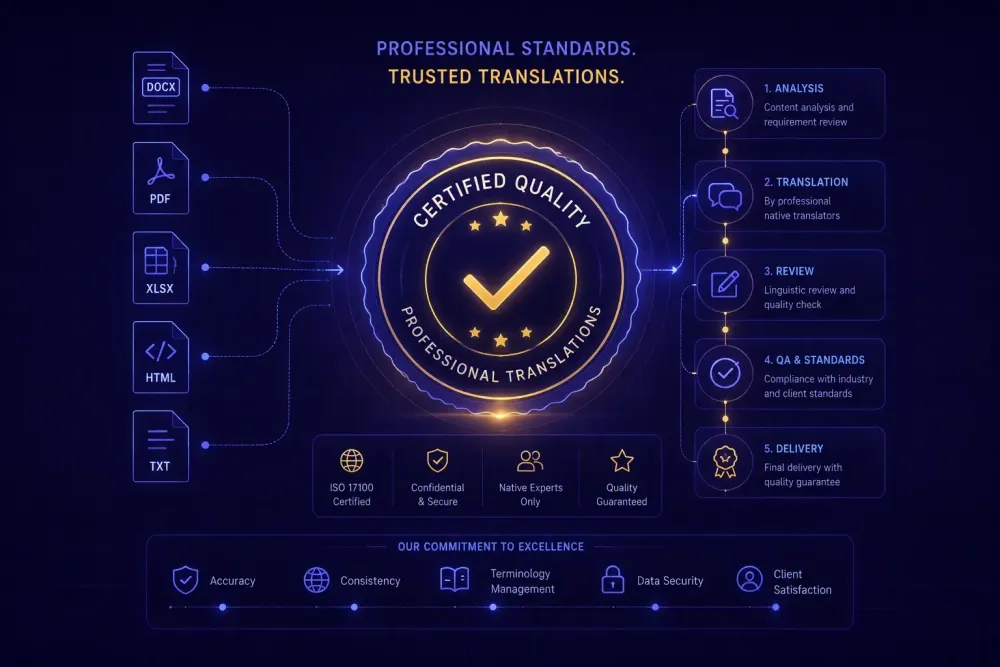
The standard covers five process stages: pre-production (capturing and confirming client instructions, agreeing on scope), translation, revision by a second qualified linguist, verification of formatting and completeness against the source, and post-production review before delivery. Documentation requirements attach to every stage. The revision step in particular catches agencies off guard during initial gap analyses. ISO 17100 requires every translation to be checked by a different qualified person before delivery, enforced as a process requirement that auditors verify in actual project records rather than just claimed in policy documentation.
Personnel qualifications are specific. Translators must hold a recognized translation degree, a recognized degree in another field combined with two years of full-time professional translation experience, or five years of documented full-time translation experience. Revisers need the same baseline and must be a demonstrably different person from the translator on each project.
For agencies already routing work through formally trained translators and running structured revision cycles, meeting these requirements may be closer than expected. For agencies working with a mix of experienced but informally trained translators and informal review processes, the gap is larger. In practice, qualification tracking consistently turns out to be the biggest operational lift during preparation. Agencies often discover during their gap analysis that translators they assumed were compliant don't meet the specific criteria once they apply them systematically.
The standard also requires documented quality management procedures, project-level records of client instructions, complaint-handling processes, and ongoing compliance records that demonstrate consistent adherence. Most agency owners who complete the certification process report that the documentation burden was two to three times what they initially estimated.
The real cost of certification
Certification fees vary by country and certifying body. BSI, SGS, Bureau Veritas, and TÜV are common in the translation space. Initial certification typically runs $3,000 to $8,000 depending on agency size and geography, covering the application, initial audit, and first certification cycle. Annual surveillance audits, required to maintain certification, run $1,000 to $3,000 per year in most markets.
The financial cost is only part of the picture. Preparation typically takes six to twelve months for agencies without existing documented systems. That means writing process documentation, creating project templates, building qualification records for every translator and reviser on the roster, setting up a complaint log, and ensuring that everyone touching client work follows documented procedures consistently. The agencies that have gone through the process typically estimate 150 to 300 hours of internal preparation time spread across management, operations, and whoever manages freelancer relationships.
What auditors examine during surveillance visits typically includes project records with timestamps showing that translation and revision were completed by different people, qualification documentation for each linguist used during the audit period, records of how client instructions were captured and communicated, and complaint records with resolution notes. These aren't hypothetical requirements. They're the specific records an auditor will request.
There's also an ongoing operational cost that tends to get underestimated. After certification, skipping the revision step on a small urgent job isn't an option. Assigning a translator who doesn't meet the qualification criteria because the usual person is unavailable isn't an option. Surveillance auditors examine actual project records against documented processes. ISO 17100 commits you to your workflow in a binding way, which is either a stabilizing force or a significant operational constraint depending on how the agency currently runs.
Agencies already operating with consistent, documented workflows and qualified personnel typically find the compliance burden minimal. Agencies that rely on flexibility during busy periods face a more significant operational shift, and should factor that into any realistic cost estimate.
When ISO 17100 certification actually opens doors
The certification has concrete business impact in three client segments, and being precise about which segments matters.
Enterprise procurement is the clearest case. Large companies in pharmaceutical, financial services, and industrial manufacturing sectors commonly require ISO 17100 certification from translation suppliers before adding them to preferred vendor lists. The requirement appears in RFP qualification criteria and vendor onboarding checklists. A pharmaceutical company running a tender for ongoing medical documentation translation may screen on certification before evaluating price, turnaround time, or team expertise. Agencies without certification don't advance past the initial screening, regardless of track record or client references.
The reason these sectors care is straightforward: regulated industries need to demonstrate that their processes, including outsourced functions like translation, meet documented professional standards. ISO 17100 gives procurement teams a certifiable answer to that question.
Government contracting in the EU, UK, and parts of North America carries similar requirements. National and regional public-sector bodies purchasing translation at scale frequently list ISO 17100 as a minimum qualification, not a preference but an entry filter that determines whether a submission gets read at all.
Legal translation and certified document work for courts or regulatory submissions represent a third area where the credential carries weight. Some clients need to demonstrate to a court or oversight body that their translation was produced to a professional standard, and ISO 17100 makes that case easier to support.
Outside these three segments, the credential is largely invisible. SME clients rarely ask for it. Direct clients in technology, marketing, or e-commerce usually don't know it exists. Agencies working primarily in these markets pay for a certification that never comes up in a sales conversation.
The practical question is: look at where revenue actually comes from and where growth is genuinely targeted. If meaningful pipeline or near-term revenue involves enterprise procurement, government contracting, or regulated sectors, certification has a traceable return path. If it doesn't, the ROI argument is hard to make.
What you actually lose without it
Not being ISO 17100 certified doesn't mean an agency's work is substandard. It means a third party hasn't audited and documented that the agency meets a specific set of process requirements. The credential and the quality are separate things, and conflating them leads to poor decisions in both directions.
The concrete losses are specific. Enterprise vendor qualification lists with explicit certification requirements will exclude you. Government tenders that list it as a minimum filter you out before anyone reads your submission. Some large agency partnership tiers require certification from their subcontractors as a standard condition. In those situations, absence of certification is a genuine disqualifier that portfolio work and client references can't overcome.
Consider what this looks like in practice: a potential client from a regulated sector sends an RFP with a standard qualification questionnaire. One of the questions asks whether the agency holds ISO 17100 certification. Without it, you check "no." In most enterprise procurement processes, that's the end of the evaluation. The rest of your submission (your team qualifications, your client list, your quality process) doesn't get read. The certification requirement functions as a pre-filter, not a scoring criterion.
There's also a subtler competitive effect in head-to-head comparisons. Two agencies quoting similarly for the same project, one certified and one not: a risk-averse procurement buyer may default to the certified option as a defensible choice. This effect is real in certain buyer profiles even when certification isn't actively weighted in the evaluation criteria.
What agencies don't lose: direct client relationships, most SME work, referral-sourced projects, and most marketing and creative translation work. The majority of translation agency revenue flows outside procurement processes that require certification. That ratio changes as agencies grow into enterprise territory, but for most small agencies it's a useful anchor when evaluating whether the investment makes sense now.
What small agencies do instead
Agencies that operate without ISO 17100 without losing meaningful business tend to have a few things in common.
Most document their processes anyway. Not at ISO compliance level, but enough that a new project manager can follow the workflow without guessing and a client asking about quality gets a concrete answer. Written process documentation covering translation, revision, and delivery signals professionalism without requiring an external audit. This matters most in mid-market sales conversations where buyers aren't running formal procurement but still ask what happens before a file leaves the building.
Many maintain qualification records for their translator roster. Knowing which translators hold formal translation degrees or have documented domain experience in specific fields—legal, pharmaceutical, technical—means you can answer client questions about team qualifications credibly. For clients in specialized domains, who does the work often matters more than what certification label the agency holds.
Some invest in client references and project documentation rather than credentials. A specific, documented example of a complex project delivered well, with client permission to reference it, often carries more weight in a sales conversation than certification paperwork a buyer can't independently evaluate. For SME and mid-market clients, demonstrated proof outperforms compliance frameworks.
A growing number invest in structured translation workflows that produce visible quality artifacts: QA reports, documented revision records, structured review steps. Tools that bring traceability to the translation process, like those discussed in how AI translation tools are reshaping agency workflows in 2026, give clients something reviewable even without a certifying body involved.
Making the decision
Start with your actual client mix. If 30% or more of current or targeted revenue involves enterprise procurement, government contracting, or regulated sectors like pharmaceutical or legal, ISO 17100 certification belongs in a 12-month planning horizon. The investment has a traceable return path in those segments, and the longer you delay while actively pursuing those clients, the longer you leave those procurement doors closed.
If you're at an earlier stage or working primarily with SMEs and direct clients, the more useful question is whether documented processes exist at all. If not, build them first—not for certification but because undocumented workflows introduce errors and don't scale. Getting operations in order before pursuing certification means building something useful regardless of whether you ever pay for the audit. The third-party validation adds legitimacy; the underlying documentation adds actual operational value.
If you're between these two positions—growing, winning occasional enterprise interest, not yet consistently inside procurement cycles—building toward ISO 17100 readiness over 18 to 24 months is a practical path. Many certifying bodies offer pre-assessment audits that clarify where you stand before committing to the full process. This approach works best when certification readiness comes as a byproduct of building a better-organized operation, not as the primary driver.
One observation from agencies that extracted the most from certification: they were already running structured operations and used the certification process to formalize what they were doing anyway. If the plan is to pursue certification as the mechanism for finally building quality systems, the cost in time and money will be considerably higher than if you build those systems first and certify when the business case is genuinely clear.