Is Google Translate safe for confidential documents? A 2026 privacy guide
We break down whether Google Translate is safe for confidential documents: what Google does with your text, GDPR implications, and what to use instead.
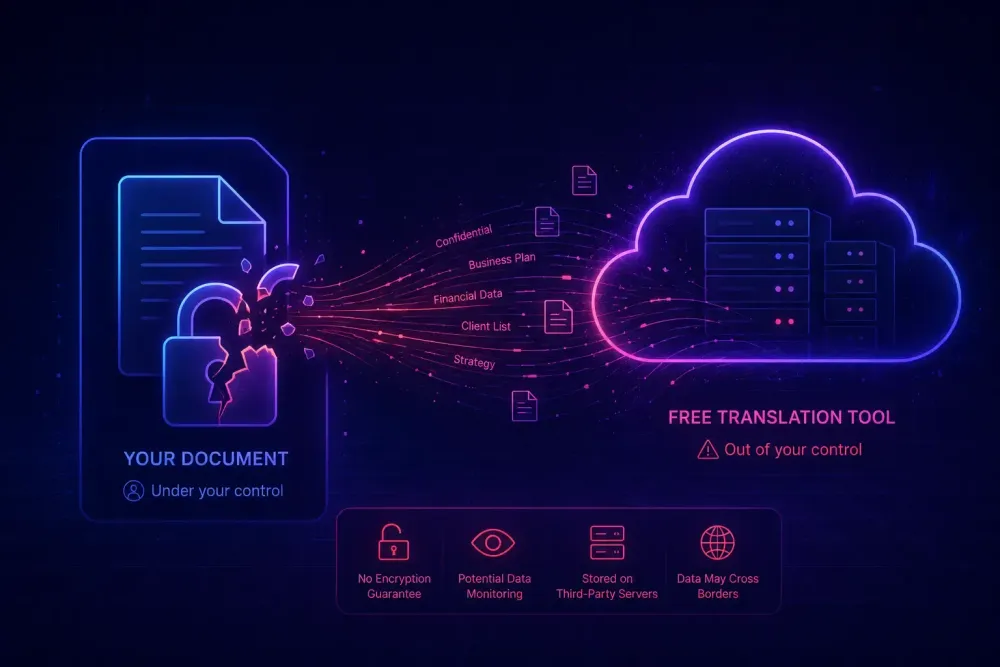
Translation teams use Google Translate every day for dozens of small tasks: checking a word, sanity-testing a phrase, roughing out a segment before post-editing. But when the document is an NDA, a medical record, a financial statement, or a contract, the question stops being trivial. Is Google Translate safe for confidential documents? It's one of the most common questions we hear from project managers and agency owners, and the honest answer depends on which Google product you're actually using, what your client contracts say, and how applicable data-protection law defines processing.
What Google Translate actually does with your text
Start with the basics. Google Translate at translate.google.com is a free consumer product. Like most free tools, it sits inside an advertising and data ecosystem. Google's Terms of Service — the ones governing consumer products — grant Google a license to use, host, store, and process content you submit for the purpose of operating and improving its services.
In practice, text pasted into the web interface may be stored by Google and potentially used to improve translation quality. Google has not published a specific, auditable data-retention policy for the consumer Translate product that says how long text is kept or exactly how it feeds into model training. That absence of specificity is itself the risk.
What you're working with is not a defined retention window or a data-processing agreement — it's a consumer terms document that gives Google broad discretion over submitted text. For one-off, non-sensitive phrases, that discretion rarely creates a problem. For a 50-page M&A due-diligence document or a clinical trial report, the same terms create a real exposure that most legal departments would flag on first review.
The picture changes with Google Cloud Translation API. If your TMS or internal workflow connects to Google translation through the Cloud API, you're operating under Google Cloud's enterprise terms, which have tighter data controls and a formal DPA (Data Processing Addendum). Text submitted via the API under those enterprise terms is not used to improve Google's consumer-facing models. But this distinction is invisible in daily practice: translators pasting text into translate.google.com are not on the API path, and many off-the-shelf "Google Translate" integrations in basic translation tools use consumer endpoints unless the vendor has explicitly licensed the Cloud API.
Knowing which version you're actually using is the first thing worth checking.
GDPR, CCPA, and the legal framing agencies can't ignore
For teams working in the European Union or with EU clients, the free product creates a specific compliance problem under GDPR. Article 28 of the Regulation requires that when a controller (your client) shares personal data with a processor (you, as the translator), you work only with sub-processors who can provide sufficient guarantees under the Regulation. If you use a tool that processes that data without a signed Data Processing Agreement, you may be in breach.
Google does offer a DPA for its Cloud products. It does not publish a GDPR-compliant DPA for the free consumer Translate product. This means personal data — patient names, employee records, customer information — pasted into the free tool is being processed by a sub-processor (Google) without the legal framework GDPR demands.
In the United States, the picture is less uniform. CCPA's requirements apply to California residents' personal information, and HIPAA's Business Associate Agreement requirements apply to protected health information. Neither framework is satisfied by a free web translation tool. The CCPA regime requires that data shared with service providers is governed by a written contract limiting how they can use it — and the consumer Translate terms do the opposite, giving Google broad usage rights.
None of this applies if your content is fully anonymized with no personal identifiers. But most confidential business documents are not anonymized. The moment a document contains a name, a company identifier, a patient ID, or financial figures tied to a natural person, you're in data-processing territory — and the tool handling that content needs a corresponding legal basis.
Which document types carry the most risk
Not every translation job carries the same risk profile, and the privacy concern around Google Translate applies most sharply to a specific subset of content.
Legal documents — NDAs, contracts, litigation materials — typically contain personal identifiers and fall under attorney-client privilege or explicit confidentiality clauses. Most NDA agreements between clients and translation vendors prohibit disclosure to third parties, and most lawyers would classify a third-party AI system that stores and processes document content as disclosure, regardless of intent.
Medical records and clinical documents are protected by specific regulations (HIPAA in the US, equivalent frameworks in the EU and UK). Pasting a patient intake form or clinical trial summary into a free translation tool creates potential exposure that's difficult to walk back.
M&A and financial due-diligence materials often contain material non-public information. The risk here goes beyond data privacy into securities considerations for content related to publicly traded companies.
The other end of the spectrum is genuinely lower risk. Generic marketing content, public-facing website copy, or documents with no personal identifiers are a different situation. If you're checking a tagline translation or confirming a term in a product brochure that's already publicly available, the practical exposure is minimal.
Technical manuals with no proprietary methodology detail, general educational content, and creative texts where the author has given consent also tend to sit in a safer category. Knowing which category your work falls into before you open a tool is the habit worth building.
What your client contracts almost certainly say
Most professional translators work under client contracts or agency agreements that include confidentiality clauses. Many of those clauses were written before AI translation tools were standard in professional workflows, which means they weren't written with free cloud tools in mind — but they still apply.
A standard confidentiality clause prohibits disclosing or sharing the client's confidential information with any third party. Legal interpretation of "sharing" typically includes submitting content to a service that stores or processes it, even when the purpose is operational rather than competitive. The fact that you're using Google Translate to help complete the translation, not to leak the content, is not a defense most contracts or courts would accept.
The practical problem is that many freelancers signed their client agreements years ago and haven't revisited the confidentiality provisions since. If you manage translation delivery at an agency, this is worth auditing before you're in a position where you wish you had. Pull the last three or four client master service agreements your team works under and find the confidentiality section. Check how it defines "third party" and whether it covers tools and software, not just human subcontractors.
Some enterprise clients now include provisions about AI tools that are explicit enough to name categories of prohibited services. We've seen RFQs that require vendors to confirm no content will be submitted to AI systems that store or train on user data. If your client sends you one of those questionnaires and your team has been using the free Google Translate product, the honest answer is a problem. Better to audit the workflow before that question arrives.
Tools that give you actual data control
Google Translate is not the only option, and several professional alternatives offer data controls the free consumer product simply doesn't have.
BYOK (Bring Your Own Key) AI translation is one of the stronger options for agencies that want high-quality AI output with clear data ownership. When you supply your own API key — from OpenAI, Anthropic, or another provider — and translate through a tool that sends requests under that key, the data-processing relationship is between you and the API provider, not a free consumer product with broad terms. OpenAI's enterprise API agreement states that data submitted through the API is not used to train models, and the API comes with a defined data retention and deletion policy. This means you can point to a signed legal document when a client asks how their content is handled.
On-premise or locally hosted LLM translation is the most private option and the right choice for regulated industries handling truly sensitive content. Running a model locally means no data ever leaves your infrastructure. The trade-off is quality — local models in 2026 are still below the best cloud models for many language pairs and specialized domains — and the infrastructure overhead is real. For most small and mid-sized agencies, on-premise is not practical, but it's worth knowing it exists for the right use case.
Structured AI translation tools with explicit DPAs sit between those two. If you're using a product that has signed a GDPR-compliant DPA and processes your content through a licensed API arrangement rather than a free consumer endpoint, you have a defensible paper trail. The word you need to look for is "explicit" — make sure you've seen the actual DPA, not just assumed it exists because the product looks professional.
For translating DOCX, XLSX, or PPTX files through a structured workflow with glossary and prompt controls, SnapIntel is built for that use case. The agency tier includes BYOK behavior: you supply your own OpenAI API key, so the data-processing terms that apply are those of your API agreement, not a free consumer product.
How to decide when Google Translate is acceptable
A blanket "never use Google Translate for anything professional" position is impractical for most teams. A short decision framework is more useful than a flat prohibition.
Match the tool to the document's sensitivity level. Establish a simple internal classification — public content, internal content, confidential content. Apply a corresponding tool policy. Free translation tools: public content only. For anything confidential, use a tool with a signed DPA and a clear data-retention policy. The classification doesn't need to be formal to work; a shared team understanding is enough for most agencies.
Use Google Translate for quick reference, not for processing full documents. Looking up a term or checking one sentence is meaningfully different from pasting a complete 30-page document. Even isolated lookups aren't risk-free, but the exposure is proportionally smaller and harder to argue rises to the level of a confidentiality breach.
Check client agreements before the project starts, not after. This should be standard intake for any new client relationship. If an existing agreement prohibits free cloud tools and your team has been using them, the right move is to surface the gap and adjust the workflow. Hoping it stays undiscovered is not a risk-management strategy.
Don't assume that "enterprise" means compliant. There are professional-looking translation platforms that sit on free-tier APIs or have privacy policies written for consumer use cases. A polished interface doesn't guarantee a signed DPA. Ask your vendor for it directly, or check their documentation for a GDPR page that links to an actual Data Processing Agreement, not just a privacy notice.
This framework works best for agencies with repeating workflows and multiple client relationships. If you're a freelance translator handling one-off projects, the overhead might feel disproportionate — but a short mental checklist before opening any tool takes less time than dealing with a client complaint about how their content was handled. See also: how AI translation tools are changing the way translators work in 2026 for a broader view of where the profession is heading.
Data privacy is a procurement decision, not an afterthought
Google Translate is not broken or deceptive. For personal use, public content, and quick terminology checks, it's a functional tool that billions of people use appropriately every day. The problem is using a consumer product in a professional context where the content's sensitivity, your client's contracts, and applicable data-protection law all pull in a different direction.
The agencies and translators who handle this well treat tool selection the same way they'd treat any vendor procurement decision: understand what the tool does with data, verify the legal documentation exists, and match the tool's controls to the content's sensitivity. For confidential DOCX files, medical records, legal contracts, and any content with personal identifiers, the free consumer Translate product is the wrong tool — not because Google is untrustworthy, but because its terms don't give you the control that professional work requires.
The actionable step: before your next project with a confidential document, answer three questions. Which Google product or endpoint is your team actually using? What does the relevant client agreement say about third-party data processing? And do you have a signed DPA with any AI tool in that workflow? If any of those answers are unclear, that's where to start — before the client asks the same questions.