How translation agencies are responding to AI: five real strategies
How translation agencies are responding to AI: five concrete strategies covering MTPE workflows, pricing tiers, and post-editor training.
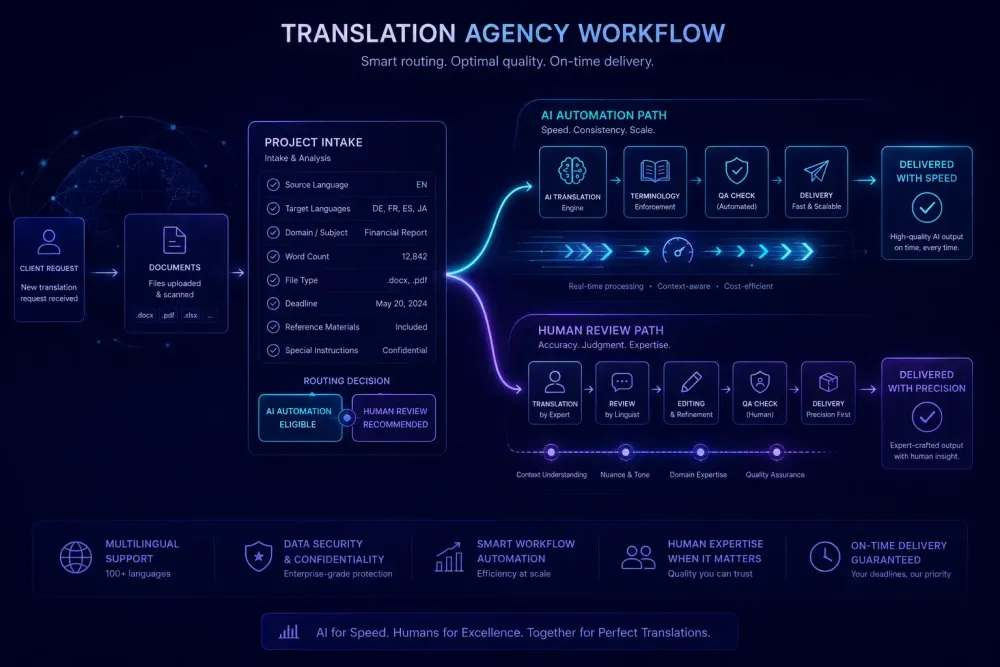
The debate about whether AI will change translation is over. It already has — for specific content types and language pairs, in ways that are now impossible to ignore at the pricing level. What's still unresolved is how translation agencies should respond, not in principle, but in practice. When we talk to project managers and agency owners, the thing we hear most often isn't "should we adopt AI?" It's closer to "we've already started, and we're dealing with consequences we didn't expect." Here are five concrete strategies agencies are actually deploying, along with where each one tends to go sideways.
The real pressure driving how translation agencies respond to AI
Most industry coverage frames this as a single pressure: AI is going to displace human translation, agencies need to adapt. The actual picture is more fragmented.
One pressure is coming from buyers directly. Clients who used to rely entirely on agencies for internal communications, product descriptions, and corporate content have started running MT themselves. Some come back when quality doesn't hold up. Others don't — they've concluded MT is good enough for documents that won't be read closely, and they're not paying agency rates for that category anymore. For agencies whose revenue was concentrated in high-volume, lower-stakes content, that's a real contraction in addressable work.
A different pressure is hitting at the contract level. As MT quality has improved in common language pairs, clients renewing agreements are increasingly asking why per-word rates don't reflect the fact that AI can produce a rough first pass in seconds. MTPE work is where this friction is sharpest: disagreements about how much post-editing actually happens, and what that editing is worth, have become standard negotiation issues in a way they weren't two years ago.
There's a third pressure that gets less coverage: the translator side. Experienced translators are being asked to do post-editing at rates that don't reflect what the task actually demands. Post-editing isn't easier than translation — it's different, and in some ways more demanding. Agencies that treat it as a cheaper substitute without adjusting how they compensate for it tend to lose the reviewers they most need to keep.
Slator's industry reporting has consistently noted that agencies navigating these pressures most clearly tend to share one thing: a defined position on where AI belongs in their workflow, and the ability to communicate that position without ambiguity. Vague adoption — running AI without telling clients or translators exactly how it's used — tends to create more problems than it solves.
Strategy 1: Making AI the first pass, not the full workflow
The most common structural change we've seen in midsize agencies is what you might call an MT-first model: AI translation runs on every project as an initial pass, then a human translator or post-editor reviews the output. The translator's primary job shifts from production to review.
That sounds like a small change. It isn't. Agencies running MT-first measure productivity differently — no longer words translated from scratch per day, but review throughput and edit density: how many words a post-editor can process per hour, and what proportion require significant changes versus light correction.
A practical example: an agency handling legal contracts for corporate clients runs incoming documents through MT, then routes segments with low confidence scores to senior translators. Standard boilerplate — indemnification clauses, governing law language, routine representations — typically clears QA with a light pass. Non-standard drafting and jurisdiction-specific provisions go to a specialist who works from the source.
This model works well for content where MT quality is predictable and errors are correctable before delivery. It breaks down for content where errors carry liability, and for clients who have contractual requirements that translation be performed by a qualified human translator without MT involvement. The agencies that learned this the hard way adopted MT-first without reviewing their service agreements first.
Strategy 2: Building pricing tiers that reflect what's actually different
The agencies that have been most deliberate about AI have mostly stopped presenting a flat service structure to clients. They've built explicit tiers: an AI-assisted track for content where speed and cost matter most, and a full human translation track for content where quality is the primary requirement.
The gap between the concept and the execution is larger than it looks. Clients used to one price for "translation" often don't understand what the distinction means in practice, or they assume the lower-priced tier means less effort rather than a different kind of effort. An agency that doesn't invest in explaining this tends to produce clients who feel misled, even when the output was entirely appropriate for what they ordered.
One workable approach: a marketing and communications agency built a two-track structure for web content and social media. The AI-assisted track uses MT with human review, delivers in 24 hours, and carries a lower per-word rate. The editorial track runs human-led translation with senior review, delivers in 48-72 hours, and is priced at the standard rate. Clients select the track at the brief stage. The intake form includes a plain-language explanation of what each track covers and where the output characteristics differ.
The constraint for smaller agencies: running two quality tracks stretches capacity. Two QA checklists, two reviewer pools, two sets of client expectations to manage. Below a certain team size, that operational overhead may not be worth the structural complexity.
Strategy 3: Training post-editors, not just pointing translators at MT output
This is the strategy most agencies skip, and it's usually the most expensive skip.
Post-editing is not a simpler version of translation. Translating from scratch means building meaning from source text, making choices about tone and register, constructing target-language sentences. Post-editing means reading AI output quickly, identifying what's wrong or suspiciously smooth, deciding whether to correct in place or rewrite the segment entirely, and doing all of this at a pace that makes the project economics work.
CSA Research and Nimdzi have both documented this friction: translators with strong source-to-target instincts often find MT review more cognitively demanding, not less, because the mode is different. Reading AI output requires evaluation rather than construction. Translators who approach post-editing the way they approach translation — starting from the source, rebuilding meaning segment by segment — tend to be slower than the workflow requires, and more frustrated than they expected to be.
The agencies that have handled this well built actual training programs. One European LSP referenced in Slator's coverage ran a four-week post-editor training cycle, tracking edit density and review speed before and after. Editors who completed the program reviewed 30% more words per hour while maintaining quality scores. The program cost roughly 40 hours of trainer time. They reported that it paid back within six weeks on active MTPE contracts.
That's the kind of ROI figure that makes the decision look obvious in retrospect. It's much less obvious before you run the program, which is why most agencies keep deferring it.
Strategy 4: Using quality documentation as the actual product
Some agencies aren't rushing into MT workflows at all. Their response to AI is positioning quality visibility as the explicit differentiator — not quality in the abstract, but quality that's documented and deliverable.
These are mostly agencies serving regulated industries: pharmaceuticals, financial services, legal. Their clients don't want cheaper AI-assisted translation. They want confidence that the translation is correct, and they want records that confirm it. So rather than competing on cost reduction, these agencies compete on audit trail.
In practice: they deliver QA reports as client artifacts, not internal documents. The report shows error counts by category — accuracy, fluency, terminology — revision history, and reviewer credentials. It's part of the deliverable package. Clients who ask "how do I know this is right?" receive a scored, categorized document rather than a general reassurance.
This approach also means engaging more explicitly with quality frameworks. Agencies using MQM (Multidimensional Quality Metrics) or similar structured error typologies can speak to enterprise buyers in language those buyers increasingly expect. A pharmaceutical company asking about translation accuracy for a regulatory submission wants an error severity breakdown, not a rating of "high quality."
Where this breaks down: the positioning promise has to be backed by real systems. An agency selling quality as its differentiator without consistent terminology management, reliable QA workflows, and a way to generate accurate reports efficiently is setting client expectations it can't meet. The systems have to exist before the positioning does.
Strategy 5: Deciding which projects get AI — and holding that line
The agencies managing AI integration most thoughtfully don't have a blanket policy. They have a classification framework, applied before the project starts.
The logic typically runs: content type first, then domain, then client context. Marketing copy with high style tolerance and a short shelf life goes AI-first. Technical documentation for regulated products runs human-led with AI support at specific points — pre-translation of repetitive segments, automated QA flagging. Legal and regulatory content for clients with explicit contractual requirements around human translation gets no AI in the translation step.
At many agencies, this framework isn't a formal flowchart. It's embedded in the project intake checklist — a set of standard questions about end use, content type, and client requirements that determine which workflow the project enters. The classification happens at intake, not after the translator has already done the work.
The risk with selective adoption is consistency across the team. If one project manager applies the framework carefully and another treats it as optional, the agency is effectively running two different quality standards. According to GALA's research on LSP operations, workflow classification at the intake stage — deciding which process a project enters before work begins — is one of the clearest dividers between agencies handling AI integration smoothly and those struggling with it.
What the agencies doing this well actually have in common
Looking across agencies managing the transition thoughtfully — not perfectly, just deliberately — a few patterns stand out.
They made an explicit decision about where AI belongs in their workflow, rather than reacting project by project. That position might be "MT-first on everything except regulated content," or "human-led with AI QA support," or even "we're not using AI in translation yet, but we're building QA infrastructure so we can do it responsibly when we're ready." Any of those is defensible. Having no position — adopting whatever the client asks for this week — is where agencies tend to lose ground.
They communicated that position to both clients and their translator roster. Translators who don't know whether AI is being used in projects they're reviewing, and clients who don't know what they're actually paying for, both become problems. Just at different stages of the delivery cycle.
And they resisted the pressure to adopt AI across all workflow steps simultaneously. The agencies that tried to run AI translation, AI QA, AI project assignment, and AI client communication all at once — because the tools were available and the efficiency gains seemed additive — are largely the ones who've had to walk back at least one of those decisions and spend time rebuilding trust.
One concrete place to start
If you haven't settled on a clear position, start with the intake classification decision before anything else. Map your project types, your client contractual requirements, and your translator roster's actual skills. Decide where AI belongs and where it doesn't — and build that into your intake process.
If you've already adopted MT-first workflows, check whether you've done real post-editor training or whether you pointed translators at MT output and hoped for the best. The throughput gains that make the economics work don't appear without the training step.
Both of these decisions intersect with how AI tools in translation are developing more broadly, and understanding that trajectory matters for planning ahead. Our overview of how AI translation tools are changing the way translators work in 2026 covers where the capabilities are heading and what that means for professionals managing this transition now.