How to translate e-commerce product listings without losing conversion power
Ecommerce product translation goes beyond accuracy. Register, units, SEO, and cultural context all affect whether your localized listings actually convert.
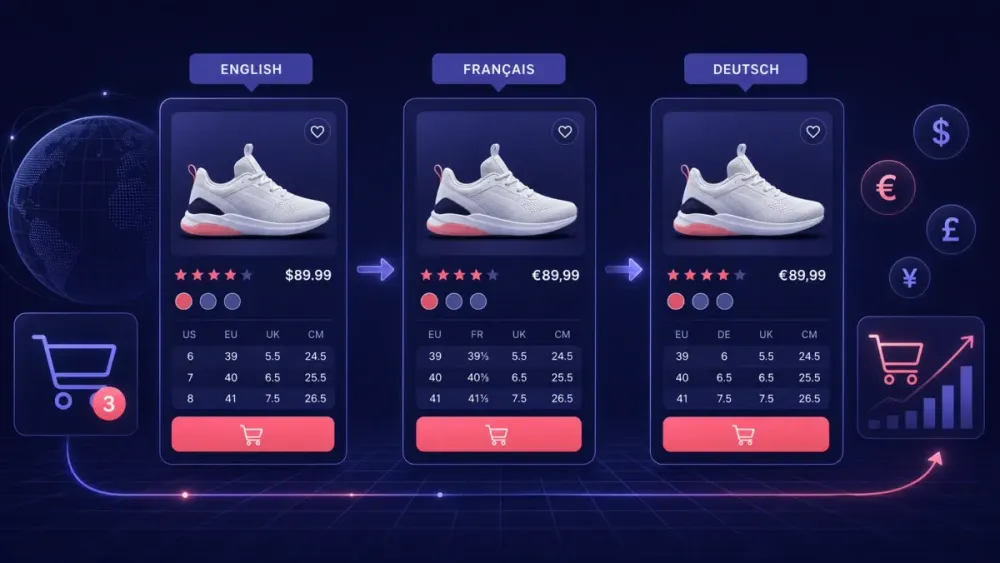
When a product listing gets translated, the most common outcome is copy that's technically accurate and commercially dead. We've seen this in catalog after catalog: grammar checks out, the words mean what they should, and somehow nobody clicks "add to cart." Ecommerce product translation isn't translation in the traditional sense. It's persuasion work in a different language, and those are genuinely different skills.
Why ecommerce product translation fails when you treat it like document work
Standard translation workflows are built for fidelity. A legal contract needs to say exactly what the source says. A user manual needs to match source procedures step for step. These are correctness problems, and most translation workflows handle them reasonably well.
Product listings operate differently. They're sales copy. The goal isn't to preserve the source — it's to make someone in a different country, reading in a different language, feel compelled to buy. The source text is already a compromise between product description and persuasion. Translate it literally, and you often lose the persuasion while keeping the facts.
Consider a listing for a leather messenger bag. The US source copy opens: "Durable enough for a Monday, stylish enough for Saturday." That's a lifestyle appeal. It tells a story about when and how you'll carry the bag. A word-for-word German translation might technically convey the same message, but German consumer copy tends to be more direct about product specs and quality signals. A translator who doesn't know this will hand you copy that feels slightly off to a German buyer, because the appeal structure doesn't match what they're used to reading.
The underlying problem is that ecommerce listing translation often gets treated as a throughput task: words, speed, cost. It rarely gets treated as a persuasion localization problem. Workflows and KPIs push toward volume, and quality gets measured as "no translation errors," not "does this convert."
The tone and register problem nobody puts in the brief
Register sinks more ecommerce translations than any individual word choice. How formal, how direct, how warm — these vary significantly by product category and by market, and almost nobody documents this in the translation brief.
We've reviewed translated fashion listings, kitchen appliance descriptions, and supplement copy across French, Italian, and Japanese markets. In each case, the English source had a distinct register: direct and confident for supplements, aspirational for fashion, technically dense for appliances. In each case, the translated versions flattened toward a generic middle register: polite, slightly formal, grammatically correct, and emotionally flat.
French beauty copy feels intimate and personal in the original. German consumer electronics descriptions tend to be structured and claims-focused. Japanese product listings often use a softer register that sounds overly cautious translated back into English but reads appropriately in context. None of this shows up in a standard translation brief.
The practical fix is a one-page register guide for each product category. It doesn't have to be long. Something like: "This brand voice is direct and no-nonsense. Avoid exclamation points. Use second person (you/your). Short sentences preferred." That's enough for a competent translator to make better calls than the source text alone would guide. Without it, they default to whatever feels safe, and safe tends to be flat.
This matters more with generalists. A translator moving between legal contracts, medical records, and consumer products in the same week will settle into a neutral tone that doesn't embarrass itself anywhere. A translator who spends most of their time on fashion or consumer tech has internalized what copy sounds like in those categories. For ecommerce listings, that kind of category fluency is worth seeking out.
Product names, units, and measurements
Branded product names generally stay as-is across markets. "ProX8 Wireless Earbuds" stays that in every locale. The copy around the name is what needs localization.
Generic product descriptor words are trickier. "Premium" is widely used in English marketing copy, but it doesn't translate uniformly. In France, "premium" often appears as-is because it has absorbed its English connotation, but "de qualité supérieure" signals something different and sometimes more credible. A translator defaulting to one or the other without guidance is making a brand positioning call that nobody told them to make.
Units are a known problem that still gets overlooked. Cooking equipment descriptions with cup and tablespoon measurements mean very little to a European buyer expecting metric. A mattress described in US queen/king sizing is confusing in markets that use centimeter dimensions. Clothing sold in US sizes needs a size chart, not just translated label text.
In one catalog project, a camping equipment seller had carefully localized their product descriptions for German buyers but left all temperature ratings in Fahrenheit. A sleeping bag rated "for temperatures above 40°F" is clear to a US buyer. To a German buyer expecting Celsius, it requires a mental conversion most shoppers won't bother with. The problem wasn't a translation error. It came from a brief that didn't flag temperature units as needing conversion. Fixing it cost a full revision round that could have been avoided.
Build a measurement conversion checklist into every ecommerce catalog brief. Walk through the source catalog and flag every unit type: temperature, weight, volume, clothing sizes, shoe sizes, display dimensions, electrical specs. Decide the target market standard for each and document it before translation begins. For a new product category, this takes maybe 30 minutes and prevents revision rounds you'd otherwise pay for later.
Why translated listings need their own SEO research
Source-language SEO doesn't survive translation. A listing optimized for "men's leather wallet" in English is not automatically optimized for anything in French once it's been translated. The text may now contain "portefeuille en cuir pour homme," which is correct, but whether that phrase is what French shoppers actually type into a search bar is a separate question requiring separate research.
Search behavior differs meaningfully by language. In German, compound words work differently than in English, which changes how people phrase product searches. In Japanese, transliterated English brand terms sometimes outperform their Japanese-language equivalents in product search, because of how international products get referenced online. In Spanish, regional variation between Spain and Latin America means a term that performs well in one market can underperform in another.
The practical consequence is that ecommerce product translation needs a parallel keyword brief for each target locale. This doesn't mean a full SEO audit for every product — that's impractical at catalog scale. But for primary product categories, someone needs to verify that the translated text uses terms people actually search, not just terms that translate correctly.
An approach that holds up at scale: identify the 20-30 highest-traffic products in each target locale, run keyword validation for those, and use the findings to build a glossary reference for the rest of the category. High-traffic items set the terminology standard; lower-traffic items follow through TM and glossary. You're not doing keyword research on every SKU, but the research you do propagates through the catalog.
What breaks after the catalog goes live
The most persistent post-launch problem is terminology inconsistency. The same product attribute rendered three different ways across hundreds of listings because nobody defined it in the brief.
"Machine washable" is a simple claim. In a translated catalog, it might appear as three different phrasings in the same product category because different translators, different translation memories, or different review passes each made a slightly different call. For a buyer browsing related products, the inconsistency reads as carelessness. The meaning is correct each time. The effect is that the catalog doesn't look like it was put together with care.
The fix is a frequency check of high-occurrence attribute terms before the catalog goes live. Pull the 50 most-used product descriptor terms in the translated catalog and check them for consistency. If "waterproof" has three different translations in a single market, standardize to one and push the correction through. Line-by-line QA review misses this because reviewers focus on individual listings rather than term-level patterns across the catalog.
The second recurring problem is cultural references that survived translation when they needed to be adapted. "Perfect for a weekend at the cabin" translates correctly into Norwegian. It may still mean nothing useful to the buyer, because what a Norwegian shopper imagines as cabin life and what an American buyer imagines are not quite the same thing. The phrase needed rewriting, not translation. These references should be flagged during project setup, not discovered after delivery.
For teams working with machine-translated copy at the post-editing stage, this guide on handling AI translation output efficiently covers which types of errors to prioritize when review time is limited.
A workflow approach that holds up at catalog scale
For ecommerce product translation at real volume, ad hoc workflows break down. The catalogs that localize well share a consistent setup that gets established before any translation begins.
Define product tiers first. Not every listing needs the same treatment. High-traffic hero products warrant full translator plus editor review. Mid-tier products can go through translation with a lighter review pass. Long-tail items in low-traffic categories can often be handled through MT post-editing focused on register and measurement issues. Assigning workflow based on traffic and revenue impact, rather than applying a uniform process to every SKU, is where you recover efficiency without sacrificing the listings that matter most.
Build the brief before translation starts. Voice and register guidelines by category, product name handling rules, a measurement conversion table, and a priority keyword glossary for each target locale. An hour on the brief saves several hours in revision.
Use translation memory from your existing localized content. If you've already translated 200 items in a product category, those confirmed translations should feed the TM for the next batch. Standard disclaimers, shared product attributes, material descriptions — all of these should pull from existing TM rather than being retranslated from scratch. This isn't just a cost consideration. A maintained TM keeps attribute language consistent across a catalog in a way that human review alone can't sustain at scale.
Measure after launch. Track add-to-cart rates by locale for comparable products. If a localized listing consistently underperforms its source-language equivalent after accounting for market differences, pull the copy and compare it to the source. Underperformance usually traces back to register mismatch, unresolved cultural references, or missing search terms — and those are fixable with targeted revision rather than full re-translation.
One thing worth tracking separately is the return rate by locale. A product that gets purchased but returned at a higher rate in one market than others may have a listing that oversells or misdescribes for that market's expectations. That's a translation and localization quality signal that add-to-cart rates alone won't surface.
The goal isn't to produce a flawless first-pass catalog. It's to build a system where the second localization is easier than the first, and the fifth is easier still. That only happens if you document the decisions, maintain the glossaries, and treat ecommerce product translation as a discipline rather than a one-time throughput job.
What the brief should actually contain
If there's one practical thing to take from all of this, it's that the translation brief is where most ecommerce localization projects succeed or fail — before a single segment gets translated.
A useful brief for an ecommerce catalog covers: the target locale and any known regional variation within it (Spain vs. Mexico matters for Spanish, for example); brand voice and register notes by product category; product name handling rules with explicit examples; a measurement conversion table covering every unit type in the catalog; a keyword glossary for the top product categories in that locale, ranked by search volume; and a short list of cultural references or seasonal hooks in the source copy that need adaptation rather than translation.
That's not a long document. For a mid-size product catalog going into three locales, it might run to four or five pages total. The time investment is a few hours of preparation. What it buys you is fewer revision rounds, more consistent terminology, and listings that are more likely to perform rather than just read correctly.
Ecommerce product translation done well is a combination of linguistic accuracy, category knowledge, cultural awareness, and market-specific SEO. None of those four things comes automatically from a standard translation workflow. They all require deliberate setup — and that setup is almost always worth doing before translation begins rather than correcting its absence after the catalog goes live.