How to standardize quality control across your translation agency
Translation agency quality control becomes consistent when QA is process-driven, not person-dependent. Here's how agencies build it that way.
Translation agency quality control is one of those problems that gets solved once and then comes undone. A team puts together a solid QA process, it works well for a year, and then the team grows, experienced staff move on, and no two project managers are running the same checks. Output quality varies by who's assigned to a project rather than by what the process specifies. We've seen this cycle at agencies of many sizes, from ten-person operations to teams managing hundreds of freelancers, and the cause is nearly always the same: quality control that depends on institutional memory rather than documented process.
Standardizing QA doesn't require an expensive system. It requires deciding what checks happen on every project, who is responsible for each one, and what constitutes a pass. The rest follows from that.
Why translation agency quality control is hard to maintain
The first QA problem at most agencies isn't inconsistent execution -- it's inconsistent definition. Ask five project managers what they mean by "quality review" and you'll get five different answers. One means a terminology check. Another means a full bilingual read-through. A third means running a QA tool and accepting whatever it flags. None of them are wrong, but they're not the same thing, and the output clients receive reflects which PM handled their project.
This happens because translation quality has multiple dimensions -- accuracy, fluency, terminology adherence, register consistency, formatting -- and most organizations haven't made explicit decisions about which dimensions matter most for which project types. A legal document and a marketing email have different quality requirements by definition. A QA process that treats them identically will either over-check routine content or under-check sensitive material.
Standardization begins with a decision about project types, not just project size. What are the distinct content categories your agency handles, and what QA steps are non-negotiable for each? That decision needs to exist in a document someone can reference. Until it does, every quality discussion is ad hoc, and quality consistency depends on whoever happens to be managing the project that week.
Starting quality control at the brief stage
Translation agency quality control that starts at delivery is already too late. The most consistent agencies we've observed build quality into the project intake process -- the brief that goes out to translators before a single segment is translated.
A brief that actually prevents QA problems includes: the target audience and expected register, the client's approved glossary, any style guide the translator should follow, the document type and its specific conventions, and known client preferences from previous projects. When this information reaches the translator at the start, the rate of first-draft problems drops substantially. Translators don't need to guess about register or terminology. Reviewers don't spend their time catching decisions that should have been made at brief stage.
For agencies managing large translator rosters, a standardized brief template for each project type removes the variation that comes from PMs who are more or less thorough in the information they pass on. The brief becomes a checklist in itself: if the translator has what they need to start correctly, many of the most common QA failures don't occur in the first place.
Two patterns that reliably signal the brief isn't working: clients giving feedback about "tone" without being able to point to specific examples, and translators asking questions mid-project that should have been answered before work started. Both indicate the brief didn't transfer enough context for good independent judgment.
Building a QA checklist that any reviewer can use
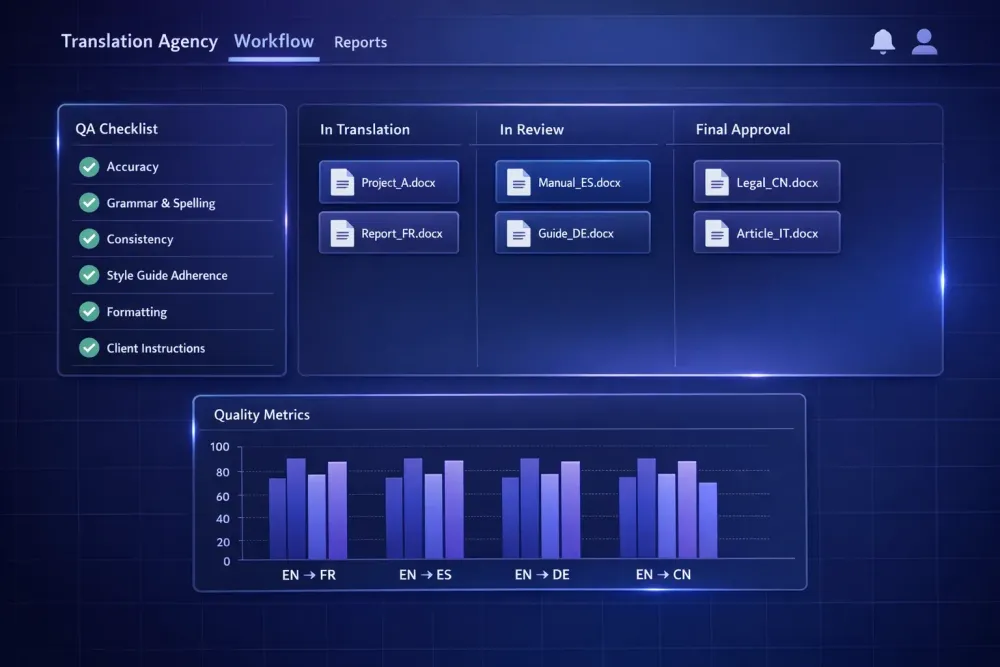
Once you've defined what quality looks like for each project type, you can build a QA checklist that travels -- meaning any reviewer on your team runs the same checks regardless of whether they've worked on that account before.
The checklist shouldn't be exhaustive. Long checklists get skimmed and then ignored. A working QA checklist for a technical translation project might cover six to eight items: source-target completeness (no segments skipped or doubled), terminology against the approved glossary, numbers and dates verified against source, formatting preserved, register consistent with the brief, any specific client preferences flagged from previous projects.
For projects with a QA report requirement -- where the client wants documented error categorization -- you need a shared error taxonomy. A five-category scheme (accuracy, fluency, terminology, style, formatting) with a severity rating (minor, major, critical) is enough to produce consistent reports that different reviewers can populate in the same way. Without shared definitions, two reviewers categorize the same error differently, and the QA report reflects their individual judgment calls rather than a consistent standard.
If your agency uses QA tools like Xbench or Verifika, the checklist should specify which checks the tool is configured to run and what manual steps are added on top. "Run QA tool" isn't a checklist item that produces consistent results. "Run QA tool with [specific profile], review all segments flagged for terminology deviation, manually verify all proper nouns" is. The difference matters more than it seems when you're onboarding a reviewer who hasn't developed their own sense of what needs a second look.
Our guide on translation quality assurance covers the full QA framework for agencies in more detail, including how to calibrate error severity across different content types.
How to run consistent pre-delivery checks
Pre-delivery checks are where the checklist gets applied. The goal is a final pass before anything goes to the client -- not a re-translation, but a structured review of the output against the checklist.
For short to medium-length projects, this is typically a bilingual read-through by someone other than the translator, combined with a QA tool pass. For longer or more sensitive projects -- legal texts, regulated medical content, high-visibility external communications -- a separate subject-matter reviewer adds a second layer on top of the language review.
The problem most agencies face is time pressure: pre-delivery checks get compressed when projects run late. The response to time pressure is usually to shorten the review, which is exactly when errors slip through. A better structural answer is building review time into the project schedule from the start, treating it as fixed rather than as time that can be borrowed when other things run over.
One way to protect review time: set the translator's internal deadline separately from the client delivery deadline, with a fixed buffer for each project type. If the translator delivers Thursday afternoon and the client deadline is Friday morning, that buffer is visible in the schedule and harder to collapse than review time with no reserved slot. The buffer size can vary by project type and sensitivity -- a few hours for routine content, half a day for material that carries higher risk.
Our article on running pre-delivery QA checks without slowing down your team goes into the specifics of balancing thoroughness and speed.
Managing quality across different language pairs
One of the more difficult standardization problems for agencies is maintaining consistent quality across language pairs where the team has different depths of reviewer expertise. An agency strong in Western European languages may handle German and French projects with well-developed reviewer networks, but run Eastern European, CJK, or Arabic projects with fewer experienced options.
The honest reality is that QA standards can't always be identical across all language pairs if reviewer capacity differs. What can be standardized is the process structure and the documentation -- the same checklist, the same brief template, the same error taxonomy -- even when the human resources vary in depth.
Where reviewer expertise in a given pair is limited, automated QA checks carry more of the load. Checks for source-target completeness, number and date consistency, formatting preservation, and glossary adherence work regardless of the reviewer's proficiency in the target language. They don't catch nuance or fluency errors, but they catch the mechanical failures that are easiest to prevent and that clients notice most immediately.
Building reviewer capacity in underserved language pairs is a longer-term investment, but the path becomes clearer when you track QA outcomes by pair. Identify which language pairs produce the highest error rates or generate the most client feedback, and prioritize freelancer development or vetting in those directions. Agencies that don't track outcomes by language pair often have incorrect assumptions about where their quality problems actually sit.
Tracking QA outcomes to improve over time
Standardization holds its value only if there's a feedback loop. A QA process that doesn't inform how projects are assigned, how briefs are written, or how freelancer relationships are managed produces consistent checks but not consistent improvement.
The minimum useful tracking: error counts by project type, by language pair, and by individual translator. You don't need a sophisticated system. A shared spreadsheet updated at project close works if the team actually uses it. What you're looking for are patterns: a translator who consistently produces terminology errors in one domain, a language pair where fluency problems recur across multiple projects, a project type where the same error category shows up repeatedly across different translators.
The last pattern is the most actionable. If a specific error category repeats across multiple translators on the same project type, the problem is usually in the instructions they received rather than in the individual translators. That's a brief problem, or a glossary gap, or a missing style guide -- something that can be fixed structurally rather than addressed case by case.
QA data also tells you when your freelancer roster needs attention. A translator producing acceptable work for a year who then starts generating repeated errors may be taking on volume beyond their capacity, working outside their primary domain, or responding to market conditions that are changing their own workflow. Catching that through outcome tracking is far less expensive than discovering it through a client escalation.
Agencies that review QA data quarterly tend to see gradual reduction in error rates as weak points in the process get addressed systematically. Agencies that don't track it tend to find that quality stays reactive, catching problems after they occur rather than reducing their frequency at source.
Practical takeaway
Translation agency quality control becomes consistent when it's driven by documented process rather than by individual memory. The path there isn't complicated in concept: decide what checks happen on each project type, write them down, make sure every reviewer uses the same checklist, and track outcomes so the process can actually improve over time.
If your agency handles more than ten projects per week and doesn't have a documented QA checklist and brief template for your main project types, that's the right place to start -- before adding new tools or headcount. The infrastructure gap is usually smaller than it appears from the outside, and closing it produces results that are visible in client retention and revision rates within a few months.