How to reduce translation turnaround time without sacrificing quality
How to reduce translation turnaround time without sacrificing quality: preparation, TM, AI pre-translation, automation, and QA workflows that actually work.
Most teams trying to reduce translation turnaround time focus on translation speed. That's usually the wrong place to look. In our experience working with agencies and independent translators, the biggest delays don't happen during translation — they happen around it. Work sits waiting for a glossary nobody approved, a source file that needs re-exporting, or a QA pass that starts late because nobody defined the handoff. These are process problems, and they don't respond to translating faster.
Where turnaround time actually disappears
Take a 10,000-word project at a reasonable pace: four working days for translation. Common actual timeline: seven to ten days. That gap goes to file preparation, terminology questions that surface mid-project, source file updates that arrive after work has started, and a final QA pass that's discovering problems rather than confirming what's already in good shape.
One agency tracked their project timelines for a full quarter and found that about 38% of total calendar time across completed projects was non-translation overhead. Translation was done by day three. The project closed on day eight because of an unresolved terminology question, a DOCX that needed re-exporting after a late correction, and a delivery check that caught formatting inconsistencies.
Freelancers lose hours to client clarifications that should have been documented before work started. Agencies lose days to handoff gaps between project managers and translators. In both cases, the root cause is work that starts before it's ready to start.
Front-loading preparation: where the real time savings come from
Before any translation begins, you need final source files, a glossary of preferred terms, reference translations from previous projects if they exist, and clear instructions about tone, audience, and any terminology that can't vary across the document. Skipping any of these creates rework downstream.
A translator working on an 8,000-word IT services contract received the file with a note that said "technical, professional tone." Two days in, the client flagged that product names required specific capitalization that wasn't documented anywhere. The translator revised over 200 instances across the document. A one-page glossary would have prevented that entirely.
File version control is the other preparation gap. Source documents get updated — that's just how document-heavy projects go. A clear cut-off before translation starts prevents the common scenario where a mid-project file swap invalidates work already done, forces TM re-matching, and pushes the delivery date further than the actual editing time suggests.
For ongoing clients, a maintained glossary and style guide does most of the preparation work automatically. The investment is in building and updating those assets over time, not recreating context for each new project. One practical approach: instead of a formal brief document for each project, maintain a client profile that accumulates as you work. Terms confirmed on one project get added to the glossary. Style notes from client feedback go into the profile. The profile grows; the pre-project setup shrinks.
Setting timelines before the project starts
Client-driven deadline pressure is real, and it's worth pushing back on more often than most translators or agencies do. A lot of "urgent" deadlines are arbitrary — not because the client is unreasonable, but because nobody asked what's actually driving the timeline.
In many cases, the real constraint is a review window on the client side: they need two or three days to check the translation before publishing. If translation takes four days and client review takes three, the total is seven days regardless of whether translation is delivered in three or four. Knowing this creates room to negotiate the translation window without affecting the date the client actually cares about.
Where a timeline is genuinely tight, communicating what's realistic builds more trust than agreeing to something that won't hold. We've seen agencies damage long-term relationships with reliable clients by accepting timelines they couldn't meet. A client who expected five days and received five is less frustrated than one who was promised three and received four.
Rush fees serve a function here too. A pricing structure that distinguishes standard from expedited delivery sets the right expectations: faster work requires restructuring the workflow, and clients who genuinely need speed generally understand that.
Translation memory: efficiency that accumulates
A new client in a specialized domain might start with a 5–8% TM match rate on their first project. After several projects in the same subject area, that can climb to 30–40%. At that point, a substantial number of segments are handled automatically from the TM without any translation input. That compounds into real calendar savings over time.
The precondition is TM accuracy. In Smartcat, 100% exact matches are applied and confirmed automatically — which only works if those matches are trustworthy. Sloppy confirmations at the end of a project to clear the queue contaminate the TM and slow future work, because translators end up checking whether suggestions are correct rather than applying them. A high match rate on a bad TM doesn't save time; it adds a verification cost to every project that follows.
A few questions are worth confirming before a large project starts: Does the TM already contain content from this client? Are there conflicting entries from different translators that haven't been resolved? Is the terminology in the TM consistent with the current glossary? These checks take thirty minutes. Missing them can cost three days.
Building TM maintenance into project workflows explicitly — flagging entries that conflict with a client's updated glossary, removing outdated segments, resolving duplicates — is worth treating as a recurring task rather than a one-time setup.
Pre-translation with AI: why preparation determines draft quality
AI pre-translation can sharply reduce the time from project start to a reviewable first draft. Whether it actually saves time depends on what context is in place before translation runs.
An underprepared AI translation of a technical document can require more post-editing than translating from scratch. The model fills terminology gaps with plausible-sounding choices that don't match the client's established usage. Fixing those in the MTPE stage takes longer than preventing them by supplying an approved glossary and domain context before the job starts.
We've seen this on parallel projects. One agency ran AI pre-translation on two similar legal files for the same client. On the first file, the translator's glossary and a prompt describing the contract type were approved before the job started. On the second, the file ran without any preparation. The first came back from post-editing in roughly 40% of the time the second required, and needed fewer client review rounds because the terminology was consistent throughout.
The preparation principle applies regardless of the AI tool you use. Whatever the translation engine, the context you provide before the run determines how much post-editing follows after it.
If you need a structured workflow that builds in domain analysis, glossary review, and prompt approval before any translation job starts, SnapIntel is designed around that sequence. The workflow returns a translated DOCX and a QA report, which makes handoff to post-editing or client review cleaner than working from raw AI output.
Batching files and running stages in parallel
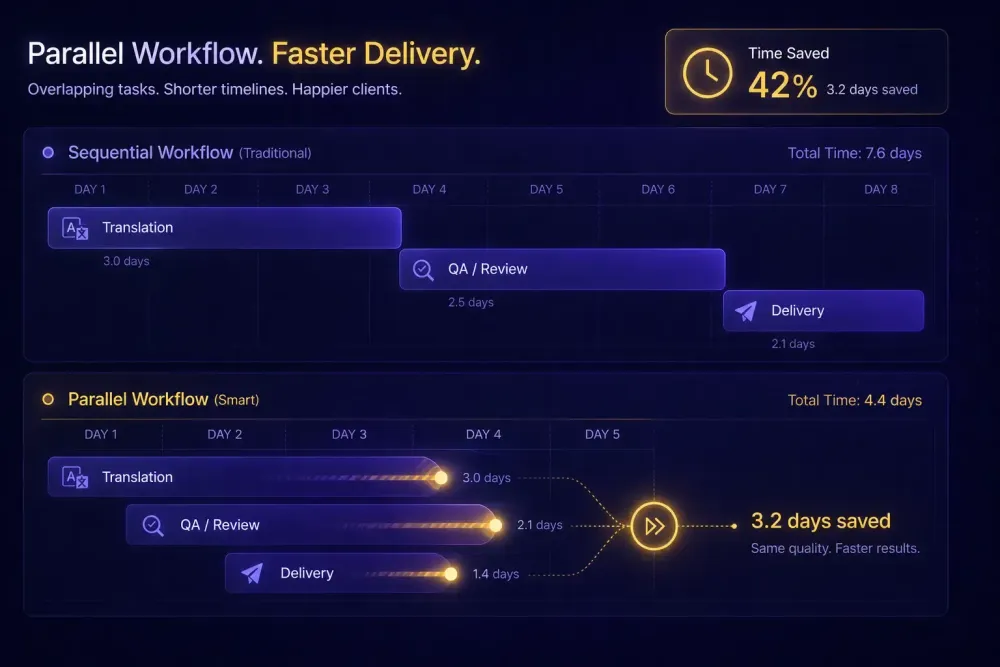
Sequential project handling — one file, then the next, then QA, then delivery — is one of the quieter contributors to slow turnaround. For projects with multiple source documents, running them through the same workflow at once cuts the effective timeline without adding headcount.
Parallel staging extends this further. While one translator works on the main document, a second can update the project glossary from the source text. While AI pre-translation runs on a new batch, the project manager can prepare delivery for completed files. This requires clear role definitions, but it works in small teams with documented process.
Our post on batch translation for agencies covers how to set up multi-file workflows without letting quality slip between files.
This doesn't apply to all project types. Legal documents where each clause references terms defined earlier in the same file, or contracts where later sections depend on translations confirmed in earlier ones, should still be handled sequentially. Forcing parallelism on inherently ordered content generates coordination overhead that erases any time savings.
Automating the handoffs
Most CAT tools and TMS platforms include automation capabilities that teams configure once at setup — if at all. Smartcat's automation rules can trigger AI pre-translation when a project is created, auto-assign translators by language pair, and send notifications at workflow transitions. The setup takes time once; the payback repeats on every subsequent project.
File routing and status notifications are the first targets worth automating. The time spent on manual status tracking — "has the file come back from QA?", "did the final DOCX get sent?" — is consistently higher than expected when you measure it explicitly. A trigger that notifies the next person in the chain when their step is ready removes that overhead from every project.
Automation amplifies whatever process it runs on. Unclear handoffs and inconsistent file naming don't disappear when automated — they get reproduced faster. Map the workflow clearly before automating it.
Running QA at the right stage
Running quality checks only at the end is one of the more expensive workflow habits in translation. A late QA pass that finds terminology mismatches or untranslated segments means re-exporting files, another review cycle, and sometimes a client conversation. Significant calendar time attaches to problems that were findable much earlier.
Moving checks earlier doesn't add time to a project — it redistributes time in a way that compresses the total. A terminology check during translation catches mismatches before they've propagated across 200 segments. A style review at the midpoint addresses register problems while correction is still straightforward.
The final pre-delivery pass should still happen. But if earlier stages handled terminology and style, that pass confirms what's in good shape rather than discovering what isn't. Our post on running a pre-delivery QA check without slowing your team down covers what that final check should include and how to keep it fast.
Where to start
Write down where a project in your current workflow actually stops between steps. Most teams can identify three or four consistent gaps without much analysis: the glossary approval that never gets sent on time, the PM-to-translator handoff that requires chasing, the QA pass that starts two days late because the file arrived without warning.
Fix those gaps before adding tools or people. A complete brief, an approved glossary, and a defined handoff protocol between translation and review will compress timelines more reliably than any optimization applied to the translation step itself. Build in TM discipline and structured AI pre-translation with proper preparation context on top of that, and you're reducing turnaround from multiple directions at once — without trading output quality for speed.