How to onboard a new client as a freelance translator: a process that saves hours
How to build a freelance translator client onboarding process: intake forms, glossaries, revision scope, and delivery protocols that prevent rework.
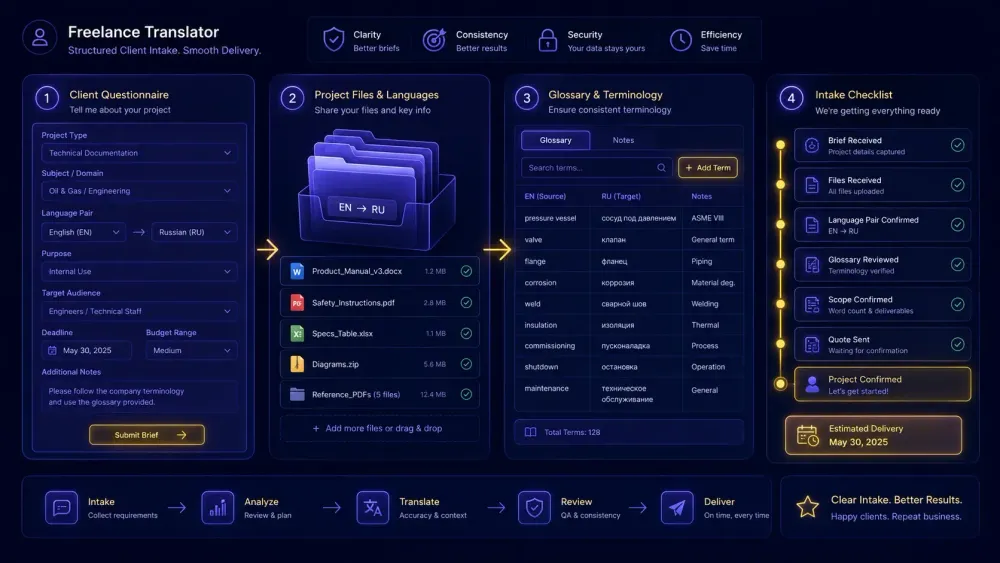
Every freelance translator remembers a project that started well and unraveled somewhere in the first week. A new client reached out, the scope seemed clear, you agreed on a rate, and then the questions started accumulating. What glossary should you follow? Does the client want tracked changes in the deliverable or a clean file? Is the deadline for the first draft or the final revised version? Is the word count based on the source language or the target? By the time you had answers, you'd sent nine emails, the deadline had quietly shrunk, and you were starting the actual translation in a slightly frantic state.
Having a structured freelance translator client onboarding process — the steps you take to gather project information before you open the first file — is one of the most consistently underbuilt parts of a freelance translation practice. Translators who manage high workloads without constant friction have usually developed a repeatable intake routine. This article walks through what that process looks like and why it saves time at every subsequent stage.
Why client onboarding matters more than most freelance translators assume
The case for onboarding is straightforward: 20 minutes of structured intake prevents far more than 20 minutes of rework later. A misunderstood file format means resetting work you've already done. An unclear revision policy leads to an extra round of editing you didn't budget for. A missing glossary means making terminology decisions in isolation, and then defending them when a reviewer comes back with questions.
Many translators skip onboarding entirely, often because taking a new client through a formal intake process feels like adding friction at exactly the moment you want to appear available and easy to work with. In our experience working alongside translators across a range of language pairs and domains, clients almost always respond better to a structured intake process than translators expect. When someone sends a well-crafted set of questions before starting work, the message is clear: this translator takes quality seriously, has done this before, and understands that vague briefings produce vague translations. For clients who care about their content, that's a reassuring signal.
There's also a practical protection dimension. When scope creep appears (and it does, across language pairs and client types), a documented intake process gives you something to reference. "Per our kickoff agreement, revisions cover translation accuracy. The layout changes you're requesting would be a separate scope addition." That sentence becomes much easier to deliver when the client answered a form that defined those terms at the start.
The intake form that replaces nine separate emails
The most practical tool you can build is a short intake form. It doesn't need to be elaborate — a Google Form, a templated email, or a shared document all work. What matters is that the same questions go to every new client before work begins, without relying on you to remember each one.
The questions you need fall into four areas. The first covers project basics and file logistics: source and target languages, subject matter, estimated word count, whether existing reference materials are available, and what format the file will arrive in. If the client is sending a PDF or scanned document, who handles conversion to an editable format? Does the visual layout need to be preserved exactly, or is the text content the only concern?
The second area is reference materials: glossaries, style guides, and previous translations the client has approved. Many first-time clients don't have any of these — but asking early establishes whether you're building context from scratch or inheriting an existing framework.
The third area is revision scope: how many rounds are included in the agreed rate, what counts as a revision versus a new request, and who reviews the translation on the client side — a bilingual editor, a subject matter expert, or a monolingual reader checking general fluency?
The fourth covers delivery: whether the client wants a clean translated file or a source/target comparison, whether a QA report is expected alongside it, and what file naming convention applies.
Most clients answer these questions in under two minutes. Clients with established translation workflows will have most of this ready immediately. Those who don't — their answers will tell you a great deal about how to scope the project before you commit.
One practical note: the intake form creates a record. When scope creep appears weeks later, you have a documented baseline to reference rather than relying on a half-remembered phone conversation.
Reading the brief before you price
Not every client sends a formal project brief. "Please translate the attached file" is not unusual. That doesn't mean you have to work without context — it means you need to ask for it.
Ask about the intended audience. A compliance report for an internal legal team reads very differently from a brochure written for general consumers, even if the source text covers the same subject. Knowing the reader shapes how you handle terminology, sentence length, and the level of technical detail you can assume the reader will follow.
Ask about tone. "Formal" means different things across domains: legal formality is not the same as academic precision, which is not the same as corporate-formal communications. If the client can share a previous translation they were satisfied with — even from a different project — that example tells you more than any written description of tone.
For technical domains such as medical devices, financial services, or engineering, ask whether there's a subject matter expert you can contact when source-text ambiguity comes up. This is standard practice in those sectors, and clients working in them typically have an answer ready. Knowing who to reach mid-project beats waiting for an email response during a deadline push.
As AI tools become more integrated into translation workflows, the briefing step becomes more rather than less important. The context you gather upfront — audience, tone, terminology priorities — shapes what any translation process produces, AI-assisted or not.
Document what you learn. A half-page of notes on the project context, the intended reader, the agreed tone, and any specific exceptions is enough to anchor your decisions when ambiguities appear in the source text, and to explain those decisions if they come up during review.
Handling glossaries and style guides from day one
Most post-delivery translation disputes come down to terminology or tone rather than factual accuracy. A client expected "data controller" and received "data manager." They expected formal register and received conversational phrasing. Neither translator nor client made a clear error — there just wasn't enough shared context established before translation began.
This is why the glossary and style guide conversation belongs in onboarding, not in the revision cycle.
If the client has a glossary, get it before you start. Review it briefly for coverage and flag terms that look ambiguous or potentially out of date. Specialized domains generate new terminology faster than any static glossary can track, and clients in industries like pharmaceutical or financial services often don't realize their glossary hasn't been updated in two years.
If there's no glossary and the project scope justifies it, offer to build one. A working bilingual table of source terms and agreed target equivalents, documented as you translate, becomes a reference the client can use on every subsequent project — and a practical reason to keep working with you rather than starting fresh with a new translator each time.
Style guides are rarer in freelance contexts but they matter more than most clients realize. A one-page document covering preferred register, handling of brand names and trademarks, and conventions for numbers and dates can prevent a dozen small disputes that would otherwise arrive as post-delivery revision requests. If no style guide exists and the scope is large enough, offering to document your stylistic decisions during translation is a professional move that most clients will appreciate and remember.
For ongoing client relationships, consider maintaining a shared reference folder: a single location holding the current glossary, style notes, and previous translations. When terminology questions come up mid-project, the answer is usually already there.
Setting revision and delivery expectations your clients will respect
Revision scope is where most freelance-client friction originates. A client returns the file with what they describe as "a few small edits" that turn out to be a wholesale restyle. Or they loop in a reviewer who is a native speaker of the target language but has no translation background, and the feedback becomes a style debate without clear resolution criteria.
Getting explicit about revision terms during onboarding doesn't require a confrontational conversation — just a clear one.
"Two revision rounds included" should mean: corrections to translation errors, missed content, or genuine misunderstandings of the source. It should not mean stylistic rewrites based on personal preference, layout changes, or content additions the client decides to make after delivery. Stating this during intake — not as a warning, just as a factual description of what's covered — sets expectations most clients are comfortable accepting.
Ask about the review process. If a bilingual reviewer will look at the translation, do they have professional translation experience or are they a fluent native speaker reviewing by instinct? This doesn't mean their feedback won't be useful — clients often know their audience better than you do. But knowing the review context shapes how much explanatory commentary you include with the delivery and how you frame the choices you made.
On timing: be specific about what "deadline" means. Is it the date the file must leave your desk or the date it must arrive in the client's system? Do weekends count? What happens if the source file is delivered late or modified after you've started? Set your personal working deadline a day earlier than the agreed date and put the agreed delivery date in writing at the end of the intake conversation.
File structure and handoff protocols that prevent last-minute confusion
The practical mechanics of file delivery get overlooked during intake and cause problems that have nothing to do with translation quality.
Ask about file naming conventions before you start. Should the translated filename include a language code, a version number, or a date? Clients who manage multiple language pairs or work across several freelancers often have their own system — asking for it takes 10 seconds. Those who don't will appreciate a sensible default.
Ask about tracked changes. Some clients want a clean translated file. Others need to see exactly what was modified for compliance or internal approval. Some want both. Knowing this before you start means you're not recreating work after delivery.
For ongoing clients, agree upfront on how files will be exchanged. Email works well for one-off projects. Clients with regular volume usually prefer a shared folder or a more structured handoff arrangement. If a client works within a specific project management tool, ask to be added at the start rather than troubleshooting access at deadline.
One question many freelancers overlook when working with agencies: does the agency need a bilingual spreadsheet export alongside the translated file? A source/target table organized by segment is straightforward to produce from most CAT tool workflows, and it lets the agency import content directly into their translation memory (TM) system without additional work on their end. For agencies coordinating many translators across many files, this small addition tends to get noticed.
Building a client profile that compounds over time
A good first project with a new client should leave you with more than a delivered file. It should leave you with a client profile — a short record of what they need, how they like to work, and what you observed during the project.
The content doesn't need to be elaborate. The terminology decisions you made, the register you calibrated to, the exceptions you agreed on, the contact person for subject matter questions, and a link to the shared reference folder: that's enough to make the second project significantly faster than the first. On a returning project, you can orient yourself in minutes rather than going through the full briefing process from scratch.
Over time, a well-maintained client profile is one of the genuine competitive advantages of an experienced freelance translator. Project estimates become more accurate because you understand what the client actually requires. Deliveries need fewer explanatory notes because you already know the terminology they expect and the reviewer they'll use. And the working relationship becomes harder to replace: a translator who already knows the glossary, the preferred register, the review process, and the file conventions is worth considerably more to a busy client than a new translator who has to learn all of it from the beginning.
If you don't have a format for client profiles yet, the intake form is the right starting point. The answers the client gives during intake, combined with your notes from the first project, become the foundation of the profile for everything that follows.
The most common mistake freelance translators make with new clients isn't overcharging or underdelivering — it's starting work before they have the information they need. A one-page intake form, a brief review of the project brief, and a shared folder for reference materials cost almost nothing to set up and tend to pay back several times over in the first revision round they prevent.
Start with one change: before taking on the next new client project, send a templated set of questions and wait for the answers before opening the file. That single shift will change how the project runs.