How to handle rush translations without destroying quality
Rush translation doesn't have to mean quality problems. Here's how agencies build a workflow that handles urgent jobs reliably, every time.
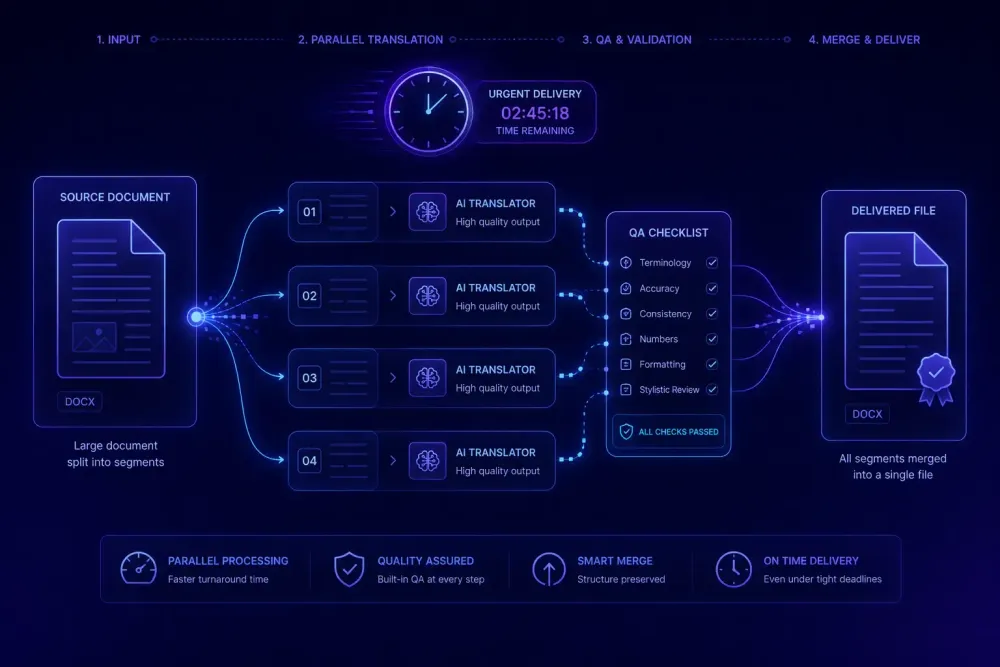
The call comes in at 4 PM. A client needs 11,000 words translated by 9 AM. Three of your best translators are tied up on existing projects. Your preferred reviewer signed off an hour ago. The project manager is already stretched across two other jobs. This is not a hypothetical — rush translation is one of the most consistent pressure points any agency faces, and for many it represents 20 to 30 percent of revenue. The surcharges are real. So is the risk.
The thing is, urgent translation work isn't inherently incompatible with quality output. What it's incompatible with is a workflow built only for standard turnarounds. Agencies that handle rush jobs well don't wing it under pressure. They run a different, faster version of the same structured process they use for every project.
Why rush jobs go wrong before the translator even starts
The failure mode we see most often isn't a quality problem with the translation itself. It's a process gap that gets exposed because there was no time to work around it informally.
The most common: inaccurate scoping. When a client sends a "12,000-word document," that number usually comes from their word processor. It doesn't account for repetitions, headers that appear identically across 40 pages, boilerplate, or non-translatable segments. Run the same file through a CAT tool with repetition analysis and you might see 7,500 unique words. The difference between 7,500 and 12,000 at a realistic translation rate changes the delivery math completely. Agencies that commit to deadlines without running their own count first find themselves in an unwinnable position midway through the job.
The second problem is the skipped brief. Under time pressure, project managers skip the written job brief because there "isn't time." What they're trading is a few minutes now for a costly revision cycle later. A translator who doesn't know the client's preferred register, which product names should be left untranslated, or what formality level the end reader expects will make reasonable guesses throughout a large document. Those guesses may all be reasonable individually and still produce output that's inconsistent with the client's existing materials.
The third failure mode is availability-based assignment: someone is free, so they get the job. A legal translator filling in on a medical device manual because the domain specialist was booked will produce output that needs substantially more post-editing than the timeline allows for. Sometimes that's genuinely unavoidable. In agencies without a dedicated rush roster, it's the default rather than the fallback.
Build a rush-ready roster before you need it
The highest-leverage investment any agency can make for rush translation capability is a pre-qualified shortlist of translators who are willing to take urgent work and who have already been tested under pressure. This is not the same as your general translator pool.
Most agencies maintain a large list of qualified translators they can theoretically assign to any project. The rush roster is the subset of that pool who respond within an hour, deliver on time without needing to be chased, don't skip their own QA steps when pressed, and have been through a fast-turnaround job with you before and come through clean. In our experience, this subset is usually 15 to 20 percent of a typical agency's available translators. It's smaller than most PMs expect.
Building it requires deliberate effort. Start by reviewing past rush jobs and identifying which translators delivered without management intervention. Contact them directly and ask whether they're willing to be on a priority contact list for urgent assignments, at an established rush rate. Most experienced translators who are reliable under pressure know it about themselves and are comfortable having it formalized.
Tier the roster by domain and language pair. A rush-capable EN-DE legal translator is not interchangeable with a rush-capable EN-DE medical translator, even if both are fast. Urgent turnaround on specialized content still requires the right domain fit.
For translators you're considering adding to the shortlist but haven't yet tested in a rush context: run a small, paid urgent assignment before a real crisis requires you to rely on them. You're not evaluating translation quality in isolation — you can do that elsewhere. You're looking at whether they communicate proactively when something is unclear, whether they flag problems early, and whether the file arrives when they said it would.
Review the list every quarter. Availability changes. People take on full-time work, change their preferred workload, or move into other roles. A rush roster that hasn't been verified recently will fail you at the worst moment.
How to scope a rush job accurately in 15 minutes
Fast, accurate scoping is a learnable skill and one of the clearest operational differentiators between agencies that handle rush translation well and those that don't.
The first number you need is the actual translatable word count, with repetition analysis, not the source file's reported word count. Open the file in your CAT tool before committing to a timeline. On jobs we've reviewed, the difference between a client's reported word count and the unique-segment count after TM analysis runs 20 to 40 percent. Committing to a deadline based on the wrong number is a mistake you'll pay for at delivery.
The second factor is content complexity. A 5,000-word product description and a 5,000-word technical regulation are both 5,000 words. The regulation will take two to three times longer to translate accurately. Translators working on technical, legal, or medical content can realistically produce 1,500 to 2,000 words per day at sustainable quality. Applying a flat 2,500-words-per-day estimate across all content types is how agencies consistently underprice and overpromise on complex rush jobs.
The third factor is output format. A client who needs a clean formatted DOCX ready for print is asking for something different from a client who will accept a draft with tracked changes for internal review. Post-translation formatting work — particularly in documents with tables, footnotes, or complex layout elements — can add two to four hours to a job. Ask before you quote.
With those three data points, you can make a real commitment rather than an estimate you'll have to walk back. Or you can tell the client upfront that their requested window isn't achievable at the quality level they need. That conversation, delivered early, is better for the relationship than a late delivery or a delivery with errors.
Splitting a document across translators without losing consistency
When a single document is too large for one translator to finish in the available time, distributing it across two or three translators is the practical solution. The problem is that two translators working independently will make different terminology choices, use different registers for the same organizational voice, and produce output that reads like two different people wrote it. Because two different people did.
The controls for this are not complicated, but they require preparation time you need to build into your urgent translation workflow.
Before any translator starts, prepare a project-specific glossary. Cover the domain terms, product names, organizational units, and any repeated phrases that appear throughout the document. For most documents, this takes 20 to 30 minutes. It's the single most effective thing you can do for consistency across a split job. Without it, each translator will make their own terminology decisions, and consolidating the output later takes longer than the glossary would have.
Set up a shared project translation memory in your CAT tool before work begins. Any segment confirmed by one translator will auto-populate when the other reaches the same segment. This eliminates parallel effort on repetitions and forces consistent terminology on repeated content automatically.
Assign clear section boundaries. Tell each translator where their section starts and ends, and make sure those boundaries align with the document's actual structure — chapter breaks, numbered sections, logical transitions. A split at a chapter boundary is straightforward to consolidate. A split in the middle of a continuous argument is not.
Reserve 30 to 45 minutes after translation is complete for a single consolidation pass of the joined document. One person, looking specifically for consistency between sections — not accuracy, not style, just whether the document reads like a single voice. If the glossary was built and the TM was shared, this pass usually catches minor issues rather than major ones. When those two controls weren't used, the consolidation step is where you find out.
Quality gates that work under time pressure
The instinct to cut QA when time is short is understandable. The result is almost always a worse outcome than a scoped, time-limited QA step would have been.
Not all parts of a document carry the same risk. A prioritized QA approach focuses available time on the sections where errors have the largest downstream impact, rather than reviewing everything superficially at the same depth.
Content involving numbers, dates, measurements, or currency is high risk regardless of document type. These errors are often invisible to a reader scanning for fluency — they don't disrupt reading — but are immediately obvious to anyone checking the actual figures. Review these specifically, every time.
Section headings and opening paragraphs receive the most attention from end readers. A clean heading and a clean first sentence create an impression that survives minor imperfections elsewhere in the body. If you only have time for one targeted pass, start there.
Any clause with legal implications — rights, obligations, liability, warranties — should be reviewed even in documents that aren't primarily legal in nature. These are the sections where a mistranslated word is most likely to have consequences that outlast the original deadline pressure.
Beyond the human review, run your CAT tool's automated QA pass before the translator submits. Checks for tag errors, missing translations, number inconsistencies, and terminology against the glossary take seconds and catch mechanical errors that human reviewers miss when they're reading for meaning. This is not a substitute for human review, but it is a genuine safety net that takes almost no time to run.
If a second translator or editor is available for even 20 to 30 minutes of targeted peer review — focused on terminology consistency and register across the document — it catches a disproportionate share of real errors relative to the time invested. This is especially true on split jobs where the consolidation pass alone may not catch everything.
Setting turnaround expectations the client will actually accept
One of the less visible contributors to rush translation quality problems is the client conversation itself. Many jobs that go wrong were committed to on terms that left no margin for anything unexpected — a missing glossary, a file format issue, a translator who hits a dense technical section and slows down.
The most common pattern: the PM says yes because saying yes feels safer than a conversation about trade-offs. The client gets a confident delivery promise. Something goes wrong. The agency ends up managing an error under even more client pressure than existed during the original job.
A more sustainable approach is to present a real choice: "We can deliver a translated document by 9 AM with a focused spot-check, or by 2 PM with a full review pass. For a legal document of this type, we'd recommend the 2 PM window." Clients given this framing often choose the later option. When they genuinely need 9 AM, they at least understand what they're accepting — and you have a record of what was agreed.
We've found that this conversation doesn't lose clients. It distinguishes agencies that think about quality from those that say yes to everything and manage the fallout after delivery. "We can do this, here are your options" is not the same as "we can't guarantee quality at this speed." The first is professional. The second is a way to lose the job.
Explicit rush pricing tiers also create a useful natural filter. When same-day delivery costs a meaningful premium over next-day, clients who don't actually need the fastest turnaround tend to choose the tier below it. Over time, this reduces the proportion of genuinely constrained rush jobs and increases the proportion of jobs where a realistic timeline exists.
AI translation tools are also changing the economics of fast turnaround — for agencies that have integrated them thoughtfully into their workflow, MT pre-translation on well-scoped documents can reduce the effective translation time without compressing the QA step.
When a rush job goes wrong
With a good system, failures are less frequent. They still happen. A translator delivers six hours late. A number error in a financial table is caught after delivery. A formatting problem appears in the DOCX that wasn't visible in the CAT tool environment. How an agency handles that moment shapes the client relationship more than the original delivery did.
Tell the client before they notice. If something has gone wrong, contact them as soon as you know — with a clear explanation of what happened, what you're doing about it, and when they can expect the corrected version. The instinct to wait and see whether they catch it is almost always the wrong call. Clients who discover an error on their own, before hearing from you, experience the problem and the silence. Clients who hear from you first experience the problem and a demonstration that you're paying attention.
Provide the revision the same day, regardless of how the error is characterized. Whether it's clearly the agency's mistake or a contested interpretation, delivering a corrected version quickly demonstrates that accuracy matters to you more than the argument about whose fault it was. That demonstration is what clients remember.
After the job wraps, trace what happened. Did scoping miss the content complexity? Did the translator assignment fail on domain fit? Was QA skipped on the section where the error appeared? Did the client brief get dropped because there was no time? The answer tells you which part of the process needs attention. Agencies that treat errors as system problems rather than individual failures get better with each one. Agencies that treat them as one-off bad luck tend to make the same errors on the next tight deadline.
Build the system before the next call comes in
The agencies that handle rush translation reliably aren't better at working under pressure than everyone else. They've built something before the pressure arrives: a qualified roster sorted by domain, a scoping habit that produces real numbers in 15 minutes, a glossary protocol that runs even when time is short, and a QA step that's scoped rather than skipped.
None of this is complicated to implement. Most of it can be documented in a few internal SOPs and tested on the next standard-turnaround job before it's needed under pressure. The cost of building the system in advance is low. The cost of not having it when a client calls at 4 PM is something most agencies have already paid at least once.