DeepL vs ChatGPT for translation: which one should professionals trust?
DeepL vs ChatGPT translation compared on terminology, context, formatting and failure modes, plus how to pick the right one for each document.
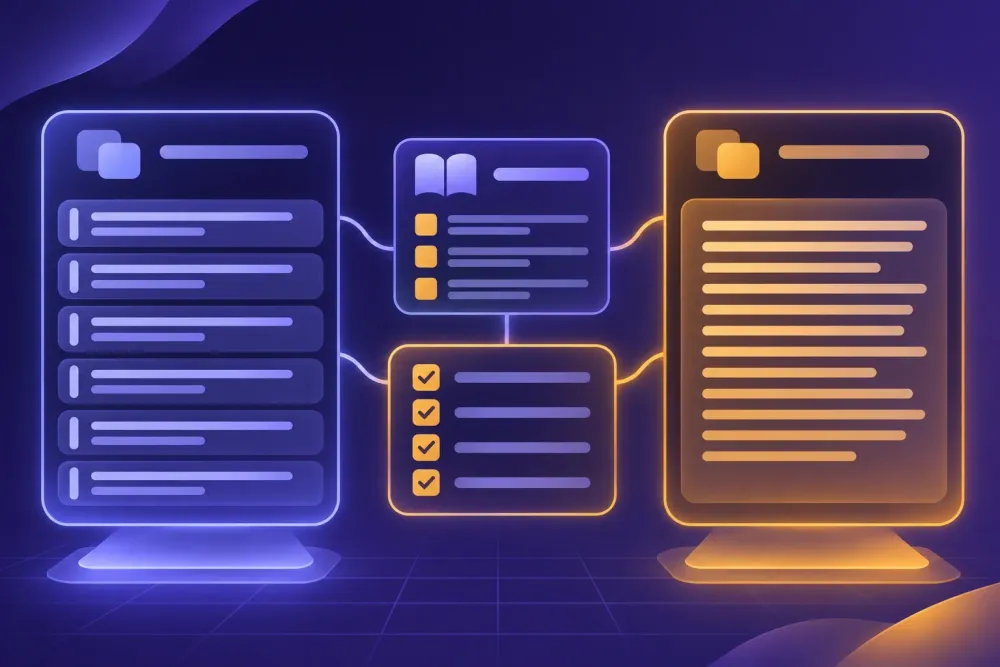
Every few weeks someone asks us a version of the same question: should I run this file through DeepL, or just paste it into ChatGPT? The deepl vs chatgpt translation question usually gets framed as a quality contest with one winner. We think that framing is the problem. These are two different machines built for different jobs, and they break in different ways. We have watched translators pick one, get burned, switch to the other, and then get burned differently. Here is what holds up, what does not, and how to find out before a deadline is riding on it.
What deepl vs chatgpt translation actually compares
DeepL is a neural machine translation system. It was trained to do one thing, map text from one language into another, and almost everything about its behavior follows from that. It works through your text in segments, it returns the same output for the same input, and it will not comment on your source text or decide that a paragraph needs shortening.
ChatGPT is a general-purpose language model that happens to be good at translation. Nothing inside it is dedicated to the task. It reads your instructions, your source text, and whatever else sits in the conversation as one long context, then produces what seems most plausible next. That is why it can honor a translation brief, and also why it can quietly rewrite your bullet list into prose.
So the honest comparison is not "which one is more accurate". It is closer to this: do you want a machine that does the same predictable thing every time, or an assistant that understands what you asked for but has its own ideas about execution?
The distinction has consequences. A system with stable output can feed a translation memory without polluting it, because tomorrow's run of the same sentence matches today's. A system that reads instructions can be told that this document is a safety manual for factory floor staff and that the register should stay flat and imperative. You rarely get both behaviors from one tool. When a project needs both, you end up building a workflow rather than finding a prompt.
Where DeepL still holds up
Consistency is the thing people undervalue until they lose it. Run the same 40-page DOCX import twice through an NMT engine and the two outputs are effectively identical. Run it twice through a chat model and they are not. For anything that gets reviewed, re-exported, or compared against a previous version, that stability is worth more than a slightly better turn of phrase.
Volume is the second advantage. For long, repetitive, low-ambiguity content, interface strings or specification tables or parts lists, an NMT engine does the job fast and does not get creative on item 2,400.
The third is restraint. DeepL does not add. It will mistranslate a term, but it will not invent a sentence that was never in the source, and it will not decide that two adjacent paragraphs mean the same thing and merge them. When the job is to deliver what the client wrote, in another language, restraint is a feature.
The limits are just as clear. Segment-level processing means a pronoun four sentences away from its antecedent is a coin flip. Glossary support exists, but it is essentially term substitution, so it cannot express a rule like "translate this word one way when it refers to the device and another way when it refers to the company". Document upload is convenient and comes with real file type and size constraints, which we went through in our DeepL document translation review. And the engine knows nothing about your client's naming conventions unless you tell it, term by term.
Where ChatGPT does better work
Instruction following is the real difference. You can tell a language model that the audience is Spanish-speaking warehouse supervisors, that the client prefers usted, that "unit" means the physical device and never the business unit, and that any genuinely ambiguous sentence should be flagged rather than guessed. An NMT engine has no slot for most of that.
Context is the second. On a document where meaning depends on what came before, a model that reads the whole chunk resolves ambiguity that a segment-level engine cannot. Marketing copy, correspondence, anything with irony or an implied subject: this is where the language model earns its place.
It also copes better with bad source text. Typos, inconsistent capitalization, half-finished sentences from a hurried author. A model that reasons about intent handles those more gracefully than one that pattern-matches the segment as written. And it can tell you what it did. Asking which three terms in a passage were ambiguous, and why, produces a list that is useful to a reviewer. No NMT engine will give you that.
Then the problems. Output varies between runs, so you cannot diff two versions and trust the differences to mean anything. Over long documents the model drifts, and terminology chosen in chapter one quietly changes by chapter five. It summarizes when it should translate. It drops things, and it drops them with perfect fluency, so the result reads well and is short by two sentences. We have written more about what GPT-class models get right and wrong in professional translation, but the short version is that the failures are harder to see rather than rarer.
Two jobs we have run both ways
The first was a German supplier quality manual into English, around 40 pages, heavy on tables and warning notices. DeepL came back fast and clean, and the tables survived. The problem was terminology. One German compound appeared as three different English terms across the document, depending on the surrounding sentence. Nothing was wrong, exactly, and a client reading chapter 2 against chapter 7 would still have asked which version was correct.
The same file through a chat model, with a short term list in the prompt. Terminology was consistent this time. Two bullet lists had become running sentences, and a figure caption on page 19 was simply not there. Faster to fix than the terminology problem, but only because we went looking.
The second job was an Excel product catalog, roughly 2,800 cells, English into Spanish. The NMT run translated every cell it was handed, including the ones it should have left alone: unit abbreviations turned into words, and a column of internal codes got helpfully localized. It had no way to know which columns held data and which held prose. The chat model, told to leave column A alone along with any value shorter than four characters, respected that. But on a run that long it started compressing the longer descriptions, and the returned cell count came back short of what went in.
The pattern repeated often enough that we stopped calling it coincidence. The NMT engine needs terminology discipline imposed from outside. The language model needs structural verification: did everything come back, in the same shape, in the same number of units. Those are two different review jobs. Teams that use both tools without adjusting their checks usually catch one class of error and miss the other.
The failure modes differ, so the QA has to differ
With an NMT engine, we look for wrong sense and wrong term first. A negation dropped from a safety instruction. A number format converted when it should not have been, or left alone when it should have been. The same source term rendered three ways. These are findable with a terminology check and a targeted bilingual review of the high-risk segments, and they cluster in the places you would predict.
With a language model, completeness comes first. Before reading a single sentence for quality, count: segments in versus segments out, cells in versus cells out, headings present, captions present. Fluent omission is the characteristic failure, and reading the translation on its own will never reveal it, because what is there reads perfectly well. Only once the shape checks out does it make sense to review terminology, then style.
That ordering matters more than people expect. We have watched a reviewer spend an hour polishing register on a file that was missing a paragraph. A QA report that gives you completeness and terminology before you start reading saves that hour, whether it comes from a tool or from a checklist someone works through by hand.
One caveat on both engines. None of this applies cleanly to regulated content. For medical, legal, or safety documentation, which engine produced the draft matters less than whether a qualified bilingual reviewer signed off on it. Pick whichever tool makes the draft cheapest to review, and do not let the comparison pull attention away from the review itself.
Terminology control is the real dividing line
If we could give only one piece of advice to someone weighing these two tools, it would be this: the glossary matters more than the engine. A mediocre engine working from an approved term list beats an excellent one working blind, on any document where the client cares about consistency.
The two tools take terminology differently, and the difference is instructive. NMT glossaries are substitutions. This source term becomes that target term, with limited conditionality and limited language pair coverage. Clean and reliable inside those limits. A language model can handle conditional rules, which is strictly more expressive, but it will not apply them reliably across a long document unless the rules are re-supplied with every chunk. Expressiveness without enforcement is not control.
Which points at the practical move: build the term list before you translate, not after a reviewer complains. Pull candidate terms out of the source document, get the client or the subject expert to approve the ten or twenty that actually matter, and hand that list to whichever tool you use. In our experience a 15-term approved list removes more review friction than switching engines ever does, and it affects translation quality in a way you can point at afterwards.
This is less work than it sounds. Term extraction on a 40-page document takes minutes with a tool, and the approval conversation with the client is usually one email. The reason it does not happen is that it feels like overhead at the start of a project, before anybody has felt the pain.
How to choose for the project in front of you
Our working rules, which we revise whenever a project proves them wrong.
High volume, repetitive, low ambiguity, feeding a translation memory: NMT. Predictability is what you need there, and a chat model will not give it to you.
Ambiguous, context-dependent, client voice matters, the brief needs explaining: a language model, with the brief written down and the terminology supplied.
Mixed documents, which is most real work: NMT for the bulk, a language model for the sections that need judgment, and a person deciding which is which. Less elegant, but it matches how documents actually arrive.
Regulated or high-liability content: either one, as a draft only, with bilingual review that somebody is accountable for.
If you want the question settled for a specific client rather than in the abstract, run the test. Take a 300-word representative sample from a real document, translate it both ways with the same approved glossary, then compare on the things that cost you time: terminology consistency, completeness, formatting survival, and how long the post-editing takes. Write the result into the client file. That one measurement is worth more than any comparison article, this one included, because it was measured on your content.
If a structured workflow is closer to what you want than a single prompt, that is roughly the problem SnapIntel was built for. You import a DOCX, XLSX, or PPTX file, run domain analysis, review and approve the glossary and the translation prompt before translation starts, and get back the translated document along with a QA report and a neutral source/target XLSX export you can move into any CAT tool. The approval gate exists for the reason this article keeps circling back to: terminology decided before the run is cheaper than terminology fixed after it.
So, concretely, before your next AI-assisted project: spend 20 minutes extracting terms from the source and getting them approved. Then run a 300-word sample through both tools and time the post-editing on each. Whichever engine you keep, you will have chosen it on evidence, and the glossary will have done more for the result than the choice between engines ever could.