DeepL vs AI translation workflows: what professional translators actually use
DeepL vs AI translation workflows: how they differ for professional document work, where each fits best, and how to choose based on job requirements.
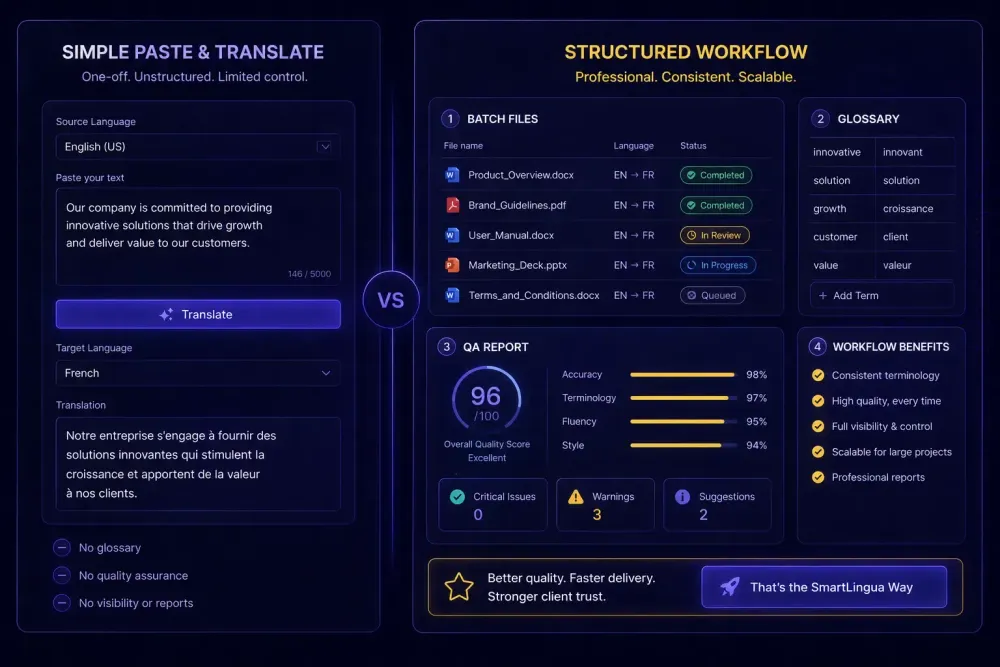
DeepL has earned its reputation. It is fast, its output quality is competitive for many language pairs, and translators reach for it constantly: during post-editing sessions, as a research reference, and when a client needs something turned around quickly. But when we hear the question about deepl vs ai translation from agencies and freelancers, the answer rarely stays simple. That is because DeepL and a structured AI translation workflow are designed for different things, and knowing which is which prevents a lot of wasted effort.
We have worked with translators who use DeepL every day and find it genuinely useful. We have also talked to project managers who built a client-delivery process around DeepL file upload and ran into the same friction points every time. This article covers both sides: what DeepL does well, where it stops being enough for professional document work, and how to think through the decision for a specific job.
What DeepL actually does
DeepL is a neural machine translation engine. Source text in, target text out. Its quality for European language pairs like English-German, English-French, and English-Spanish has made it a benchmark reference in professional translation circles. For clean, well-structured source text, DeepL Pro frequently produces output that is more fluent and natural than competing MT engines in the same language pair.
DeepL Pro adds file translation support. Upload a DOCX, PPTX, TXT, or a handful of other formats, and you get back a translated file with formatting preserved. For straightforward documents—a standard one-column report, a business letter, a product description with simple layout—this works well enough to be useful in professional contexts.
There is a glossary feature as well. You define term pairs: one source term, one approved target term. DeepL applies those substitutions during translation. For a short list of straightforward pairs it contributes to consistency. The limitation becomes visible when you are working with 50 technical terms, compound nouns with domain-specific behavior, or terms where the right target-language choice depends on surrounding sentence context. DeepL's glossary handles surface-level substitution. It is not designed for context-aware terminology enforcement across a long document.
One thing DeepL does not produce: QA artifacts. The output is a translated file, nothing else. No quality score, no segment-level error flag, no QA report. If your delivery process includes quality documentation for the client, that comes from a different tool.
The difference between an MT engine and a translation workflow
This is where most deepl vs ai translation comparisons lose precision, and it matters for reaching the right decision.
DeepL is an MT engine. A translation workflow is the structured process that encompasses a complete job: document import and normalization, preparation of glossary and domain context, translation execution with that context applied, progress tracking, QA review, and structured output generation with multiple download formats.
One is a component. The other is a system. An MT engine handles one step. When translation professionals talk about "AI translation workflows" for document work, they generally mean tools that manage the whole sequence, not just the translation step itself.
We have seen the gap play out in practice. A mid-sized agency tried routing client DOCX files through DeepL file upload as their delivery process: upload, download, deliver. For internal communications and rough-draft content it held together. For client deliverables with approved terminology, QA documentation requirements, and TM-compatible output, they ended up doing significant post-delivery rework on almost every project. Not because DeepL's MT output was bad. Because the output format and the process did not match what the job required. The workflow infrastructure simply was not there.
This distinction is the right frame for evaluating both tools. DeepL is a strong MT engine. Evaluating it as a complete workflow substitute asks it to do something it is not designed for.
Where DeepL fits in a professional translator's setup
In most professional setups, DeepL does not operate in isolation. It works as part of a larger system, and that is where it performs best.
As an MT engine inside a CAT tool: Trados Studio, memoQ, Smartcat, Phrase, and other CAT platforms support DeepL as a pre-translation engine. The CAT tool segments the document, checks the translation memory for matches, and routes unmatched segments to DeepL for MT output. The translator post-edits in the CAT environment, where glossary suggestions, QA checks, and TM confirmation happen. DeepL contributes MT quality. The workflow infrastructure—TM, glossary, QA, export format—is managed by the CAT tool.
As a research and reference tool during translation: when a phrasing decision is uncertain or you want another rendering of a difficult passage, pasting into DeepL is fast and usually informative. Translators who use it this way are not substituting it for their process. They are using it alongside their own judgment, the way they might check a bilingual corpus or a specialized reference dictionary.
For internal drafts and low-stakes content: a rough version of a document for internal review, a short communication that does not require formatted delivery, a quick reference translation where the requester will edit the output anyway. These are real use cases where DeepL file upload is the right choice because the job genuinely does not require more.
The pattern across these roles: DeepL contributes MT output. When it works well in professional contexts, the infrastructure around it is handling everything else.
When DeepL is not enough for professional document work
Certain job requirements consistently exceed what an MT engine alone provides, regardless of how good the MT output is.
Terminology-dense documents are the most common case. A legal contract with 50 defined terms, a technical manual with specialized nomenclature, medical device documentation with zero acceptable variation in terminology—these require enforcement that goes beyond simple term substitution. In a concrete example we encountered: a 60-page contract processed through DeepL with a basic glossary came back with the same legal concept rendered as three different target-language equivalents across the document. For an MT engine operating without deep context enforcement, that is predictable behavior. For a client delivery in a legal context, it required hours of post-editing to correct. A system that applies a full glossary as part of the translation context—rather than as a surface find-and-replace—produces fewer of those inconsistencies at the source.
Batch document work introduces different friction. When you have eight DOCX files for one client with the same language pair, shared context, and a single deadline, you need the batch processed consistently as a set. DeepL Pro's file translation handles one file at a time through the web interface. There is no batch queue, no per-file progress view, no consolidated output across the set. For volume work, the manual overhead adds up, and the risk of introducing inconsistency across separate uploads is real.
QA documentation requirements come up more often than many translators expect, particularly with enterprise clients or in regulated industries. Clients want to know what QA process was applied, what the quality rating was, and what was flagged. DeepL produces a translated file. It does not produce this documentation. If the client expects a QA report as part of the delivery package, that step has to come from a different tool—which means adding overhead that a structured workflow would include automatically.
A related gap is spreadsheet output for TM population. Clients and agencies frequently want the translated content in a segment-aligned format, one row per segment with source and target side by side, so they can import the results into their CAT tool's translation memory for future reuse. This is a workflow output, not an MT output. DeepL does not generate it.
How structured AI translation workflows approach the same job
A structured AI translation workflow manages the full sequence rather than one step. Document import, segmentation, glossary and domain prompt preparation, translation execution with that context applied consistently across the document, progress tracking, and output generation—translated DOCX, segment-aligned spreadsheet, QA documentation—all come from the same process.
The practical difference on specialized content shows up at the preparation stage. When a glossary and domain-specific prompt are established before translation starts and applied consistently across every segment, terminology variance across a long document decreases compared to running MT without that context. This is not a general speed claim. It is a specific claim about where in the pipeline the quality work happens and how that affects the output.
This approach works best on well-structured source documents: a clean DOCX with consistent formatting and clear source text. Heavily designed PDFs, scanned documents, or files with text embedded inside images are harder cases for any workflow tool. That limit is worth stating directly. Structured AI workflows are not a universal answer for every document type.
For translators who need to translate a DOCX with AI and get back structured output, a tool like SnapIntel handles that workflow directly—covering import, glossary and prompt preparation, translation, and downloadable artifacts including the translated file and a TM-compatible spreadsheet export—without routing MT output through additional manual steps.
DeepL vs AI translation workflows: how they compare for a specific job
The comparison is not a ranking. It is a matching exercise.
DeepL, used as an MT engine inside a CAT tool with proper workflow infrastructure around it, is a strong fit when active post-editing is the quality mechanism and the CAT tool is managing TM, glossary enforcement, QA, and export format. In that setup, DeepL is doing exactly what it is built for.
A standalone AI translation workflow fits better when the job requires context-aware translation with glossary enforcement applied during the translation step itself, QA artifacts as part of delivery, spreadsheet output for TM integration, or batch handling of multiple files with consistent context applied across the set.
These approaches are not mutually exclusive. Some teams use a CAT tool setup with DeepL for post-editing projects and a structured AI workflow for batch document jobs where the output format and QA requirements would make a full CAT-based process unnecessary overhead. The question is always what the specific job requires.
For broader context on how these tool categories are evolving, our piece on what is actually changing in AI and the translation industry covers where MT engines and workflow tools are heading separately.
The practical takeaway
Start with the job requirements, not the tool features.
If delivery includes QA documentation: DeepL alone does not provide it. You need a tool that generates QA artifacts as part of the output.
If terminology consistency is non-negotiable across a long, specialized document: you need a system that enforces the glossary during translation, not as a post-editing correction afterward. DeepL's glossary handles simple substitutions. Context-aware enforcement at scale requires a different approach.
If you are handling a batch of files with shared context and a single deadline: a workflow tool that treats the batch as a project is more efficient than uploading and downloading files one at a time.
If the output needs to go into a TM: a segment-aligned spreadsheet is the format that makes that possible. DeepL does not produce it.
DeepL does what it is designed to do, and it does it well. The question is whether what it is designed to do matches what your job actually requires. For quick reference, draft content, and post-editing within a CAT tool that handles everything else, it is often the right answer. For structured document delivery with terminology control, QA documentation, and TM-compatible exports, the workflow layer matters as much as the MT quality—and that is where a dedicated AI translation workflow closes the gap.