Translation agency gross margin: what's a realistic target and how to improve it
Translation agency gross margin benchmarks, cost structure breakdown, and practical strategies to improve profitability per project without cutting quality.
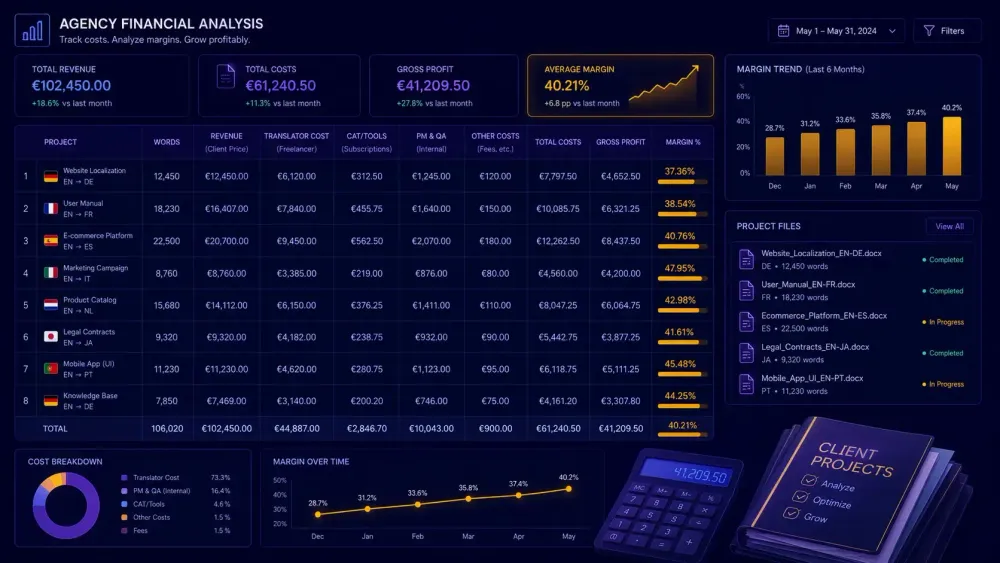
Most agency owners don't track gross margin per project. They track revenue, invoices sent, maybe cash flow. Gross margin — the spread between what a job earns and what it costs to actually produce — often lives in someone's head or gets calculated at year-end when something feels wrong.
That works until it doesn't. You can have strong revenue, full schedules, and clients who seem happy, and still find at year-end that the business made almost nothing. Translation agency gross margin is what tells you whether the project economics work. Without it, you're pricing on instinct.
What gross margin actually means for a translation agency
Gross margin measures project-level profitability before fixed costs enter the picture. The formula:
Gross margin = (Revenue − Direct Costs) / Revenue × 100
Direct costs, for a translation agency, are what you spend specifically to produce a job: freelance translator fees, reviewer fees, and any per-project charges like rush premiums or specialized tooling access. Fixed overhead — salaried PM costs, rent, software subscriptions — does not belong in gross margin. That goes lower in the income statement.
The distinction matters because gross margin and business profitability are different questions. A project at 42% gross margin doesn't automatically mean the business is healthy if overhead is high. But you can't make intelligent pricing or staffing decisions without knowing your project-level economics first. Gross margin gives you that baseline.
A simple example: you bill $0.15 per source word for a 10,000-word legal contract. Your translator charges $0.07 per word. A reviewer costs $0.02 per word. Direct cost: $900. Revenue: $1,500. Gross margin: 40%.
Run that same math on every job you close in a month. The resulting number tells you whether your pricing model holds up. Two clients paying identical per-word rates might produce very different margins if one delivers a clean brief and closes the invoice without comment, while the other needs three revision rounds, asks questions at every stage, and generates four PM hours per $200 of revenue. Gross margin makes that difference visible. Revenue doesn't.
What a realistic gross margin target looks like
The range is wider than most people expect. Nimdzi's annual LSP benchmarking data consistently places mid-market translation agencies in the 35–55% gross margin band. Slator's data reflects something similar, with agencies in specialized domains — legal, pharmaceutical, financial — frequently sitting at the upper end or beyond it.
Boutique agencies with narrow specialization and tight client relationships often achieve margins above 50%. Their linguists command higher rates, but so do they. Commodity-volume agencies competing on price for general commercial translation tend to cluster in the 30–40% range. That's fine if their overhead is low. It's not fine if they're running a team of five with a project management layer and a QA function.
Below 30% is a warning. Pricing is too low, translator costs have drifted relative to billing rates, or the job mix has too many low-margin project types. Nothing about that corrects itself.
The right target for any specific agency isn't the benchmark — it's the benchmark adjusted for your overhead. Calculate total annual fixed costs and divide by expected annual revenue. That ratio is your break-even floor. Add 15–20 points for profit. That combined number is the minimum you should be running at. An agency with two full-time project managers and an office lease needs something very different from a lean two-person remote operation.
The cost structure that determines your margin
Three cost categories drive most of the variance.
Translator fees are the biggest line. In Western European and North American language pairs, specialist translators typically charge $0.10–$0.18 per source word for legal, pharmaceutical, or technical content. Standard commercial rates run $0.05–$0.09. Eastern European, Southeast Asian, and Latin American pairs often carry lower rates for comparable quality, though this varies considerably by market and domain.
Review and proofreading adds a second layer. A second-pass review by a native target-language speaker usually costs $0.02–$0.04 per word. For agency-grade work, this isn't optional. It's the difference between what you're billing for and what you'd produce without it. Removing the review step to save on cost is trading a small gain for a much larger quality risk. When that risk shows up, it means rework, client complaints, and eventually client loss — all of which cost more than the review step you cut.
Project management time is less visible but real. A PM spending three hours on communication, file handling, and revision rounds on a $300 job is consuming margin, not generating it. If your PMs are salaried, this goes into overhead and doesn't directly appear in gross margin. But it's still worth knowing which jobs demand disproportionate PM time relative to their revenue. Those jobs are structural problems whether they show up in gross margin or below it.
The ratio between translator cost and billing rate is the core determinant. For most agencies in competitive language pairs, healthy economics leave 35–45% of revenue after paying translator and reviewer. Jobs where that ratio inverts — because a rare language pair has no cost-effective source, or because market rates moved while client rates didn't — are the ones that quietly drag down monthly averages.
How your pricing model shapes margin visibility
Per-word pricing is standard in translation for good reason: translator time correlates with word count, so revenue scales roughly with cost. But it creates a specific blind spot — it hides complexity.
A 10,000-word project at $0.12 per word generates $1,200 whether the job takes four hours or twelve. If the file needs manual cleanup before import, requires two subject-matter translators, or arrives with a style guide nobody has read before, the cost side expands while the revenue stays flat.
Per-hour billing solves this directly but clients resist it because they want predictable costs. So most agencies land on per-word base rates with documented complexity uplifts — a 10–25% adjustment for tight turnaround, specialized content, or difficult file structures. Clients in regulated industries usually accept this logic without much friction. Build it explicitly into your quoting template rather than applying it inconsistently from one PM to the next.
Some agencies set project minimums, typically $30–50. This matters especially for short jobs under 500 words, where setup, communication, and QA overhead consume margin regardless of word count. Without a minimum, small jobs often run at effective margins well below 20%.
Where agencies lose margin without noticing
Over-servicing price-sensitive clients is probably the most common pattern. Most agencies have accounts that pay commodity rates but generate significant volume. That volume looks reassuring in a revenue report. But these clients often have the most demanding communication requirements, the most complex files, and the highest rate of revision requests. When you account for PM hours, rework, and the opportunity cost of not taking higher-margin work instead, some of your highest-volume accounts are structurally unprofitable. The pattern is invisible without per-client margin tracking.
Underpricing at quote stage is the most widespread source of erosion. A PM quotes based on word count and a standard rate without adjusting for file complexity, domain difficulty, or the fact that the only available translator for that language pair charges above baseline. The job closes at 22% gross margin instead of 40%, and nobody catches it because the loss is spread across multiple line items with no single obvious cause.
Translation memory discount grids deserve scrutiny. Reduced rates for segments matching previous translations are industry standard — clients expect them. But many agencies apply aggressive discount schedules at 75% and above fuzzy match thresholds without capturing any efficiency benefit for themselves. If your CAT tool shows 20% fuzzy match coverage on a project, you paid your translator less for those segments. There is no rule requiring you to pass the full efficiency gain to the client. Plenty of agencies cap the discount at 15–20% on partial matches and keep the rest.
Translator rate drift is the quietest problem. Long-term freelancer relationships are good for quality and consistency, but translator rates move up over time. If your billing rates don't move with them — because clients resist repricing or the conversation feels uncomfortable — the margin on established translator relationships compresses year by year. A translator who charged $0.07 three years ago and now charges $0.09 on a project you bill at $0.14 looks quite different on a margin calculation than they did at the start. Review translator rates against client billing rates at least annually.
Practical ways to improve gross margin
The most consistent improvement comes from pricing complexity deliberately. Define a complexity grid — a 10–25% uplift for tight turnaround, specialized content, or difficult file structures — and apply it at quote stage, not as a surprise after the job starts. Build this into your quoting template so it's automatic rather than left to individual PM judgment.
On fuzzy match discounts, model what you actually pay translators at different match levels and set client discounts from there. If a translator charges 40% of full rate for 75–84% matches, passing the client a 20–25% discount and keeping the rest is reasonable and transparent. Most enterprise procurement teams expect some discount on repeating segments. They don't expect you to give away all of it.
Build and maintain a preferred translator pool with documented current rates. Accurate quotes come from projects routed to known translators at known rates. Price discovery — finding a translator after you've committed a rate to a client — is a primary mechanism through which quotes become losses. A roster with rates per language pair and domain, updated annually, is one of the most useful operational documents an agency can maintain.
Audit language pair economics separately from overall margin. Some pairs are structurally difficult: few qualified suppliers, high rates, and a client base expecting standard pricing. Either price those pairs as a premium offering, develop a second supply source, or decline them when they don't meet your floor. Allowing structurally low-margin pairs to proliferate because they add volume creates a quiet drag on overall economics.
Each quarter, pull your bottom 20% of closed jobs by gross margin and ask why they underperformed. Bad estimate, unexpected translator cost, unbilled scope creep — patterns in that bottom quartile point directly at where quoting or execution needs tightening. The exercise takes about 30 minutes and tends to surface the same two or three root causes repeating.
How to track gross margin without complex software
You don't need enterprise TMS or dedicated agency ERP for this. A spreadsheet with one row per closed project — project ID, client, language pair, source word count, revenue billed, translator cost, review cost, other direct costs, and a calculated gross margin percentage — gives you everything you need.
Maintain it when you close each project. Review it monthly. Patterns across clients, language pairs, and project types tell you where to reprice, where to renegotiate, and which account types are worth growing.
If you want more granularity, track gross margin by project manager. This shows whether some PMs are systematically under-quoting, absorbing scope without billing for it, or maintaining translator relationships that no longer make economic sense. A financial metric becomes an operational diagnostic.
More sophisticated agencies use project management software that attaches costs to jobs automatically. That's worth building toward. But consistency matters more than the tool. A spreadsheet you update every week beats software you check once a quarter.
Pull your last 20 invoices. For each one, add translator cost, reviewer cost, and any other job-specific direct costs. Divide by revenue. If more than a quarter of those jobs sit below your target margin, you have a pricing or cost problem worth diagnosing before it compounds further. Start with the worst performers and answer one question: was it a bad quote, a bad client, or a bad process?