The best AI tools for professional translators: a practical comparison
A practical comparison of the best AI tools for translators in 2026 — DeepL, Smartcat, memoQ, Phrase, and how to evaluate them for real workflows.
Finding the right AI tool for professional translation work is harder than it should be. There are dozens of options, they all claim to save time, and the differences only become clear after you've spent a week integrating one into your workflow. We've had enough conversations with translators and agency project managers to know that most people are looking for something more concrete than marketing copy — so this is our honest take on what's out there and what actually matters when comparing options.
The "best ai tools for translators" question doesn't have a universal answer. A freelancer doing MTPE in memoQ has different needs from an agency running batch translation jobs on 50-file projects. We'll try to be specific about which tools make sense for which situations.
What "AI translation tool" actually covers
The category is messier than it looks. When people say AI translation tool, they might mean any of these things:
A standalone machine translation engine — DeepL, Google Translate, Microsoft Translator — that takes raw text or files and returns a translation with no human in the loop.
An MT-integrated CAT tool — Smartcat, memoQ, Phrase — that uses AI translation as one component of a broader workflow, with TM, glossary, QA, and post-editing built in.
An AI-assisted post-editing assistant that sits alongside a CAT tool and suggests edits, flags low-quality segments, or helps manage terminology.
A specialized AI workflow product built for a specific file type or workflow input, running a structured AI translation process rather than a general-purpose one.
Each category solves a different problem. A standalone MT engine is fast and accessible, but it has no memory, no glossary integration, and no structured output. A CAT tool with MT integration is slower to set up but produces consistent, structured results. Comparing DeepL to Smartcat is like comparing a pocket calculator to accounting software — both do math, but they're not the same kind of tool.
DeepL: what it's good at and where it falls short
DeepL is the tool most professional translators reach for when they need a quick sanity check or a first draft. The translation quality for European language pairs — particularly German, French, Spanish, and Portuguese — is genuinely good. Better than Google Translate for most professional content, and that's not just perception; the output reads more naturally in those pairs.
Where DeepL struggles: less common language pairs, specialized technical content, and anything that requires terminology consistency across a long document. There's no TM, no glossary enforcement, and no segment-level QA. If you translate the same term five different ways in a 40-page document, DeepL won't notice.
DeepL Pro adds a document translation feature and an API, which makes it useful as an MT backend for other tools. If you're evaluating it for an agency workflow, the real question is whether you need a standalone tool or an MT engine to plug into something larger.
Smartcat: the CAT tool with AI built in
Smartcat is a full CAT tool platform — browser-based editor, TM, glossary, project management, a linguist marketplace — with AI translation as part of the workflow. It's built as a multi-agent system where specialized agents handle file preparation, translation, formatting, and project coordination.
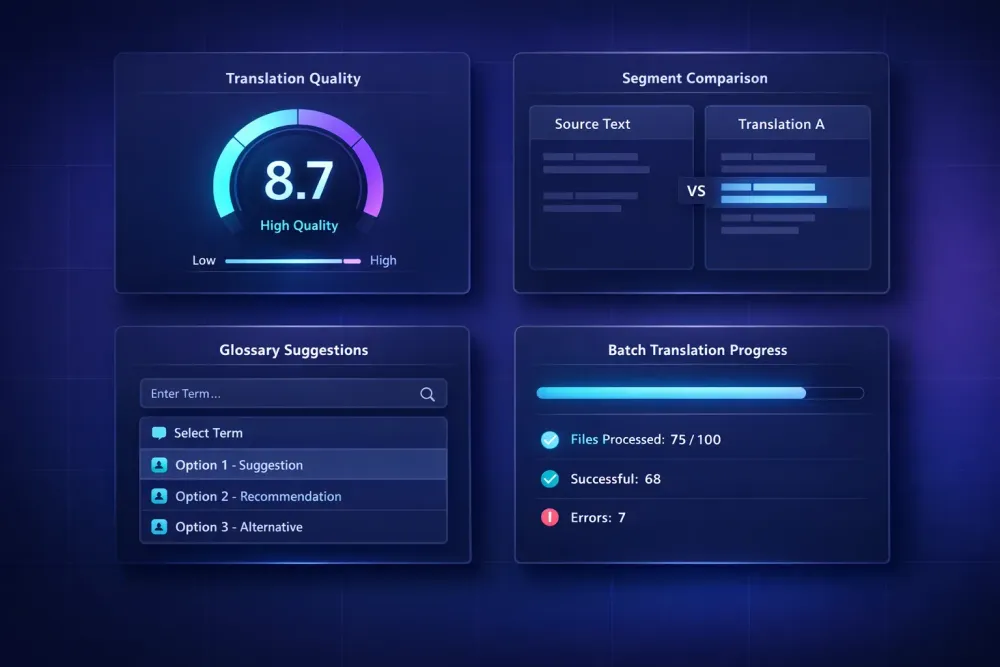
What distinguishes Smartcat for agency use is the combination: you can run AI pre-translation on a file, apply TM leverage, flag glossary violations, and do all of this in a workflow that supports multiple translators on the same project. The Translation Quality Score (TQS) rates AI-translated segments and surfaces low-confidence ones for human review, which is a practical way to triage MTPE effort.
For freelancers, Smartcat has a free tier covering individual file translation and basic project management. The full feature set — automation rules, marketplace access, team features — is on paid plans.
One thing worth knowing: Smartcat produces bilingual DOCX exports, which preserve source and target text in a structured file. This format is particularly useful if you need to run downstream processing on translation output — feeding the file into dedicated AI translation workflow tools, for example.
If you're working with Smartcat bilingual DOCX exports and want a structured AI translation workflow on top of them, SnapIntel is worth looking at. It takes Smartcat bilingual exports as input, runs AI translation with preparation controls — domain analysis, glossary, prompt approval — and returns translated DOCX files with a QA report and quality rating. It's not a replacement for Smartcat; it fits the step between Smartcat export and final delivery.
memoQ: the workhorse for complex, regulated content
memoQ is the CAT tool of choice for many professional translators and agencies who need fine-grained control over TM, glossary, and QA settings. It's desktop software (there's a server version for teams), which makes it less accessible for distributed teams but gives it performance advantages for large files.
memoQ integrates with multiple MT engines, including DeepL and Microsoft Translator. You configure the MT integration per project, giving you flexibility to use a different engine for different language pairs or content types.
Where memoQ excels is TM management. The granularity of fuzzy match settings, TM prioritization, and alignment tools is hard to match. For large agencies managing hundreds of TMs across dozens of clients, that level of control matters.
For post-editing workflows, memoQ's adaptive MT feature learns from reviewer corrections and improves over time. This works best when the same translator reviews the same content type consistently — it doesn't help much on one-off projects.
Phrase: for enterprise localization at scale
Phrase has moved upmarket — it's positioned as an enterprise localization management system with AI translation features, rather than a traditional CAT tool. For agencies managing large-scale, ongoing localization programs with CMS integrations, connector setups, and multiple language pairs running simultaneously, Phrase has the infrastructure.
For individual translators or small agencies, it's probably more than needed. The interface is powerful but not minimal, and the pricing reflects the enterprise positioning.
From an AI translation perspective, Phrase integrates with multiple MT engines and has its own AI features for TM optimization and quality estimation. The quality of AI output depends heavily on the engine you configure — Phrase itself is the workflow layer, not the translation engine.
How to evaluate any AI translation tool before committing
A few things we'd check before putting any tool into a production workflow:
Does it handle your actual file formats? Run your most problematic files through a trial version before signing. Format compatibility issues are predictable — but only if you've seen them before.
What happens to TM and glossary when you switch tools? Most tools support TMX and TBX formats for portability, but the quality of import/export varies. Check that you can get your data out before you lock it in.
What's the MTPE experience actually like at volume? The difference between a good and a bad MTPE interface is significant over an 8-hour workday. Ask for a trial project at your typical scale.
How does it handle your specific language pairs? Tools like DeepL and Google perform well on high-resource pairs and noticeably worse on lower-resource ones. If you work with Kazakh, Uzbek, or Mongolian, test quality specifically for those pairs before committing.
The honest picture on AI translation quality in 2026
AI translation quality has improved substantially over the past three years, but it hasn't converged on a single answer to "is AI good enough?" That depends on language pair, content type, and what "good enough" means for a given project.
For moderately complex content — business documents, general technical material, website copy — AI translation often produces a draft that needs 20–40% post-editing to reach publication quality. For highly specialized content — medical device instructions, legal contracts, patent filings — the post-editing burden is higher, and in some cases it's faster to translate from scratch than to fix what an MT engine produces.
The right framing isn't "AI vs. human translation." It's "AI + post-editing vs. human translation from scratch." In most professional contexts, the former is faster and cheaper at equal quality, as long as the post-editor is doing a proper review. Rubber-stamped MTPE — where a translator accepts output without reading it carefully — is one of the most common quality problems in the industry right now. The tool being fast doesn't help if the review step gets skipped.