How to maximize translation memory leverage and reduce project costs
How to calculate, improve, and track translation memory leverage in your agency — practical benchmarks and a TM strategy that compounds over time.
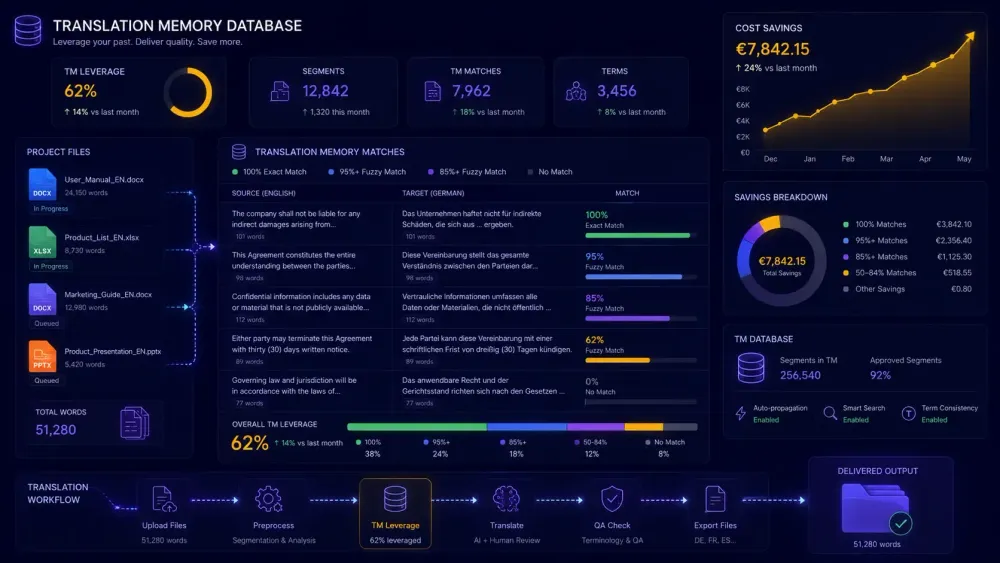
Translation memory leverage is the percentage of your project's word count handled by previously approved translations rather than fresh work. In an agency billing tens of thousands of words per month, moving from 20% leverage to 50% is not a small operational tweak — it's a structural margin improvement that compounds across every project, every client, every quarter.
Most agencies have a TM. Far fewer have a TM strategy.
What translation memory leverage actually means
TM leverage is a ratio: words covered by existing matches divided by total project word count, expressed as a percentage.
Four match categories generate leverage, and they work differently from each other. Repetitions are segments that appear more than once within a single project. Most CAT tools apply them at zero or near-zero cost, since the translator works each unique segment only once. Exact matches (100%) are segments identical to previously approved translations in the TM. These are auto-confirmed in most workflows, requiring no reviewer time. In Smartcat's billing model, exact matches cost 0 Smartwords, meaning they're essentially free to process. Fuzzy matches (75–99%) are segments similar but not identical to prior translations. They require review, but the translator starts from an approximation rather than a blank segment; standard grids charge 30–60% of full translation rate for these, depending on the match band. Context matches (101%), supported in some CAT tools, are exact matches where the surrounding context also matches — the highest-confidence category before a human review.
In practice, a project with 30% leverage isn't being translated from scratch. Roughly 30% of words arrive with approved translations already attached, and the margin on that portion is significantly higher than on new content.
Most agencies track TM leverage at the project level. Far fewer track it per client across all projects over time. That's where compounding happens — or, if the setup is fragmented, where it consistently fails to happen.
Understanding how those numbers build (or don't) over successive projects is what separates TM management from TM maintenance. Maintenance keeps a TM running. Management makes it increasingly more valuable.
Why most agencies leave TM savings on the table
The most common failure mode we see is TM fragmentation. An agency works with the same client for two years, but because different project managers set up TMs differently — different names, different structures, different segmentation rules — leverage stays low. The TM exists; it just doesn't accumulate.
The second failure mode is inconsistent segmentation. If source documents break at different points depending on how they were formatted, the TM can't match across files. A sentence ending at a line break in one document may segment differently in another. Those two segments will never generate a match, even if the underlying text is word-for-word identical.
Third, and often overlooked: terminology inconsistency. If one translator renders "Service Level Agreement" as "SLA" in one project and another writes "service-level agreement" in the next, neither version matches the other in TM lookup. The TM fills with variants instead of accumulating clean entries. Leverage drops. Client-facing output becomes inconsistent. The problem compounds with every project that doesn't enforce a glossary.
The fix starts before the first file arrives. Client-specific TMs, consistent source file preparation, and a glossary on every project above a certain word threshold are the process steps that separate TM-efficient agencies from those hoping leverage accumulates on its own.
This works best when a single person — a project manager or lead translator — owns the TM setup for each client and reviews it periodically. It doesn't work well when TM setup is delegated informally with no standard and no one checking.
How to measure your current TM leverage rate
Before improving your leverage rate, you need to know what it actually is. Most CAT tools generate an analysis report on file import — a word-count breakdown by match category, sometimes called a "word count analysis" or "leverage analysis" depending on the tool.
Run analysis reports for projects delivered in the last 90 days. Sum all words covered by TM matches (100%, 95–99%, 85–94%, 75–84%, repetitions) and divide by total project words. That's your project-level leverage. Then repeat the calculation per client across all their projects. This tells you whether your TM is building value for that client or sitting idle.
After that, compare quarters. If Q1 leverage for a client matches Q2 leverage, and they've been sending similar documents both quarters, something is broken in how the TM is being maintained — or not maintained at all.
Benchmarks vary considerably by domain. In technical documentation with consistent terminology, well-maintained TMs regularly exceed 40% leverage. Marketing copy, designed to be fresh, runs 10–15%. Legal contracts for the same client, where boilerplate sections are heavy, can reach 60–70% in mature TMs.
If your technical documentation client shows 15% leverage after two years of active projects, treat that as a structural problem, not natural variation.
One note on benchmarks: these figures reflect well-run TMs. A fragmented or inconsistently maintained TM will perform worse across all domains. The right comparison isn't industry average; it's what your leverage looks like month-over-month for the same client.
Building a TM strategy that compounds over time
The most efficient TM setups we've seen share four properties. None of them require new software.
One TM per client is the baseline. Not one per language pair, not one per project — one TM per client, with language-pair filtering at the project level. Every project for that client feeds the same pool, and the pool grows with every project delivered.
Consistent segmentation rules matter more than most teams realize. Most CAT tools allow custom segmentation rule sets per workflow. Define your rules once per client format type and apply them without variation. By the third or fourth project, the TM starts returning high-quality matches at meaningful rates. Before that point, it mostly misses.
Glossary enforcement before TM confirmation keeps the TM clean. When a translator confirms a segment containing an inconsistent term, that variant goes into the TM and creates noise across every future project. Running a terminology check before segment confirmation prevents this. Inconsistencies compound quickly once they're in the TM.
Periodic TM audits after major projects or client terminology updates prevent drift. If a client revises a product name mid-project, prior TM segments now carry the wrong term. A batch find-and-replace in the TM editor corrects this before the next project arrives. Skipping this step means every future project picks up the inconsistency automatically.
One example: an agency translating EU regulatory documents for a pharmaceutical client reached 62% leverage over 18 months by treating these four properties as non-negotiable setup steps. Initial overhead — consistent segmentation, glossary enforcement — ran about 40 minutes per new project. At their volume, that setup time paid for itself on the second project.
Fuzzy match thresholds and how to price them correctly
Pricing fuzzy matches is one of the more practically contentious areas in agency operations, and there is no universal standard. The most common grid structure looks like this:
- Repetitions and 100% matches: 0–10% of full rate
- 95–99% fuzzy matches: 25–35% of full rate
- 85–94% fuzzy matches: 40–55% of full rate
- 75–84% fuzzy matches: 65–75% of full rate
- No match: 100% of full rate
Your actual grid should reflect what a translator genuinely needs to do at each band. A 95% match in a technical specification requires essentially a verification pass — the translator reads the segment, confirms the change is minor, and moves on. A 75% match in legal text may require nearly full re-translation; the structural similarity can be misleading.
The mistake agencies make most often is setting discount grids too aggressively in the lower fuzzy bands. A translator billing at 65% of full rate for a 75% match isn't always getting a fair deal, especially when source text varies in ways that make the match look closer than the actual content change. Over time, aggressive discounting in lower bands erodes translator relationships — something agencies with large freelancer rosters feel more acutely than those with in-house staff.
The discount grid is also a client-facing document in many cases. If your grid differs significantly from what a client expects, that conversation should happen before a project rather than during invoicing. Most agencies inherit or copy grids from somewhere; fewer have actually reviewed them against what the work genuinely costs at each band.
Setting the grid thoughtfully, and revisiting it periodically, matters more than most agencies assume.
When TM leverage can hurt quality
High leverage is not automatically good for the output. There are conditions under which a strong match rate masks quality problems rather than preventing them.
Source text changes are the most common case. If a document has been revised — new sentence structure, updated terminology, rephrased clauses — segments scoring as fuzzy matches may look similar enough to accept without full review but carry the wrong meaning in context. The match rate looks healthy; the output contains errors that post-delivery QA may or may not catch.
Context shifts matter in creative and marketing content. A phrase that worked well for a product launch six months ago may feel tonally wrong now. A 100% TM match doesn't tell you whether the translation still fits the current brief, the current audience, or the current campaign.
Outdated TMs are a structural risk for any agency that skips maintenance. If the TM hasn't been audited in 18 months and the client has revised their style guide twice, the TM is generating inconsistencies more reliably than savings. Spot-checking the oldest entries periodically is maintenance most agencies skip until a client flags something.
This is worth communicating to clients when presenting leverage numbers. High TM leverage should come with a note that match-level review is part of the process. Clients who assume high leverage means lower review hours often end up surprised by post-delivery revision requests.
Getting AI-translated content back into your TM
One workflow gap that quietly costs agencies leverage over time: running an AI translation step, delivering the translated document, and then not feeding that translation back into the TM. The next time the same client sends a similar document, the TM shows no coverage for that content. The team re-translates segments that were already handled.
The fix requires a deliberate step. After delivery, export the completed translation as a source/target spreadsheet, then import it into the TM as an approved translation set. Most CAT tools accept this format when the language pair is consistent and the file structure is clean.
If you translate DOCX or XLSX files with AI, SnapIntel produces a neutral XLSX export alongside the translated document — a clean source/target file formatted for import into any CAT tool. This makes it practical to feed AI-assisted translations into your existing TM without reformatting between projects.
The time investment runs 5–10 minutes per project. For clients who send similar documents monthly, the leverage gains over a six-month window can reduce fresh translation volume by 15–20% — which, at any significant per-word rate, is a meaningful cost offset.
The underlying logic is straightforward: every translation you deliver is data. If it goes into the TM, it pays dividends on future projects. If it doesn't, you start from scratch every time.
The one step worth taking this week
Run a TM leverage analysis on your three most active clients from the past 90 days. For each, calculate the percentage of project words covered by TM matches. If any client shows under 20% leverage after more than six months of active projects, treat it as a process failure rather than random variation.
The cause is almost always one of three things: a fragmented TM, inconsistent segmentation rules, or glossary enforcement gaps. All three are fixable without new software. They require process discipline and someone willing to audit the setup rather than assume it's functioning correctly.
A single afternoon spent reviewing TM configuration for one underperforming client often surfaces the problem — and fixing it takes less time than the savings it generates over the next three months.