How to answer clients who say AI can translate it themselves
When a client says AI can translate the file themselves, arguing about quality loses the room. What agencies should say instead, and when to agree.
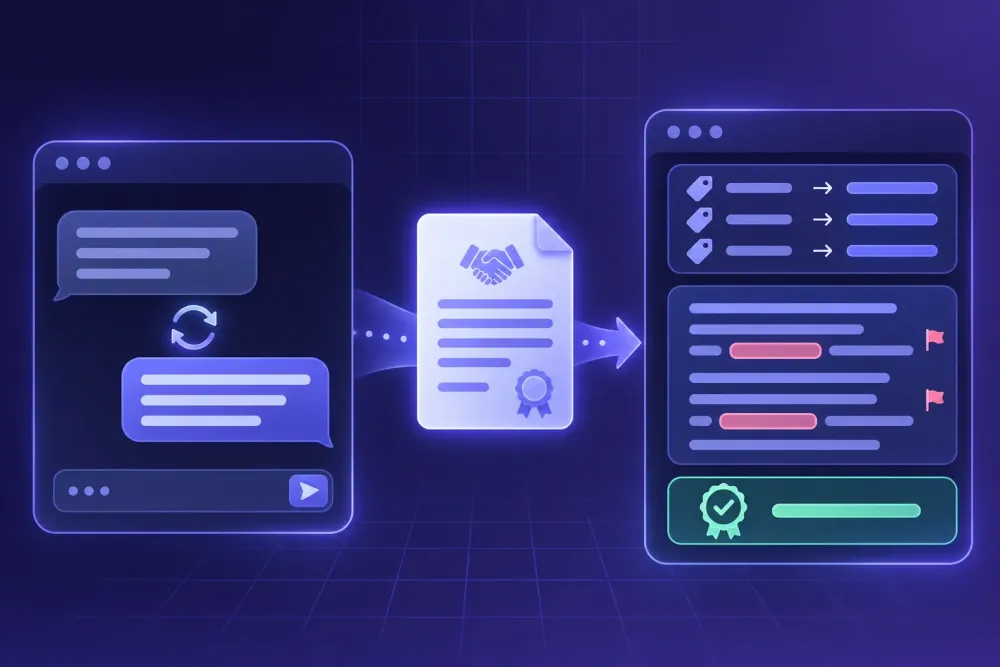
A client forwards a 42-page supplier agreement on a Tuesday afternoon and adds one line at the bottom: no quote needed, we'll run it through ChatGPT ourselves. When a client says AI can translate the file themselves, most of us answer the wrong question. We start defending human quality, listing what machines get wrong, and the client hears a vendor protecting its margin.
We talk to a lot of agency owners and project managers about this exact moment. The pattern is consistent. The people who keep the work are not the ones with the sharpest argument about linguistic nuance. They are the ones who stop debating output and start talking about what the client has just agreed to carry. That shift is learnable, and it barely depends on how good the models happen to be this quarter.
What it usually means when a client says AI can translate the file
The sentence is almost never a technical claim. It is a budget sentence wearing technical clothes, and it arrives in about four flavors.
Sometimes the money is simply gone. Procurement cut the localization line and the person emailing you has been told to find a way. Sometimes the document genuinely does not matter: an internal update that three people will skim and nobody will act on. Sometimes you are paying for a previous vendor's sins, or your own, a job that came back late or a quote that took four days while the deadline moved. And sometimes it is a directive from two levels up, where somebody signed an AI mandate and your contact is relaying it without much conviction.
Those four need different answers, and the email will not tell you which one you have. One question sorts them faster than anything else we have tried: what happens to this document after you receive it?
If the answer is "we send it to the Spanish distributor and they sign it," you are in a risk conversation. If it is "legal reviews it before it goes to the regulator," you are in a compliance conversation. If it is "we post it on the intranet," the client may be right and you should hear that. The answer also tells you who else is in the room, which matters when the client pushback originated above your contact's head rather than with them.
Ask it plainly, with no sales frame around it. Most clients answer honestly, because it sounds like a project question instead of a negotiation move.
Why arguing about quality loses the room
By the time that email arrives, the client has already run something through a free tool and looked at the result. It looked fine. The sentences were grammatical, nothing was visibly broken. They cannot evaluate the target language, so your list of things AI gets wrong lands as theory against their evidence.
There is a harder problem underneath. You will be wrong a meaningful share of the time. For a plain internal memo from English into German, raw output from a current model is often good enough for what it is for. If your position is that AI cannot translate, the first counterexample costs you the relationship, and the client will find one, because they are testing with exactly the documents where it works.
Slator and CSA Research have both tracked how quickly post-editing moved from an exception to a standard line on agency price lists. The industry already conceded that machines produce usable drafts. A client reaching the same conclusion is not being naive, and treating them as naive is how the conversation ends.
What holds up is narrower and more honest. Raw AI translation is unpredictable in ways you cannot see from the source side. Not uniformly bad. Unpredictable. A 40-page contract can come back with 38 clean pages and two sentences where a negation flipped or a defined term drifted into a synonym. Nothing in the file tells the client which two. That is a different claim from "the quality is poor," and it is one you can defend with real examples instead of adjectives.
Move the conversation to who carries the risk
The useful question is not whether AI can translate the document. It is who answers for it when a clause means something other than what it said in English.
When an agency delivers, somebody signs their name to it. There is a glossary that fixed how defined terms were rendered, a QA report showing what was checked, a TM that keeps next year's amendment consistent with this version, and a second person who read it. If something goes wrong, there is a record of how each decision was made, and usually insurance behind it.
A client translating in a chat window has none of that. No glossary, so the same term can appear three ways in one document. No record of which prompt produced which paragraph, so a problem cannot be traced or reproduced. No QA step, so omitted segments stay omitted. No TM, so the next version starts from zero and reads like a different contract. And nobody to call at 6pm.
Said in those terms, the price stops being the subject. A client who was comparing your quote against free is now comparing it against carrying the exposure internally, which is a cost nobody had priced. This is the same ground agencies stand on when clients consider hiring translators directly, and it is where the translation agency value argument actually works.
It works best when the document has consequences: contracts, regulated content, anything a third party signs or relies on, anything going to a government body. It does not work on a document nobody will act on. Use the risk argument on an internal FYI and you sound like an insurance salesman, and clients remember that tone longer than they remember the quote.
Two conversations that went differently
A distributor sent an agency we work with a four-sheet XLSX price list they had already translated themselves, English into German and French. The German read fine. The import into their ERP failed anyway. Decimal separators had been converted in some cells and not others. The "lead time" column header came out three different ways across the four sheets, so the field mapping broke. Two formulas referenced sheet names that had been translated, and product codes that should have stayed in English had been helpfully localized. The cleanup cost more than the original quote, and almost none of the damage was linguistic.
That example is worth keeping in your pocket because it moves the argument onto ground where you are not asking the client to take your word for anything. XLSX workbook translation, PPTX presentation translation and DOCX import all have structural failure modes that have nothing to do with language skill, and a client can verify every one of them without speaking a word of German.
The second conversation went the other way. A manufacturer had a 90-page PPTX training deck: internal, one language pair, read once during an onboarding week. They said they would handle it with AI. They were right. Instead of pitching full post-editing, the agency offered a glossary covering the forty terms that recur through the deck, plus two hours of spot-checking on the eleven slides about lockout procedures and chemical handling. Small invoice. The deck went out on time. Three months later the same client needed a customer-facing version of that content for a regulated market and did not shop it around.
Giving away the easy job bought the one that mattered. We have watched that trade work more often than it fails, but it only works if you are straight about which slides need a human and do not let the scope quietly expand once you are inside the file.
Repackage what you sell so the objection has somewhere to go
If the only thing on your price list is full human translation at a per-word rate, every AI conversation becomes a yes-or-no vote on your most expensive product. A client who wants something cheaper has nowhere to go except away from you.
The agencies handling this well have built a visible middle. Light post-editing as a named service, priced separately from full MTPE. Terminology work on its own: pull the terms out of the source, agree the target renderings, hand over a glossary the client can reuse in whatever tool they are working in. Review-only, where the client brings their own AI output and you check it. A sign-off service for clients who need a named professional behind a file they produced themselves.
Review-only is the tier that answers this objection head on. A client who has already run the file does not want to be told to start over. They want to know whether what they have is safe to send. Asking for source and target as a two-column XLSX, or a bilingual file from whatever they used, makes that job fast to quote and fast to do. Plenty of clients accept a flat per-document review fee for content they refused to pay a per-word translation rate on, which is also worth factoring into how you price translation work with AI in the mix.
Two cautions. Per-word pricing does not map onto review work, because the time depends entirely on how bad the input is, so quote hourly or per document with the scope written down. And do not publish a cheap tier you cannot deliver profitably: a review service that turns into a full retranslation every second job is worse than not offering one.
Scripts for the versions of this you will actually hear
AI objection handling goes better when you concede something true first. Four versions you will hear, and what has worked.
"We'll just run it through ChatGPT." Ask what happens to the file afterwards. Then: "For something the distributor signs, the part I'd worry about isn't the German, it's that you won't know which two sentences drifted. Want me to review your output instead of translating from scratch? Costs less than a full job and you keep the work you already did."
"AI is free and you're expensive." Agree with the first half. "It is, and for your internal updates I'd use it too. What you're paying me for on this contract is somebody who signs off on it and keeps the terminology matching the 2024 version, so the two documents don't contradict each other in a dispute."
"Head office says use AI for everything." Do not fight the mandate, work inside it. "Then let's make the AI output defensible. I'll build the glossary and QA the high-risk sections. You stay compliant with the directive and the files still hold up."
"Our bilingual sales guy will check it." This one is reasonable on its face, so go gently. Ask how many hours he has this month, and what it costs the company when he spends a day on a price list instead of selling. Offer to do the check and send him a short list of decisions to confirm, which gives him authority without giving him the work.
None of these survive being read aloud as a script. They work because each one gives the client something before it asks for anything.
When the client is right and you should say so
Some documents do not need you. Internal updates, meeting notes, a competitor's blog post somebody wants the gist of, a deck that gets read once and archived. When a client says they will handle those with AI, the right answer is that this makes sense, here is the one thing to watch for, call me when something carries a signature.
Agency owners resist this because it feels like talking yourself out of revenue. It does the opposite. A client who hears you decline work they did not need stops reading your quotes as self-interest, and when the regulated document turns up you are the person who was straight with them about the last one.
Some will still leave. A client whose whole reason for using you was that translation felt difficult will discover it feels less difficult now, and go. Accept that rather than arguing with it. The hours spent holding onto that account are better spent on clients whose documents have consequences, and there are more of those than the current mood suggests.
Take your last twenty invoices and mark each one: would raw AI output have been acceptable for what that document was for? Answer honestly rather than defensively. The jobs where the answer is yes are the ones you will lose over the next two years, and they tell you how much revenue needs replacing. The jobs where the answer is no are your actual business, and you will notice that nearly all of them fail the AI test for a structural or accountability reason rather than a linguistic one. That is the argument you should be making.
Then write down two prices, review-only and full, and put both in the same email the next time somebody tells you they will handle it themselves. The objection stops being a door closing and turns into a choice between two things you sell.