Gisting vs Publication Quality: When Good Enough Translation Is Genuinely Good Enough
Gisting translation is enough for most internal business documents. Here's how to tell which documents need publication quality and which don't.
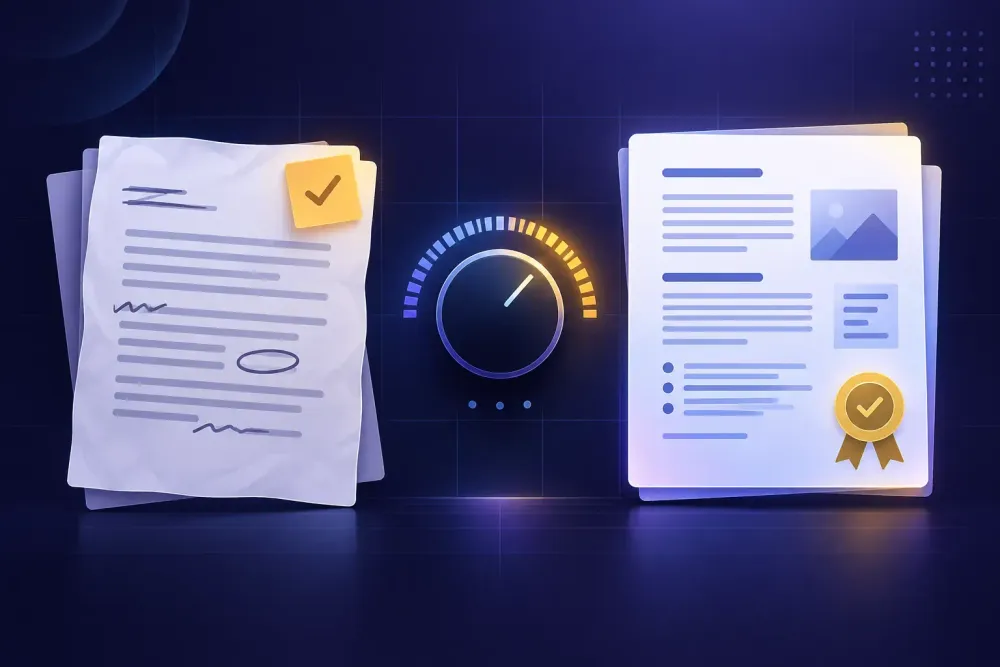
Someone in procurement forwards you a 40-page supplier report in Korean and wants to know how fast you can get it in English. Before answering, ask what happens to the document after somebody reads it. If three people skim it, decide whether to escalate, and never open it again, you need gisting translation and you can have it before lunch. If it goes into the contract file or gets sent back to the supplier, that is a different job with a different price and a different timeline. Most of the frustration we see around business document translation traces back to nobody asking that question at the start.
What gisting translation actually means
Gisting is translation that gets the meaning across without being presentable. The sentences are understandable. The terminology is roughly right. The register may be flat, some phrasing will be awkward, and a native speaker would spot within a paragraph that nobody polished it. That is the point. You are buying comprehension, not prose.
The distinction is older than AI translation. Translators have been quoting "for information only" rates for decades, and the industry wrote it into standards. ISO 18587, the standard covering post-editing of machine translation output, specifies requirements for full post-editing and treats lighter editing as a separate, less demanding category. The TAUS post-editing guidelines make a similar split between output that is merely comprehensible and output that is publishable. Different names, same underlying idea: quality is not one dial that goes from bad to good. It is a set of choices about what you are willing to leave rough.
What changed is the floor. Ten years ago, raw machine output of a technical document was often too broken to act on, so gisting still meant paying a human something. Today, for the common European pairs and for well-structured source documents, raw AI output is frequently good enough to base a decision on. That shifted a whole category of documents out of the "get a quote" pile and into the "handle it this afternoon" pile.
The trap is that the floor rising makes gisting output look better than it is. Fluent text reads as finished text. A translation can be smooth, confident, and wrong about the one clause that mattered, and nothing in the formatting will warn you.
Two caveats before going further. The floor has not risen evenly. For English paired with major European languages, raw output on a clean business document is usually decision-grade. For Japanese, Korean, Thai, or any pair where one side has little training data, the gap between "fluent" and "accurate" is wider and gisting needs more supervision. And none of this holds if your source is a scanned PDF or a photographed document, where recognition errors get translated confidently along with everything else.
The four levels most companies actually use
In practice, companies that translate documents regularly end up with four levels, whether or not anyone has written them down.
Raw output, nobody looks at it. Incoming correspondence, supplier emails, competitor material, a batch of customer reviews. You want to know what it says. Nobody outside the company will ever see the translated version.
Gist plus a spot check. Someone who knows the subject, even without the language, reads the translated document and flags anything that looks structurally odd: a missing section, a number that contradicts the source, a warning label that reads strangely. Fifteen minutes of attention on a 30-page document. This is where most internal business translation should live and where it rarely does.
Reviewed for accuracy. A bilingual person, or a professional, checks the translation against the source and corrects errors of meaning without rewriting style. Contracts you need to understand internally, technical manuals used by your own staff, HR policies going to employees.
Publication quality. A translator produces or edits the text until it reads as if it had been written in the target language, with terminology checked against your glossary and formatting rebuilt to match. Anything with your logo on it that a customer, regulator, or court will read.
The levels are not a ladder you climb. They are four different products. A company that runs everything at level four spends far too much. A company that runs everything at level one eventually ships a mistranslated safety warning.
Companies drift toward the extremes without meaning to. A bad experience with one translated document pushes everything up to level four for a year. Then somebody sees the annual invoice and everything drops to level one. Neither move is a decision about documents; both are reactions to the last thing that went wrong. Writing the levels down, even on one page, is what turns the choice back into a per-document judgement instead of a company-wide mood.
Ask what happens to the document after it is read
The decision is easier than it looks, because it does not depend on the document type. It depends on the document's destination.
Two questions get you most of the way. First: does the translated version leave the building? A supplier's quality complaint that your engineering team reads and acts on never leaves. Your response to that complaint does. Second: will anyone rely on the translated wording rather than the original? If the source stays authoritative and the translation is a reading aid, the bar drops sharply. If someone signs, certifies, or complies based on the translated text, the bar goes up regardless of how mundane the document looks.
A worked example. A German manufacturer we talked to receives monthly maintenance logs from a Turkish service partner. Fifty to eighty pages, mostly tables, mostly repetitive. For three years they paid an agency to translate them properly because the documents came from a partner and felt official. Nobody had ever reread one after the month it arrived. Those logs are level one. The same company also sends translated commissioning certificates to customers, and those had been handled by whoever on staff spoke the language best. Wrong way round on both counts.
The other direction happens too. A finance team we spoke with used raw AI output for a set of Spanish subsidiary reports and pushed the numbers straight into a consolidated summary that went to their auditor. The translation was fine. The problem was that a "provisión" line had been rendered with an English accounting term that means something narrower, and nobody caught it because nobody was reading for that. The document had left the building without anyone deciding it had.
Where gisting quietly fails
Gisting fails in predictable places, which makes it manageable.
Numbers and units survive translation badly in ways that fluent text hides. Decimal separators flip between European and US conventions. Dates reorder. A "billion" is not the same quantity in every European language's traditional usage, and older documents still use the old conventions. None of this looks like an error on the page.
Negation and modality are the second failure zone. "The equipment must not be operated without the guard in place" and "the equipment must not be operated with the guard in place" differ by one word and read equally naturally. Legal and safety text is dense with exactly this kind of construction, and fluent output gives you no signal that a modal verb flipped.
Third: anything the source document did not make explicit. Pronouns without clear antecedents, elliptical table headers, a column labelled only "2024" that could be a target or an actual. A human translator asks. An AI system picks the more probable reading and moves on, confidently.
Spreadsheets and slide decks add their own version of the problem. In a workbook, the translatable content is usually short strings with no surrounding sentence to disambiguate them: a column header reading "Balance", a status cell reading "Open", a dropdown value that also appears in a formula somewhere else. Short strings are where AI translation has the least context to work with, and a spreadsheet gives you no visual cue that a cell was guessed rather than understood. Slide decks have the same issue with fragments, plus the risk that translated text quietly overflows a box and nobody notices until the deck is on screen.
The practical response is not to abandon gisting. It is to spot-check for these three categories specifically rather than reading the whole document for general quality. A subject expert who does not speak the language can verify numbers against the source, check that section counts match, and read every sentence containing "not", "only", "except", or "unless" with suspicion. We wrote a fuller walkthrough of that approach in how to check translation quality when nobody on your team speaks the language.
What publication quality actually buys you
It helps to be honest about what you are paying for at the top level, because "better translation" is too vague to budget against.
You are paying for four things. Terminology that matches whatever your company already published in that language, which requires someone to look it up rather than guess. Register that fits the audience, so a customer-facing manual does not read like an internal memo. Formatting rebuilt to survive text expansion, since most European languages run longer than English and tables, slide text boxes, and fixed-height layouts break. And accountability, meaning a named person or company stands behind the result.
That last one is often the real purchase. When a distributor asks for a certified translation of a compliance document, they are not asking for better sentences. They are asking for someone to be responsible. No amount of AI quality changes that requirement, and it is the clearest signal that you are outside the range where gisting applies.
It also costs real time. Publication quality on a 10,000-word manual is not an afternoon. Between translation, review, terminology checking, and rebuilding the layout, a week is normal and two is common for anything technical. Companies that discover this on a deadline usually end up shipping level-two work while calling it level four, which is the worst outcome available: the cost of the good process without the result.
The decision between handling documents internally and sending them out has its own logic, which we covered in translation bureau or AI tool: how to decide for routine business documents.
Running two tiers without a translation department
Most companies do not need four documented levels. Two work: a fast lane and a slow lane, with a written rule for which lane a document enters.
The rule can be one sentence. Ours, when we describe it to customers, is roughly: if the translated file leaves the company or anyone acts on the translated wording instead of the original, it goes to the slow lane. Everything else is fast. Write your version down and put it where the people who request translations will see it, because the failure mode is not people choosing wrong, it is people not knowing there was a choice.
For the fast lane you want something that produces a usable file, not a wall of text you have to reassemble. A translated DOCX that keeps its headings and tables is worth considerably more than the same content as plain text, because the spot check depends on being able to compare structure against the source. This is where we built SnapIntel: you upload a DOCX, XLSX, or PPTX, it runs a structured AI translation workflow over the file, and you get back a translated document in the same format plus a QA report and a quality rating you can use to decide whether the file needs a closer look. It does not replace the slow lane. It makes the fast lane fast enough that the slow lane is reserved for documents that deserve it.
For the slow lane, keep a translator or agency relationship warm even if you only use it four times a year. The worst time to find a legal translator for Portuguese is the week you need one. Send them something small once in a while, share your terminology, and the urgent job in November will not start from zero.
One more thing that sounds bureaucratic and is not: someone has to own the lane assignment. If it is whoever happens to receive the file, the answer will track how busy that person is rather than what the document needs. In smaller companies this usually lands on one operations or office manager, and the whole system works as long as that person has the authority to say a document is going to the slow lane even when the requester wanted it yesterday.
The takeaway
Take your last three months of translation requests and sort them by one question: did the translated file leave the company, or did anyone rely on the translated wording rather than the source? Everything that fails both tests is gisting work, and you are almost certainly overpaying for it in money, in turnaround time, or in the attention of whoever keeps getting asked to "just look this over." Everything that passes either test needs a named reviewer, and it needs one before the deadline exists rather than after.