Back-translation as a QA method: when it helps and when it wastes time
Back translation qa explained: when it genuinely helps (clinical trials, legal filings) and when it inflates your budget on projects that don't need it.
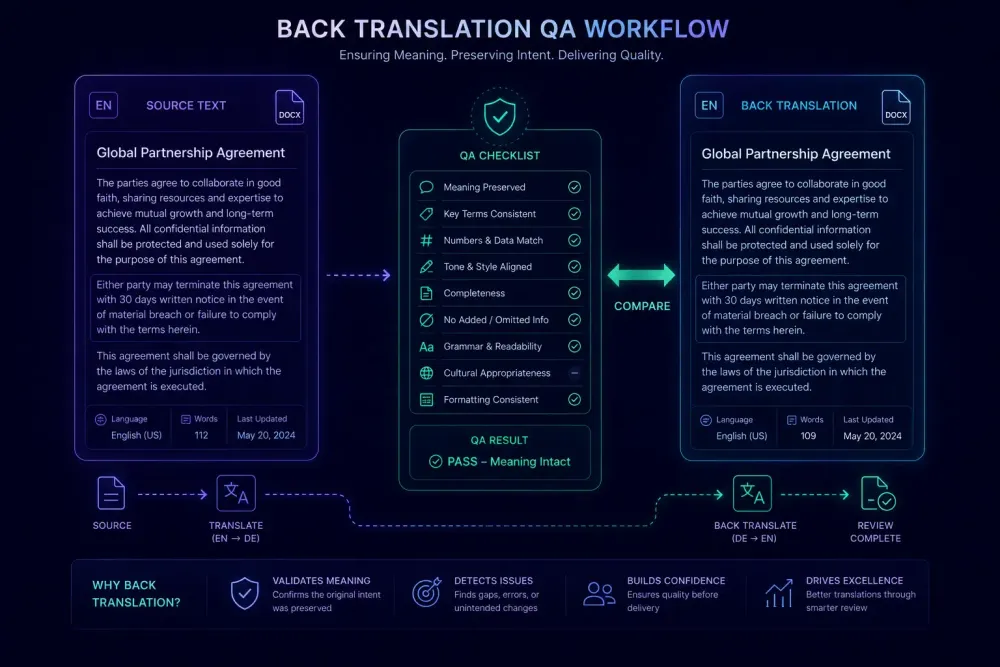
Back-translation gets requested more than it gets questioned. We've seen it appear in project briefs for marketing campaigns, technical manuals, and software UI strings — contexts where the method adds overhead without improving anything. We've also seen agencies skip it on clinical trial documents where it would have caught meaning errors that caused months of regulatory rework. The technique isn't inherently useful or wasteful. It depends on what the content is, who the client is, and whether anyone involved can actually read the target text.
Our honest read: the case for back-translation gets made too often, not too rarely. Most of the time, it's requested by clients who came across the term somewhere and assumed it was standard practice. It isn't. But there's a narrow set of contexts where it genuinely earns its cost, and those contexts matter enough to deserve a clear account.
What back-translation actually means
Back-translation is the process of taking a completed target-language document and having a second, independent translator convert it back into the source language — without access to the original source text. You then compare that back-translated version against the original to see where meaning may have shifted.
The independence piece is not optional. If the back-translator sees the original before finishing their work, they'll unconsciously align their output with it, making divergences disappear regardless of what the forward translation actually says. The method's value comes entirely from that independence. You're measuring whether the target text carries the same meaning on its own — not whether a bilingual reader can force two texts into alignment after the fact.
This is also different from round-trip machine translation, where you run a document through an MT engine in both directions and compare the result. Round-trip MT tests can catch some self-contradictions in MT output, but they measure engine consistency, not translation quality. A back-translation produced by a qualified human translator tells you something meaningful about fidelity. A round-trip MT comparison tells you whether the machine agrees with itself.
One more distinction worth making: back-translation doesn't replace direct bilingual review. It answers a specific, narrow question — does the target document convey the same meaning as the source? It says nothing about whether the translation is fluent, whether the correct glossary terms were used, whether the register suits the audience, or whether formatting choices affect comprehension. A clean back-translation result and a solid QA report from bilingual review are different things. One doesn't substitute for the other.
Where back-translation provides real evidence
The contexts where back-translation earns its cost are narrow. They share three features: the client or end user cannot read the target text, meaning drift would have serious consequences, and documented evidence of fidelity has legal or institutional value.
Clinical trials and regulated life sciences content. Patient information leaflets, informed consent forms, and protocol documentation routinely require back-translation under ICH E6 guidance and equivalent regulatory frameworks. This requirement exists because consent form translation errors have caused real harm — patients who agreed to procedures they didn't fully understand because the translation softened or changed the risk language. Regulatory agencies require back-translation not because it's the only QA method, but because it creates an auditable record filed alongside the forward translation.
The process in regulated life sciences typically follows a harmonized model: forward translation, review and reconciliation, independent back-translation by a second translator, and a committee review that includes clinical experts and a language professional. That committee review requires explicit criteria for which divergences actually matter. "The patient should be monitored for three days" and "The patient will be monitored for three days" is a meaningful divergence — one is a recommendation, the other a commitment. "The dose is administered orally" and "The dose is taken by mouth" isn't. Your comparison protocol needs to make that distinction in writing, before you start comparing.
Legal proceedings and sworn documents. When a translated affidavit, deposition, or contract clause will be used in court, back-translation provides documented evidence of meaning fidelity that a bilingual reviewer's attestation alone doesn't. Courts in some jurisdictions request it explicitly. Legal teams request it preemptively to reduce the risk of challenges during proceedings. The litigation cost of a disputed translation is high enough that the method's overhead is proportionate.
Validated psychometric and research instruments. Cognitive assessments, depression inventories, and quality-of-life questionnaires used in clinical research go through formal cross-cultural adaptation, which includes back-translation as a standard step. The World Health Organization's translation protocol explicitly includes it for health measurement instruments. The goal isn't lexical identity — it's conceptual equivalence. Back-translation surfaces cases where the adapted text no longer measures the same construct as the original, which is the problem a word-by-word bilingual comparison can quietly miss.
Where back-translation wastes your time
Most of the requests we see fall outside the categories above.
Marketing, transcreation, and brand copy. If the forward translation was deliberately adapted — idioms localized, tone adjusted, phrasing reworked to feel native — the back-translation will diverge from the source by design. That divergence is what good transcreation looks like. A back-translation QA pass on this content either wastes time confirming expected differences, or generates revision requests that undo the creative work the client paid for. We've watched an agency spend two days in revision cycles on a tagline adaptation because the back-translation "didn't match." The transcreated version was better. The back-translation process made it worse.
Technical documentation with controlled source text. Manuals written in Simplified Technical English or following a controlled authoring standard are designed to be unambiguous. A technical translator working with a domain glossary and established TM will produce output that a bilingual reviewer can check directly. Back-translation roughly doubles the resource cost for content where direct review already works.
Software UI strings and localization files. Short strings, button labels, and error messages are better checked through functional testing, in-context screenshot review, and glossary compliance checks. Back-translation doesn't scale to the volume of a typical software localization project, and it doesn't catch the errors that matter most here: truncation, wrong register, broken variable placeholders.
Any project where bilingual reviewers are available. If the client's team includes people who can read the target language, direct bilingual review finds meaning errors more efficiently and at lower cost. Back-translation adds a layer of indirection where none is needed. It's worth asking about bilingual review capacity before scoping any project that includes back-translation as a default line item.
The limitations nobody mentions upfront
Back-translation is more fragile in practice than its reputation suggests, even in appropriate contexts.
Divergence is not the same as error. Two skilled translators working from the same source will produce different outputs. A back-translator working from a correctly translated target document will still produce something that diverges from the original — because translation has inherent optionality, not because the forward translation was wrong. Reviewers who treat every divergence as a problem will spend days resolving stylistic differences with no impact on meaning. We've seen this extend project timelines significantly without improving the final document at all.
Experienced back-translators can mask real problems. A specialist working in a domain they know well may unconsciously fill in meaning from background knowledge, producing a clean back-translation even when the forward translation drifted. The comparison looks acceptable; the underlying error isn't caught. This risk increases with expertise — which is exactly the profile you'd want for the back-translator, making it a genuine structural weakness of the method rather than a fixable procedural issue.
Double cost, without proportional quality gain in most cases. Back-translation roughly doubles the translation cost for the content in scope. For most project types, that budget produces better results when directed toward a bilingual reviewer pass against the approved glossary and style guide, or a structured QA report that categorizes errors by type and severity.
ISO 17100 doesn't require it for standard workflows. Translation agencies sometimes feel pressure to include back-translation as a signal of rigor. ISO 17100:2015 defines a translation, revision, and proofreading process that doesn't include back-translation for standard projects. The standard's revision requirement — review by a second qualified translator — is designed to catch the errors that affect most content without requiring a full second translation pass.
Running the process correctly
When back-translation is genuinely warranted, the method only produces useful signal if it's structured properly.
Use a truly independent translator. The back-translator should have no exposure to the source text, the project brief, or the approved glossary before completing their work. Any contact with the source material before the comparison stage corrupts the independence that gives the method its evidentiary value.
Build a structured comparison form, not a narrative report. After the back-translation is complete, document each divergence systematically: source segment, forward translation segment, back-translated segment, divergence category (meaning-critical or stylistic), and proposed resolution. A report that notes "texts differ on pages 3 and 7" without categorizing divergences creates more downstream work than it resolves.
Categorize divergences explicitly before escalating. Your protocol needs clear criteria for which divergences trigger revision and which are logged and accepted without changes. If you're building this protocol for the first time, run a pilot comparison on five to ten segments with the criteria applied — this surfaces ambiguity in your rules before it becomes a problem on a tight deadline.
Don't let stylistic divergences drive revisions. When back-translation is reviewed by someone without translation expertise, it often generates requests to revise the forward translation to match the back-translator's phrasing preferences. The result is a document edited from the wrong direction — one that passed a back-translation check but may now have worse glossary compliance or register than the original.
When to push back on the request
The most common situation we encounter is a client who added back-translation to the brief because it sounds thorough. The content doesn't need it. The brief doesn't explain why it was included. The right response isn't to just execute the scope.
The questions worth asking before committing: Can anyone on your team read the target language? What will the comparison output actually be used for — a regulatory filing, a court submission, or an internal sign-off? Is there a qualified review committee empowered to act on what the comparison surfaces? What happens to the delivery timeline if meaning-critical divergences show up three days before the deadline?
If the request is driven by a regulatory or legal requirement, it belongs in the scope and needs to be budgeted correctly. If it's driven by a general sense that more checking equals better quality, that's a conversation about what the alternatives cover and what they cost.
For most translation QA needs, bilingual review against the approved glossary and style guide combined with a QA report that categorizes errors by type and severity covers what projects actually require. If AI translation is part of your workflow, tools that generate structured QA artifacts alongside the translated output — like SnapIntel — give teams documented error data without requiring a full second translation pass. That won't replace back-translation where regulations demand it. But for the projects where clients request it out of habit, it addresses the actual concern more efficiently and at a fraction of the cost.
Making the call
When a back-translation request comes in, three questions will usually settle it.
Can the client evaluate the target text without help? If yes, direct bilingual review is more direct and more efficient. If no, continue.
Does the content fall under regulatory, legal, or validated research protocol requirements? If yes, back-translation is likely required; scope it properly and build in enough time for the comparison review and any resulting revisions. If no, continue.
Are the consequences of undetected meaning drift severe — patient safety, legal liability, research validity? If yes, the overhead is proportionate to the risk. Put the budget toward back-translation and structure the process correctly. If no, put it toward a thorough bilingual review and a structured QA report instead.
Back-translation is a precision instrument. It does one specific thing well, in specific contexts, at approximately double the translation cost. Using it as a general-purpose quality layer — adding it to projects to demonstrate rigor — inflates budget without improving outcomes. The agencies that use it well ask these three questions before committing to the scope. The ones that don't end up billing clients for a method that doesn't address what those clients actually needed.